Get Full Government Meeting Transcripts, Videos, & Alerts Forever!
Get email alerts on the Infrastructure topic
No spam. Unsubscribe anytime.
Placentia staff weigh options to replace aging fuel tanks; council asks for cost, insurance and royalty analysis
Summary
Public Works presented options to remove and replace expiring underground fuel tanks, to fuel off-site (including an agreement with the school district) or to pursue a Galaxy Energy fleet-fueling proposal; staff estimated an $880,000 removal/replacement cost and suggested replacing tanks for emergency access, but council asked for insurance and total-cost comparisons before final direction.
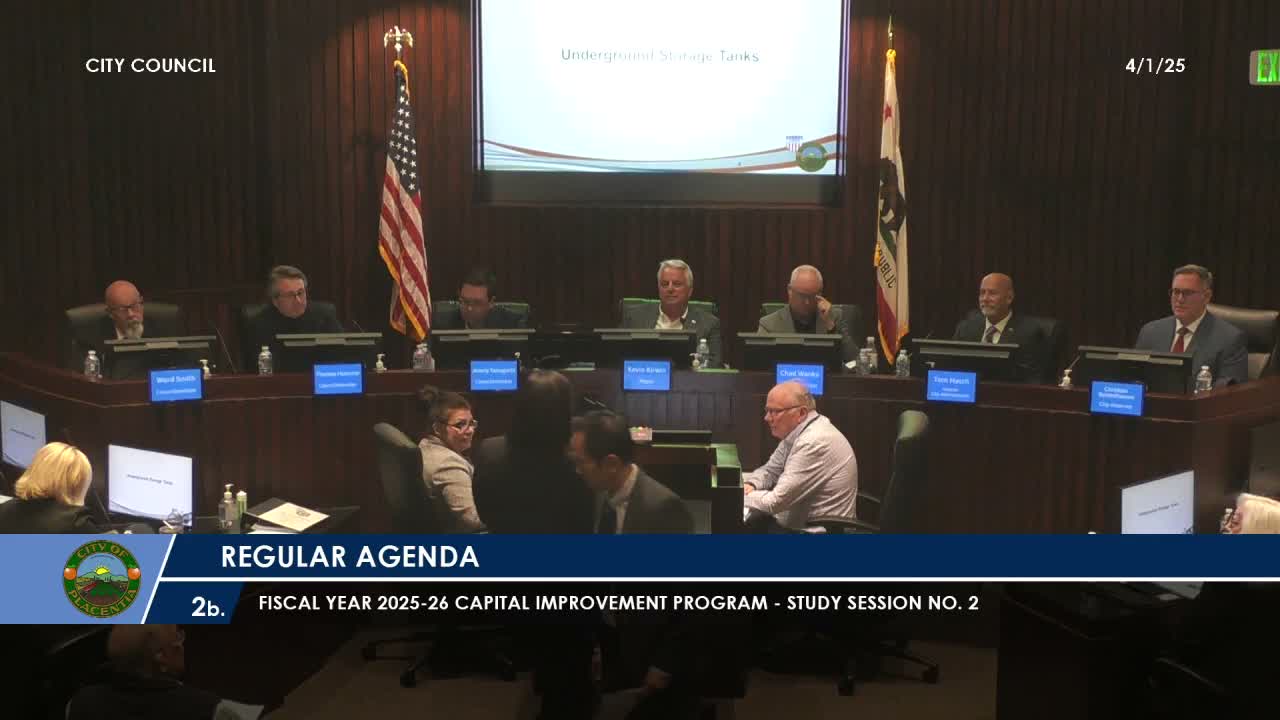
City public-works staff told the council on April 1 that two single-walled underground fuel tanks (installed in 1974) must be removed to comply with state law and presented several replacement and interim options.
Public Works said the estimated cost for tank removal—and replacement with a split 10,000-gallon double‑walled tank (5,000 gallons per fuel type)—is about $222,000 for removal alone and that the total difference for replacing on-site instead of fueling off-site was roughly $880,000. Staff outlined three pathways: reinstall underground tanks for continued bulk fueling and emergency access; rely on off-site fueling via the Placentia‑Yorba Linda Unified School District maintenance yard or commercial fuel-card programs (SC Fuels); or pursue a private partnership with Galaxy (a proposal arrived late in the packet).
Staff noted tradeoffs: fueling off-site avoids capital outlay and tank maintenance (about $8,000/year for inspections and compliance) but can raise per-gallon costs (staff estimated roughly $60,000/year more for unleaded and $12,000/year more for diesel if fueled retail rather than bulk). Off-site fueling may lack backup-power fueling capacity during outages and could be constrained during large emergencies. Staff recommended replacing the tanks for emergency operations—Fire & Life Safety recommended planning for two weeks of fleet fuel (approximately 2,500 gallons unleaded and 500 gallons diesel)—but agreed to return with insurance-cost details and a Galaxy comparison that includes royalty revenue.
Councilmembers pressed staff for (1) historical insurance figures and premium estimates, (2) a side-by-side comparison of Galaxy's proposed pricing and the city's royalty share, and (3) clarification of emergency fueling contingencies and whether Galaxy's proposal included emergency power. Councilmember concerns prompted staff to defer a final decision and return with the requested financial analyses.
What’s next: staff will calculate total-cost comparisons including Galaxy royalties and insurance impacts and return to council with a recommendation.