Get Full Government Meeting Transcripts, Videos, & Alerts Forever!
Get email alerts on the Land Use topic
No spam. Unsubscribe anytime.
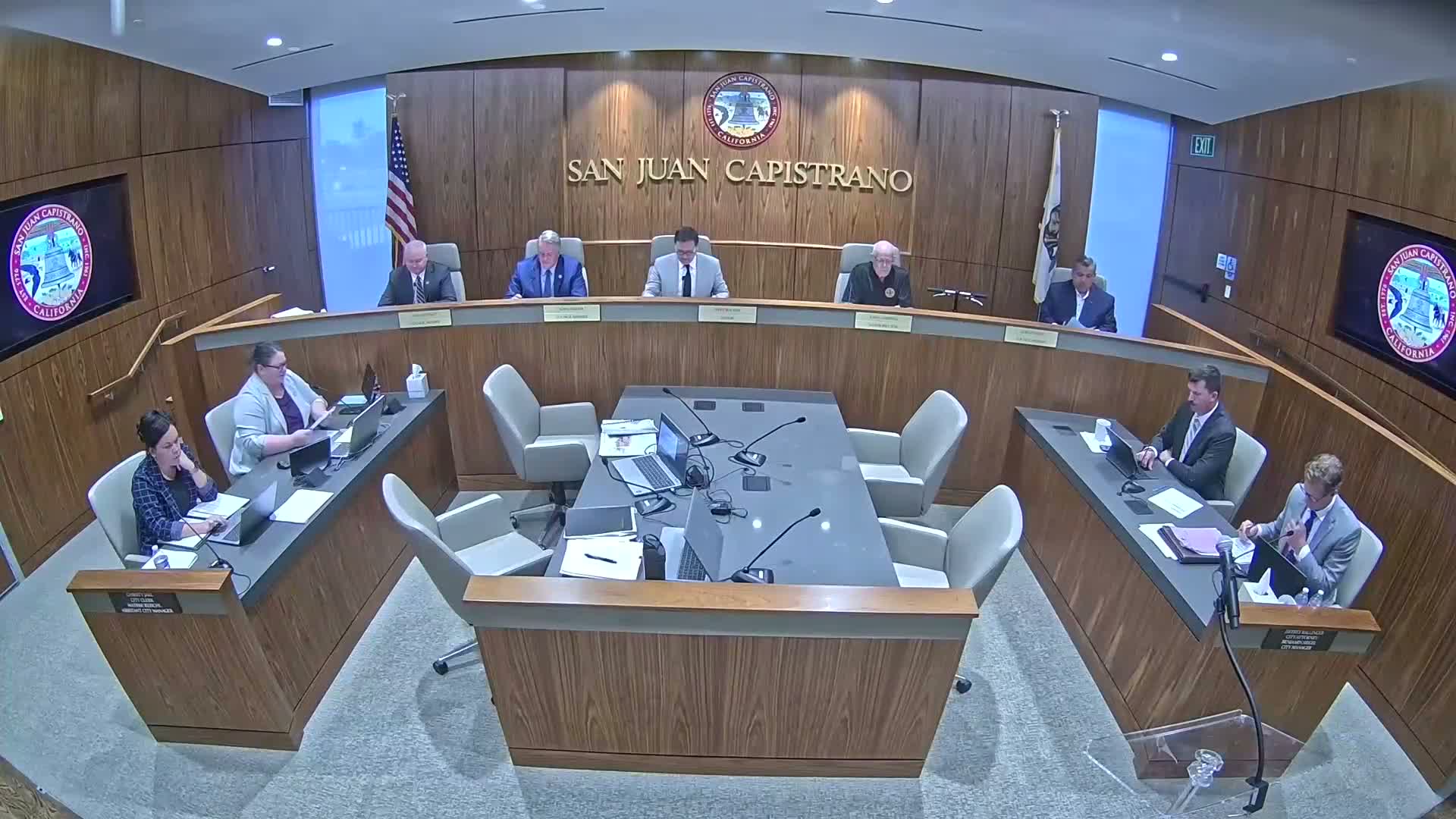
San Juan Capistrano certifies EIR, approves El Camino Specific Plan amendment for housing; tables Performing Arts Center entitlements
Summary
On Sept. 16 the San Juan Capistrano City Council certified a final environmental impact report and approved a specific plan amendment and rezone to expand the El Camino Specific Plan for a mixed‑use housing project; council voted to table several entitlements for a proposed Performing Arts Center to allow more design review and public input.
San Juan Capistrano — The City Council on Sept. 16 certified the final environmental impact report for the El Camino Specific Plan amendment and introduced an ordinance to change zoning and land‑use designations that will allow a mixed‑use development and future performing arts facility in the downtown area.
The council’s action advanced the Forrester and El Camino mixed‑use project — a private development proposing 95 residential units, a clubhouse, pool and commercial space supported by 173 parking spaces — while tabling several entitlements tied to a separate Performing Arts Center proposed on city‑owned parcels within Historic Town Center Park. The tabling leaves time for additional design review and public comment on the theater’s architecture, park layout and the land‑use transaction necessary to place a building on city property.
Why it matters: The specific plan amendment would expand the existing 1.6‑acre El Camino specific plan area by roughly 5.6 acres to create a 7.3‑acre planning area that encompasses private parcels proposed for the mixed‑use project and five city‑owned parcels where the Performing Arts Center is envisioned. Staff said the mixed‑use and performance uses are intended to be complementary: daytime commercial and office uses would help supply shared evening parking for the theater, and the development aims to activate a compact historic downtown.
What staff said: Paul Garcia, principal analyst in the city manager’s office, told the council the actions before them were limited to land‑use entitlements and did not include any negotiated real‑estate agreement or sale of public land. He summarized required land‑use approvals — a general plan amendment, a code amendment to the specific plan, and a rezone — and described traffic and parking analyses. Garcia said the combined project is estimated to generate about 1,234 additional daily trips, with 63 during the morning peak and 170 in the evening peak, and that the EIR and technical studies identified mitigation measures for intersections and circulation.
Cultural resources and mitigation: The final EIR identified significant and unavoidable impacts related to subsurface cultural and tribal archaeological resources beneath Historic Town Center Park and surrounding downtown parcels. The mitigation program requires archaeologist monitoring and a Native American monitor during ground‑disturbing activities and specifies procedures if artifacts are encountered, including a 50‑foot protective buffer, documentation and curation where required, and worker awareness training, city consultants said.
Public reaction: Public comments were split. Longtime resident Rob Williams said the project appeared to move quickly toward approving uses on land the public values as parkland, raised concerns about tandem parking, traffic and visual impacts from taller buildings near existing businesses, and urged care with heritage trees and adobe ruins. Local business owner Greg Solomon said the performing arts center and housing would be a welcome addition to downtown activity and could benefit local businesses.
Applicant response: Dan Almquist, representing the applicant team, said the project team had engaged design professionals, raised seed funding through a nonprofit entity for the theater effort and remained willing to work with council and residents on design refinements. "We've tried to be very sensitive to public resources," Almquist said, adding the applicant had committed to shared parking and to working with the local tribe on monitoring.
Council decision and next steps: After deliberation, the council voted to certify the EIR and to approve the specific plan amendment, code amendment and rezone needed to expand the El Camino Specific Plan. Councilmembers also approved entitlements needed to advance the Forrester mixed‑use housing component while tabling four entitlements specific to the Performing Arts Center: the architectural control permit, grading plan modification, historic and cultural landmark site plan review, and tree removal permit. The substitute motion to proceed with the EIR certification and housing entitlements while tabling the theater entitlements passed 3–1. Staff said the tabling is intended to allow further discussion of design details, public access and the separate real‑estate terms that would be required for development on city‑owned parcels.
What was not decided: The council did not act on any negotiated purchase or lease of city land for the Performing Arts Center this evening; staff emphasized the land transaction would be a separate real‑estate process. The council also did not finalize relocation sites for the heritage trees; staff said a relocation plan will be required as a condition for future approvals and will be reviewed by the Design Review Committee.
Where it goes from here: The ordinance title and land‑use approvals were read into the record; council directed staff and the applicant to continue design review and public outreach on the Performing Arts Center elements that were tabled. Council and staff indicated further DRC review and a future council hearing would be scheduled to resolve the outstanding design and park‑use questions.
Provenance: Topic introduced: SEG 226; staff presentation began SEG 249; EIR and cultural‑resource discussion SEG 1642–1651; public comments SEG 1864–1934; applicant response SEG 2027–2066; substitute motion, vote and tabling SEG 2926–3310.