Get Full Government Meeting Transcripts, Videos, & Alerts Forever!
Get email alerts on the Parking topic
No spam. Unsubscribe anytime.
Consultant outlines data-driven approach to downtown parking; council asks for more business input
Summary
A consultant reported early findings from a downtown parking study — inventory counts, LPR/drone data collection and 788 survey responses to date — and proposed options including time-limit adjustments, shared parking, signage and possible paid parking; council and businesses asked for more targeted business responses and follow-up data.
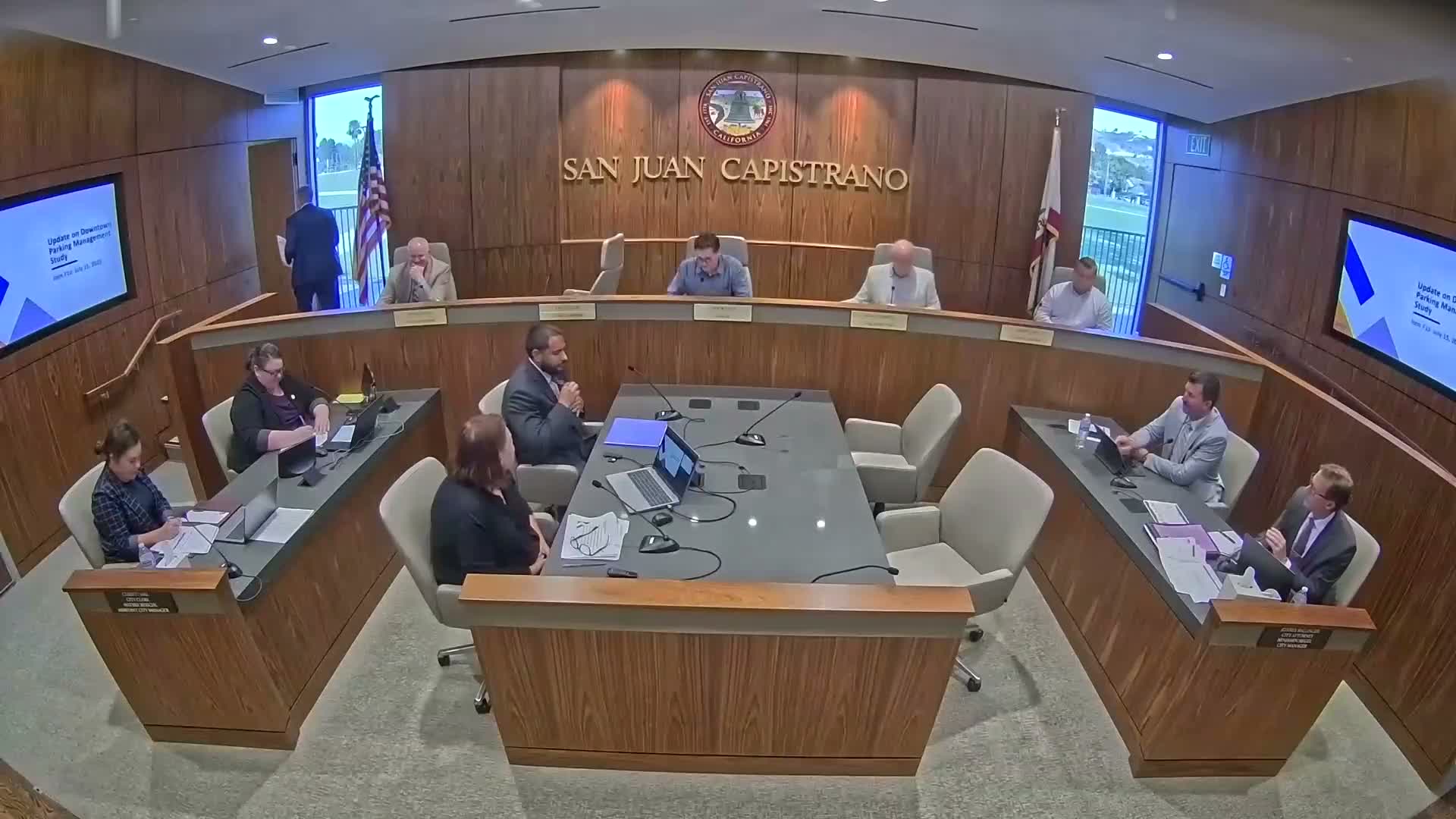
San Juan Capistrano — The council received an update July 15 on a city-commissioned downtown parking management study that aims to balance parking access for residents, visitors and employees, staff said.
Julie Dixon, lead consultant, told the council the study leverages license-plate‑recognition (LPR) sensors, drone imagery and on-the-ground counts at multiple times of day to measure occupancy and turnover and to create anonymized 'parker profiles' to distinguish likely employees from visitors. Dixon said the city inventory includes about 363 on‑street spaces and 2,581 off‑street (public and private) spaces in the study area; she said survey responses stood at 788 as of July 7, with roughly 484 resident responses and a request for more business-owner input.
Early themes from outreach included requests for a 'shopper’s permit' or local benefit for residents, more short-term pickup/drop-off spaces for deliveries, improved signage and digital wayfinding, better enforcement of delivery staging, expanded or better‑scheduled shuttle service and additional curbside/time‑limit management. Dixon said valet operations are being evaluated and noted the current valet program is about 80% used by employees in the pilot.
Council and public speakers asked for follow-up details including how current parking counts compare to the 2008 study and why employees sometimes risk parking violations rather than pay for daily parking. Businesses urged the study to examine unintended behaviors created by paid parking and whether the program’s pricing and time limits are achieving intended turnover. Several residents highlighted accessible parking shortages for people with disabilities.
Dixon said the study team will continue data collection through July and return to council later this year with recommendations, a financial analysis and community engagement. Staff and the consultant encouraged more business-owner participation in the online survey and follow-on outreach.