Get Full Government Meeting Transcripts, Videos, & Alerts Forever!
Get email alerts on the Land Use topic
No spam. Unsubscribe anytime.
Placentia council introduces ADU and urban‑lot split ordinance updates and adopts local CEQA guidelines
Summary
On July 1 the Placentia City Council introduced amendments to ADU and two‑unit/urban‑lot‑split rules to align with state law (including SB 9), and adopted updated local CEQA guidelines; each item passed on votes recorded as 3 yes, 2 not voting.
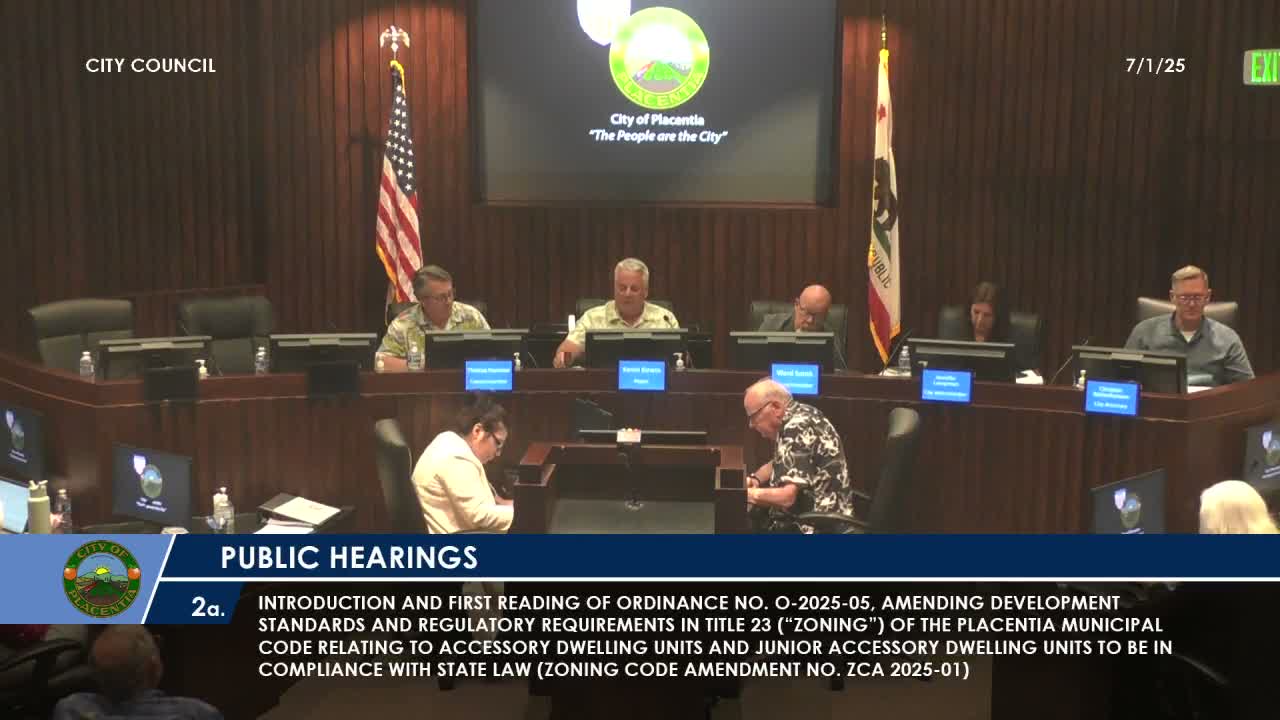
The Placentia City Council on July 1 introduced two ordinance updates to comply with recent state housing law and adopted updated local guidance for the California Environmental Quality Act (CEQA).
Staff presentation: Miss Lampman (city planning/land‑use staff) summarized proposed changes to Title 23 to bring local accessory dwelling unit (ADU) regulations into compliance with state law. Key proposed changes include a 60‑day decision timeline for complete ADU applications, removal of an extra uncovered parking requirement for ADUs, limited allowance for front‑setback encroachments only when no other placement is feasible, height allowances for attached ADUs (up to 25 feet or the district height limit) and detached ADUs (up to 18 feet in proximity to certain transit stops), and a provision that pre‑2020 unpermitted ADUs cannot be denied unless they are structurally substandard from a building or fire‑life‑safety perspective. Staff also described how JADUs (junior ADUs) are permitted and noted possible configurations on multifamily properties under state rules.
The council then held a second public hearing and introduced an ordinance to implement state rules for two‑unit developments and urban lot splits (commonly associated with SB 9). Staff explained the changes include ministerial processing timelines (60 days), prohibitions on splits or two‑unit conversions in specified sensitive locations (for example, identified historic resources), and a requirement to apply uniform objective standards consistent with the underlying zoning. The update also codifies rules for mechanical equipment screening and clarifies when demolition and rebuilding can occur.
CEQA guidelines: Staff explained the city’s local CEQA guidelines dated from 1991 and that the proposed updates clarify roles and decision‑making steps (e.g., when to require a mitigated negative declaration versus an environmental impact report) and provide clearer thresholds and responsibilities for staff and commissions.
Council action and votes: Each item was introduced for first reading and the council moved to approve the zoning code amendments and introduce the ordinances. Recorded votes on the consent and each ordinance were: Councilmember Hummer — yes; Councilmember Smith — yes; Councilmember Yamaguchi — not voting; Mayor Pro Tem Vaca — not voting; Mayor Kevin Kerwin — yes. The clerk announced the outcomes as 3 yes, 2 not voting for the consent calendar and for the ordinance introductions and CEQA adoption.
Staff said the ADU and urban‑lot‑split updates are intended to preserve as much local objective review as state law allows, while preventing default application of state rules that would remove local objective standards if the city does not adopt compliant local rules.
Next steps: The ordinances were introduced for first reading; additional hearings or subsequent readings may be required before ordinances become effective under city rules.