Get Full Government Meeting Transcripts, Videos, & Alerts Forever!
Get email alerts on the Fiscal Health topic
No spam. Unsubscribe anytime.
Consultants tell Orange council to cut costs, 'radicalize' economic development and plan a 1% sales-tax measure to avoid multi‑year shortfall
Summary
Grant Thornton presented a financial assessment warning of a projected $45 million general-fund shortfall over coming years and a risk of exhausting reserves in roughly three to four years unless the city pursues an immediate 12% cost reduction, steps to boost commercial tax base, and prepares for a 1% local sales-tax measure.
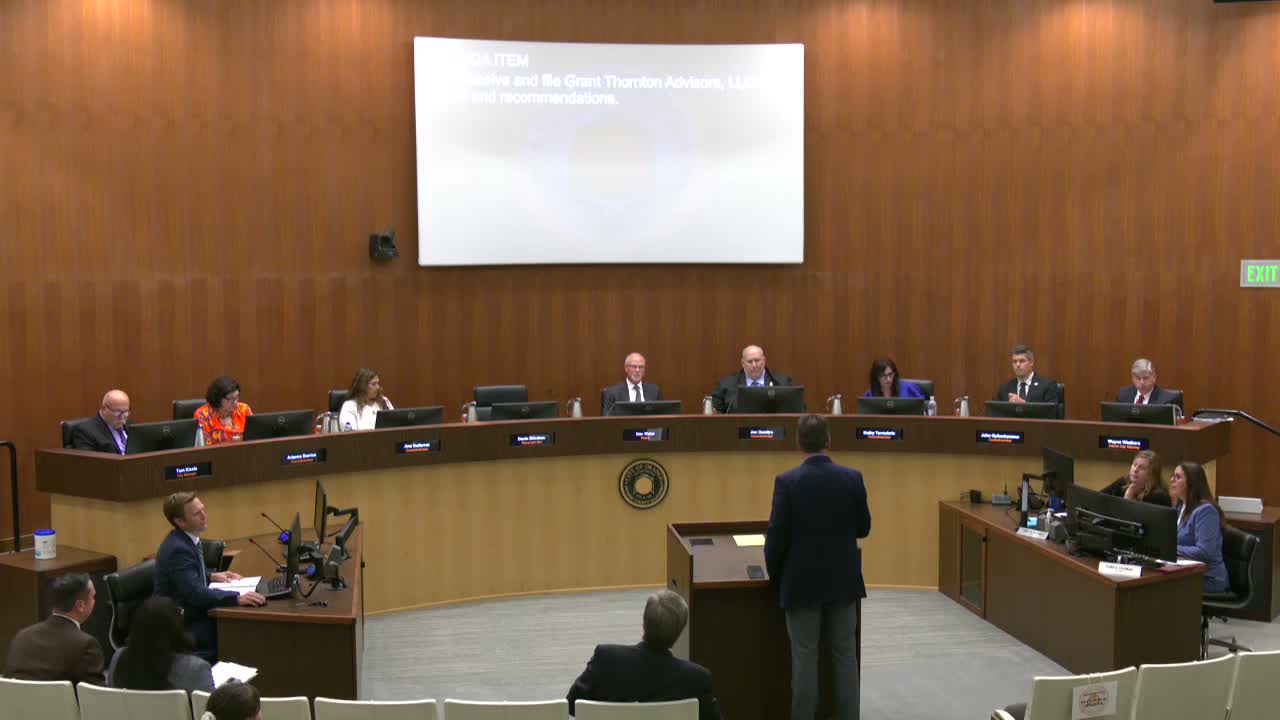
Grant Thornton Advisors presented a citywide fiscal assessment and delivered a stark message: the City of Orange faces a structural revenue shortfall that, absent action, could deplete emergency reserves and threaten financial stability within three to four years. The consultants traced the problem in part to one-time federal COVID funds that were used to support ongoing personnel costs, the addition of dozens of FTEs with recurring expense implications, and a historical underinvestment in economic development.
Consultants said the city should pursue a three-part strategy: 1) implement immediate cost reductions (they recommended a roughly 12% general-fund cost-out target, to be tailored by department and to avoid undermining public safety); 2) "radicalize" economic development efforts (a focused, funded program to reimagine the Village at Orange mall, partner with Chapman University, pursue a Disney gateway/hotel strategy and integrated Costco plan, and offer targeted incentives or a revolving loan fund for small business incubation); and 3) plan now for a 1% local sales-tax measure to stabilize operations while longer-term tax-base growth is pursued.
Grant Thornton projected a roughly $45 million shortfall through 2031 under current assumptions and warned that routine revenue growth (estimated ~3% annually) would not keep pace with expense growth. They recommended a lightweight PMO (project-management office) to execute cost-out plans, reengineer permitting and design-review processes that impede investment, and lead an intensive outreach and communications campaign to rebuild public trust before any tax measure is placed on a ballot. City staff and council members discussed where hiring freezes, overtime reductions, and targeted operational changes could be enacted and requested the firm provide more granular budget projections for council review.