Get Full Government Meeting Transcripts, Videos, & Alerts Forever!
Get email alerts on the Zoning Alcohol Regulation topic
No spam. Unsubscribe anytime.
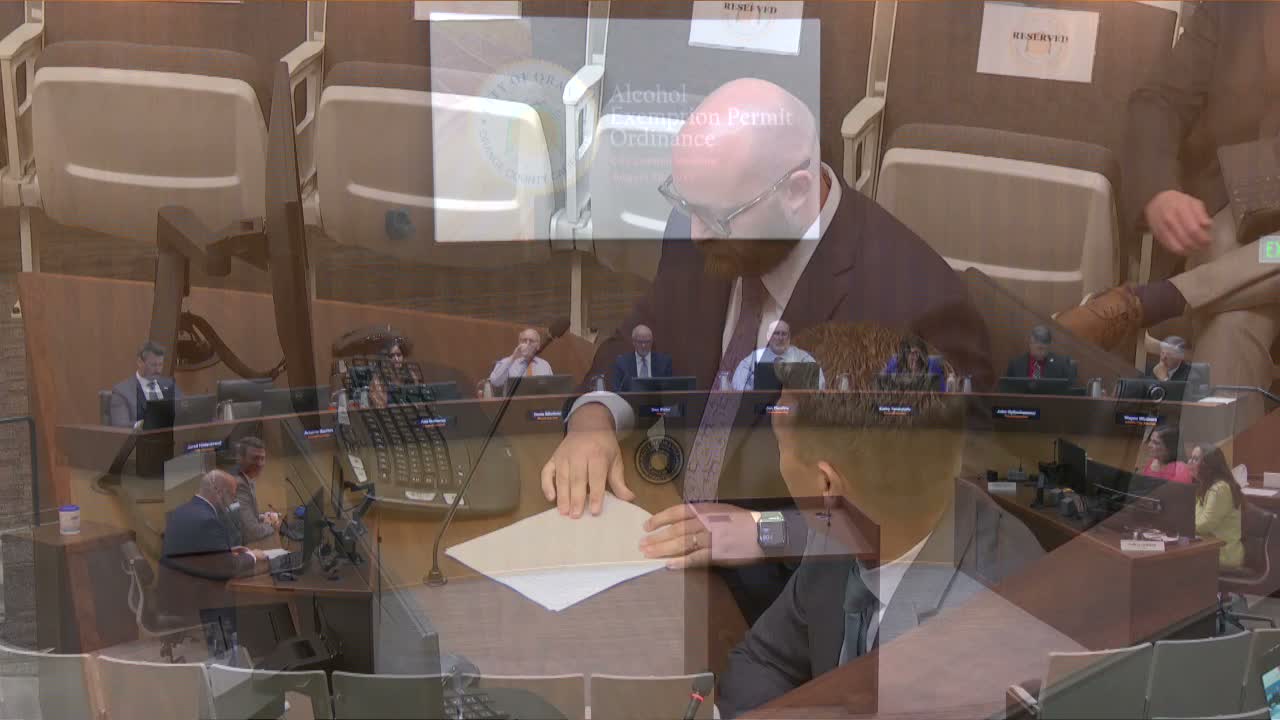
Orange council approves first reading of ordinance to streamline restaurant alcohol permits, 5–1
Summary
On first reading the City of Orange introduced and approved Ordinance 13-25 to permit alcohol service as a streamlined permitted use for qualifying restaurants, remove a prior restriction on drink specials, and set standard conditions including a 100-foot sensitive-receptor rule and outdoor-patio hours.
The City of Orange council voted 5–1 on Aug. 26 to introduce Ordinance 13-25, which would allow the sale and service of alcoholic beverages as a permitted use for bona fide restaurants in specified zoning districts if operators agree to standardized conditions. Council recorded 'Councilmember Demetrio' as the lone no vote on first reading.
Arlenbeck, the associate planner presenting the item, told the council the ordinance "will streamline the approval process for restaurants that offer alcohol service" by allowing applicants who accept standard conditions to bypass a conditional-use-permit hearing. Those standard conditions include limits on hours of operation, prohibitions on amplified music audible beyond the premises, security lighting and cameras, operational plans, annual compliance reviews by the community development director and the police department, and a 100-foot buffer from sensitive receptors such as residences, schools and churches.
The Planning Commission recommended approval with the deletion of standard condition 20, which previously prohibited generic drink specials such as happy hours. Councilmembers debated whether to limit happy-hour windows, how revocation and appeals would work, and how the 100-foot sensitive-receptor radius applies vertically to mixed-use buildings. Staff clarified that the 100-foot radius is measured horizontally but that receptors above ground level within that radius count for the exclusion; revocation determinations by the community development director may be appealed to the Planning Commission under existing code provisions.
Under the proposed standard conditions, outdoor patio hours would generally be capped at 10 p.m. while overall restaurant operating hours could extend to midnight on weekends; staff said amplified music audible beyond the property line would constitute a violation and trigger code-enforcement steps. The ordinance does not change conditions that run with the land; approvals issued under this process would, like CUPs, remain with the property.
Councilmembers and staff said the change aims to reduce uncertainty and staff time by creating a predictable process and shorter timeframes for applicants. The ordinance was introduced on first reading and will return for a subsequent reading and adoption vote at a later meeting.