Get Full Government Meeting Transcripts, Videos, & Alerts Forever!
Get email alerts on the Housing Regulation topic
No spam. Unsubscribe anytime.
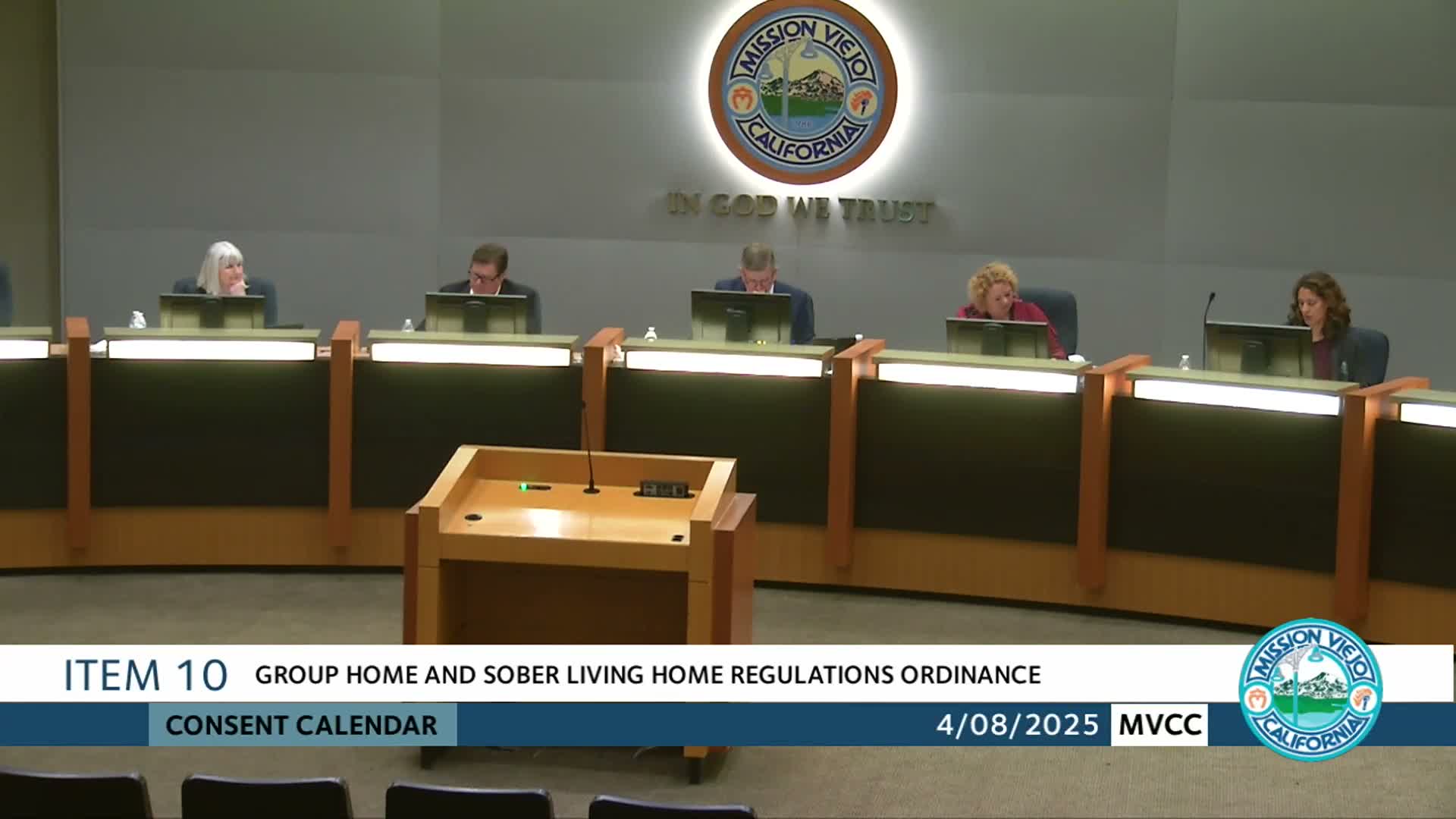
Residents urge Mission Viejo to adopt ordinance regulating small sober‑living homes
Summary
After a multi‑city task force model and extensive public comment, the Council considered Ordinance 25‑354 to require registration and 1,000‑foot separation for group/sober‑living homes of six units and under. Residents described neighborhood impacts and urged clearer enforcement and operator accountability.
Mission Viejo officials advanced discussion of a locally proposed ordinance aimed at regulating small group homes and sober‑living residences in residential neighborhoods.
City staff said the ordinance—drawn from a regional template developed by a multi‑city task force (CASLR)—is designed to protect residents of both the sober‑living homes and surrounding neighborhoods by requiring registration and, where proposed, a minimum separation (reported as 1,000 feet) between qualifying facilities. Staff described the measure as a product of years of task‑force work, noting other Orange County jurisdictions have pursued similar regulatory templates and that litigation against some ordinances has been costly.
During the public hearing, a string of residents described firsthand neighborhood impacts, citing parking congestion, loitering, prior incidents, operators who are difficult to contact, and a lack of local oversight. Connie Lanza Serra (speaker 17) said the ordinance is "long overdue," and Jenny Lauro (speaker 21), an attorney and parent, urged the council to support the ordinance because it "brings necessary structure" and accountability without banning recovery homes. Other speakers asked for specifics on occupant limits, guest rules, supervision or curfews, and what notice neighbors would receive when a facility opens nearby.
After public comment the Council moved and seconded the item and proceeded to new business. The transcript records a motion and second to move the item to its next procedural step; the document provided does not record a formal roll‑call tally for the ordinance at second reading in the supplied excerpt.
Background and next steps: staff reminded the Council that unless an ordinance is urgent, it follows a two‑step process (introduction/public hearing then a second reading at least five days later). The city noted the ordinance aims to align with case law and administrative law requirements to withstand legal challenge. Councilmembers and staff indicated they will continue to coordinate with county and neighboring cities on implementation and enforcement details.