Get Full Government Meeting Transcripts, Videos, & Alerts Forever!
Get email alerts on the Public Safety topic
No spam. Unsubscribe anytime.
Mission Viejo council approves 4‑year ALPR contract after heated privacy debate
Summary
Mission Viejo approved a four‑year automated license‑plate reader (ALPR) contract with Insight Public Sector/Flock Safety, agreeing to install 44 fixed cameras under a contract not to exceed $899,400 and relying in part on a $906,000 DOJ grant. The vote passed 4–1 after public privacy concerns and Sheriff’s office testimony on use cases and controls.
Mission Viejo’s City Council authorized a four‑year agreement to install and maintain a fixed automated license‑plate recognition (ALPR) system, approving staff’s recommendation to contract with Insight Public Sector for equipment supplied by Flock Safety and to accept related grant funding.
Staff described the proposed implementation as 44 fixed ALPR cameras and ancillary equipment located at sites selected by police services and city staff, to be procured via a cooperative purchase. The city was awarded a U.S. Department of Justice grant of $906,000 that staff said will reimburse system expenditures; staff recommended a service agreement not to exceed $899,400 and an initial budget appropriation of $246,300 for fiscal year 2024–25.
The item prompted extended public comment. One resident warned the system could amount to “mass surveillance,” noting a federal lawsuit alleging constitutional concerns and asking whether non‑hit data would be purged. Kristen Wilcox told the Council she feared the system would be used as a 'surveillance nanny state' and asked who would control and access the data.
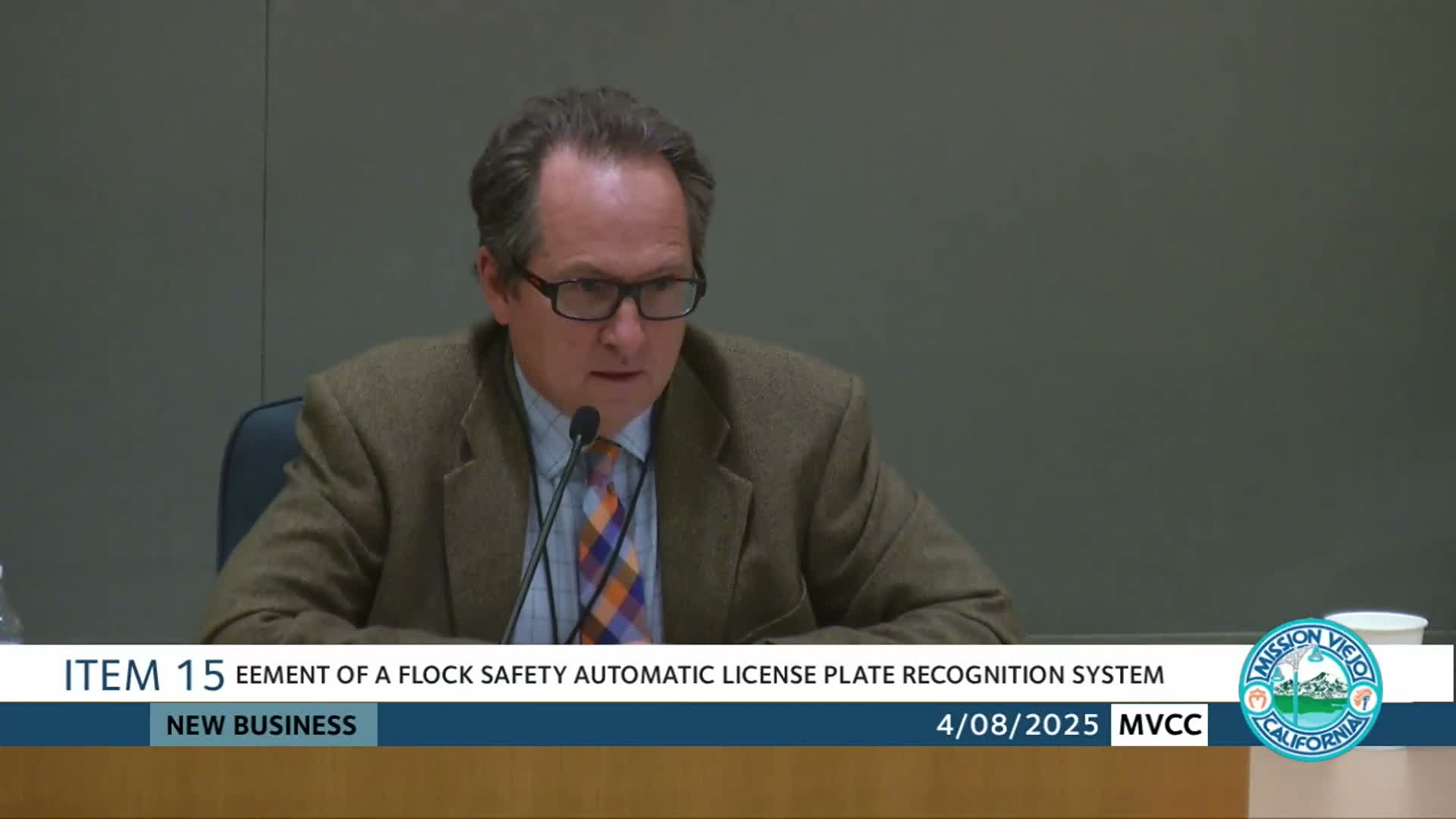
Commander Chris McDonald of the Orange County Sheriff’s Department defended the system and described several use cases the department says ALPR supports. McDonald said the county’s real‑time operations center uses ALPR data to assist on calls across the region and that, in recent months, about one in three calls the center supported led to a positive suspect identification or custody. He cited examples including arrests for organized retail theft, locating a missing elderly person within two hours, and a carjacking case resolved using a hot‑listed plate. "We don't just hot list people...there is some criminal case and some warrant that is usually attached," McDonald said, adding that hot‑listing and queries are restricted, audited and tied to training requirements.
Councilmembers questioned retention and access. Staff pointed to a recent County policy update that reduced ALPR retention for non‑hit data from 2 years to 6 months and said live‑stream (‘‘edge’’) video from 10 of the cameras would be stored on the cameras for short periods, with plate reads uploaded to the cloud. McDonald said the sheriff’s office will not deploy persistent facial‑recognition on fixed cameras and emphasized auditing and internal affairs oversight for misuse.
Councilmember Kelly moved to approve the recommended action; Mayor Pro Tem Bucknam seconded. The contract authorization passed 4–1, with Councilmember Vasquez voting no and repeatedly raising concerns about opt‑out options, data‑request procedures and how long non‑hit data is retained.
The Council approved the four‑year agreement, directing staff to finalize the contract and proceed with implementation under the proposed policy framework. The contract contains a 30‑day cancellation option prior to the end of each annual service term and budget appropriations for future fiscal years will be handled through annual budgets.
Next steps: staff will finalize the agreement, place initial appropriations in the FY24‑25 police operating budget, and return as needed to the Council for any material policy changes or follow‑up reporting.