Get Full Government Meeting Transcripts, Videos, & Alerts Forever!
Get email alerts on the Sober Living Ordinance topic
No spam. Unsubscribe anytime.
Mission Viejo adopts tighter rules for group homes and sober-living residences
Summary
The City Council adopted a new Chapter 5.06 to require group-home permits for sober living homes, add operational requirements and spacing limits, and enable civil or criminal enforcement; residents urged stronger penalties and staff cited a tested county template and related state legislation.
The Mission Viejo City Council on March 25 adopted a new ordinance regulating group homes and sober living residences, requiring operators to obtain a group-home permit and submit owner, operator and house-manager identification and operational plans.
The ordinance, rescinding the previous registration program, was introduced by Community Development Director Larry Longnecker and passed after public testimony and council discussion. It requires a 24-hour house manager, written intake and relapse policies, a 48-hour notice to emergency contacts before eviction while arranging transport, limits on garage/driveway use with on-street parking rules within 300 feet, and a 1,000-foot separation between sober living homes.
City staff said the draft mirrors a template developed and tested by county counsel and other Orange County cities. Attorney remarks to the council pointed to prior Costa Mesa litigation and the task force’s amicus support; the city described the model as regionally coordinated to reduce the risk and cost of isolated litigation. Jeff Corless, consultant to the California Sober Living and Recovery Task Force, told the council the task force has driven a DHCS audit and helped collect jurisdictional support for legislative proposals at the state level.
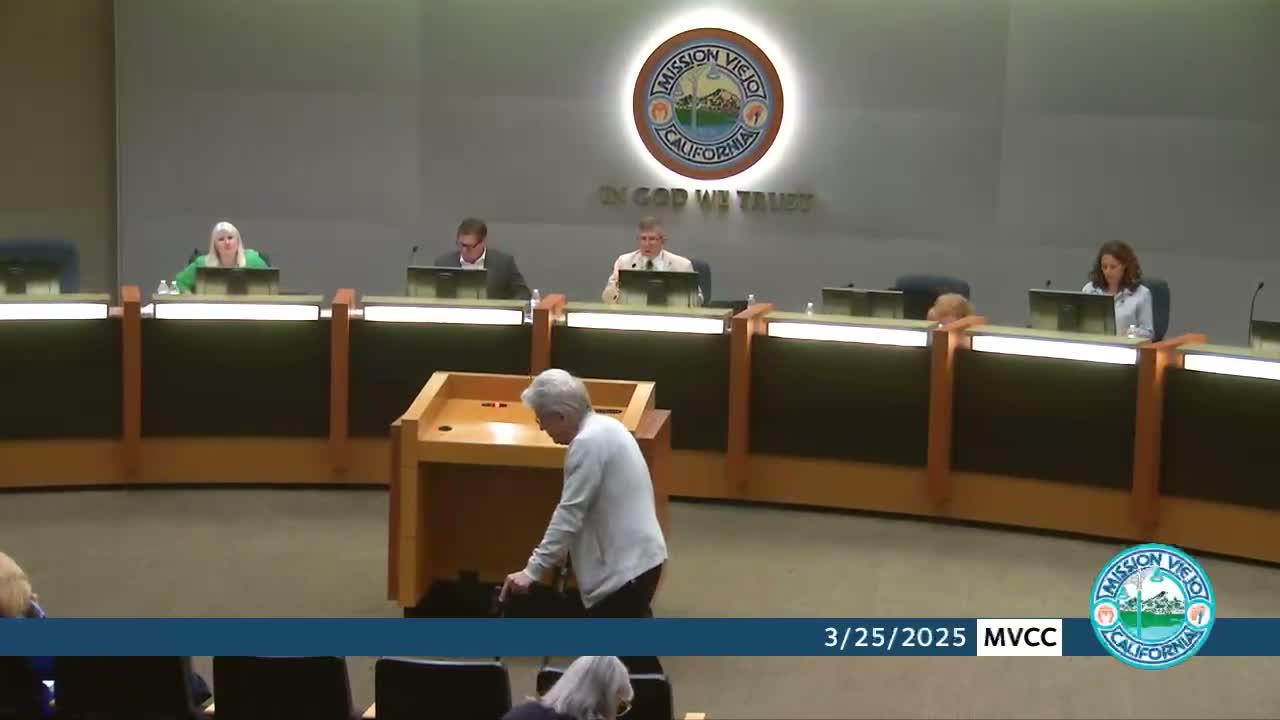
At public comment, Mission Viejo resident Tanya Wills described living adjacent to two sober living homes and the disruption she said her family experiences: “My children don't play out in front of the house,” she said, and asked whether the ordinance included penalties directed at property owners. The City Attorney replied that violations could be enforced civilly or criminally, noting that typical city-code fines start at $500 but that judicial enforcement and cost-recovery for city abatement can produce penalties in the thousands.
Councilmember Trish Kelly urged residents to use existing tools such as the city’s multiple-call ordinance and social host provisions to hold owners accountable; she called the new ordinance “a great tool in our toolbox.” The ordinance passed on a recorded voice vote with four yes votes and one council member absent.
The council also discussed the state policy context: Corless summarized several pending California bills that the task force is tracking—bills intended to clarify when a treatment facility is or is not treated as residential, to require DHCS discharge planning and complaint timelines, and to speed DHCS complaint investigations. Staff said the local ordinance is intended to complement, not replace, state oversight and that the city will coordinate with neighboring jurisdictions and the task force.
The ordinance takes effect per the timeline set in the city’s adoption procedures; staff said the ordinance replaces the prior registration program and will provide a formal permitting pathway and enforcement tools for residents and code enforcement. The council did not amend the ordinance on the floor; staff will return with any technical edits and implementation steps.
The council meeting materials and the task force website provide additional details on the ordinance language, the task force’s legislative tracking, and contacts for reporting concerns to city code enforcement.