Get Full Government Meeting Transcripts, Videos, & Alerts Forever!
Get email alerts on the Wildfire topic
No spam. Unsubscribe anytime.
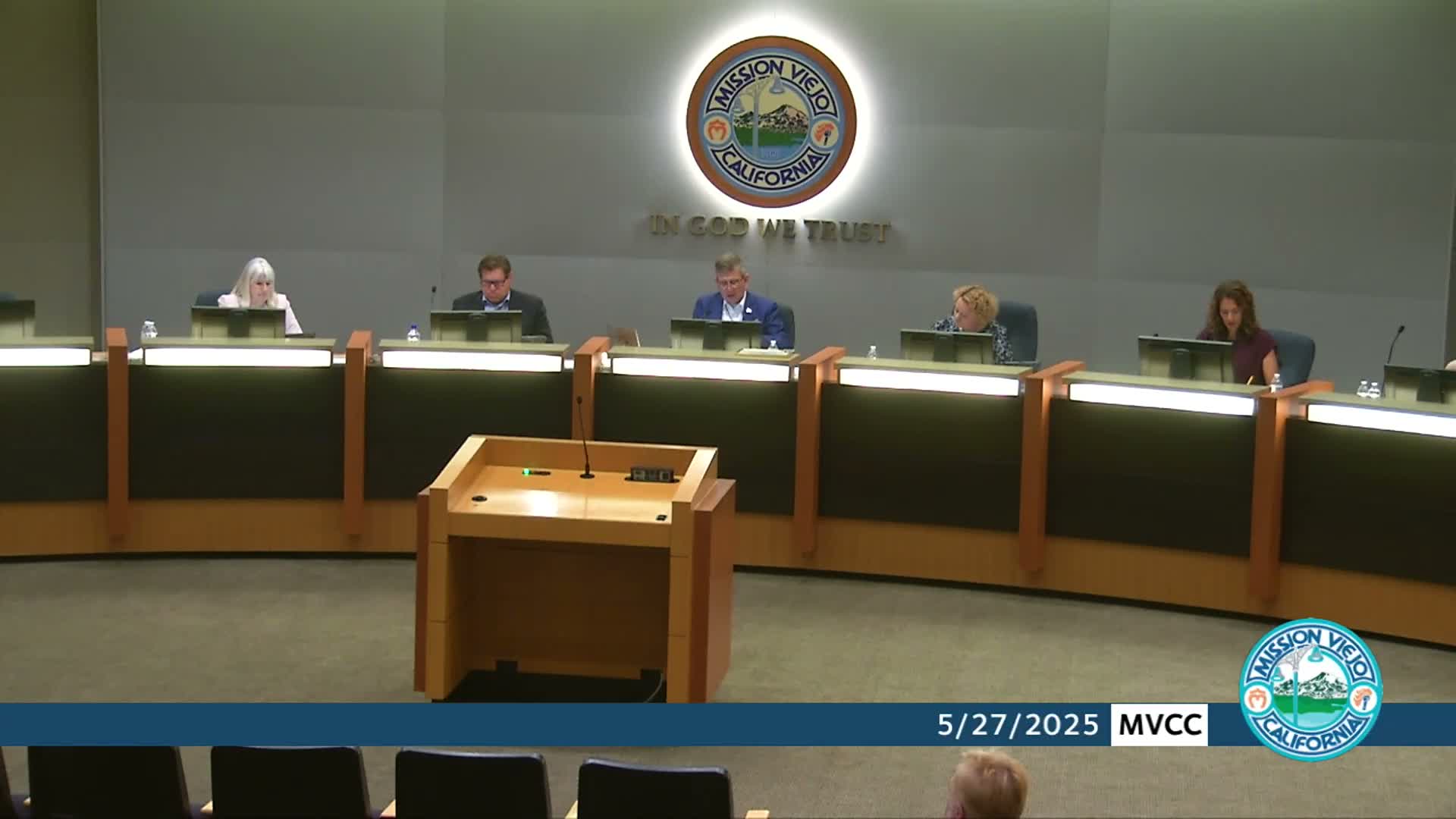
Mission Viejo council adopts state—s 2025 fire hazard maps amid resident concern over insurance
Summary
The council unanimously adopted the State Fire Marshal—s 2025 fire hazard severity zone maps as required by state law after staff described outreach and a $2 million Cal Fire grant to treat high-risk public lands; residents raised concerns about insurance increases and the inability of local mitigation to lower the official designation.
The Mission Viejo City Council on Monday unanimously adopted the State Fire Marshal—s 2025 fire hazard severity zone (FHSZ) maps, a state-mandated classification that identifies areas as moderate, high or very high fire hazard.
City planning staff and the Community Development director summarized public outreach and the state-required adoption process, noting the maps were posted March 24 and public review has exceeded the required 30 days. Planning manager Cliff Jones said the city has completed environmental review for fuel-reduction work, filed a Notice of Exemption and is reviewing bids to begin field treatments this summer.
The maps carry regulatory effects: properties designated in high or very high zones are subject to California Building Code Chapter 7A construction standards (often called home-hardening requirements), and sellers of properties in high or very high zones must make disclosure at sale. Staff explained defensible-space requirements apply in very high zones (generally a 100-foot perimeter around structures) and a 50-foot roadside clearance is typical for treated public lands.
Residents from neighborhoods identified as the —Bull—s Eye— or —Volcano— area pressed the council during the public hearing, saying they received late notice about the designation and that some households have faced steep insurance increases. One resident said a neighbor—s renewal rose 233% and asked what recourse homeowners have when insurers act on hazard designations.
Mayor Pro Tem Bucknam and other council members relayed information from an insurance town hall held May 19: insurance underwriters usually rely on proprietary, industry-produced maps for underwriting decisions rather than the State FHSZ maps. Council members said the most direct avenues for residents to seek relief are (1) to pursue risk-mitigation measures that insurers recognize (home-hardening and brush removal) and (2) to contact the state insurance commissioner elected by voters. Council members also urged residents that local mitigation (fuel reduction on city land, contract work and volunteer efforts) will continue and that the city won a Cal Fire grant of $2,000,000 to fund treatments on public property.
Several council members emphasized limits on local authority: staff said the city cannot lower a property—s FHSZ designation on the CAL FIRE map; the state process allows only suggestions for higher severity. Staff also noted the maps reflect updated modeling and science used by CAL FIRE that incorporate vegetation, topography and climatological inputs.
After the public comment period and council discussion, Councilmember Bucknam moved to adopt the ordinance to designate the State Fire Marshal—s recommended local responsibility area fire hazard severity zones for Mission Viejo; a second was recorded and the motion passed unanimously. The city attorney read the ordinance title for adoption pursuant to state law.
What happens next: staff said funding and implementation steps for the grant-funded work are in progress (bid review and forthcoming contract awards), and crews are expected to begin site work in summer months subject to state environmental and wildlife protections. Residents seeking more information were directed to the city website and to upcoming neighborhood outreach about volunteer opportunities and fuel-reduction operations.