
Madison County board directs staff to hold tax collection to last year’s level while recalculating levy rates
Get AI-powered insights, summaries, and transcripts
Subscribe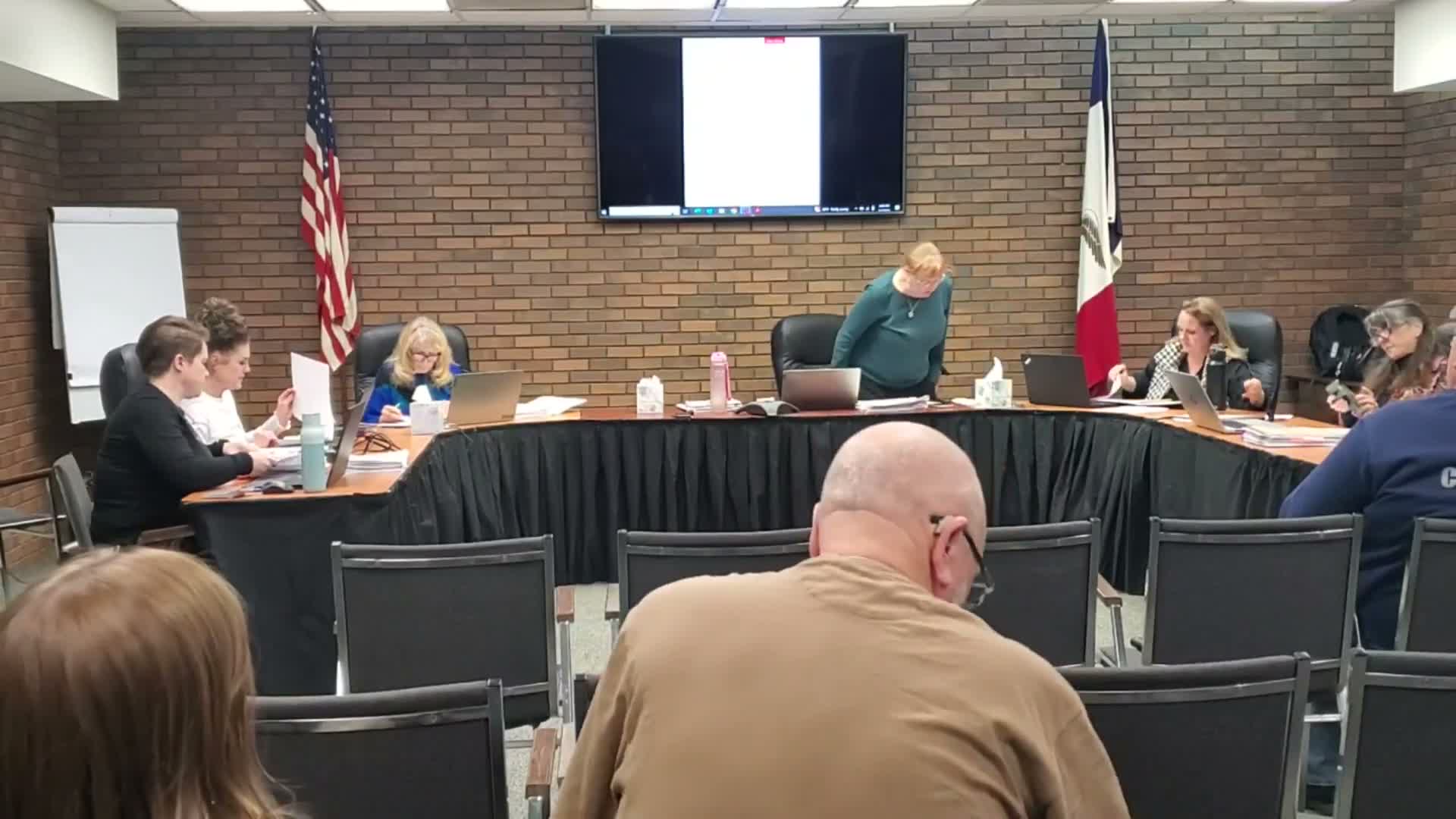
Summary
At a budget work session, board members reviewed fund balances and levy-rate options, removed several previously budgeted expenditures, and instructed staff to submit a tax-collection amount no higher than last year while they refine line items and meeting procedures.
Madison County board members met in a budget work session and directed staff to submit a tax-collection total no higher than last year while they continue refining the 2025–26 budget.
The board reviewed a fund-balance worksheet provided by county staff and heard that several large items previously in the draft budget have been removed: home-health funding of about $230,000 and a $200,006 ambulance appropriation were taken out, and roughly $50,000 remains in ARPA funds, the presenter said. The presenter cautioned the board the worksheet was a preliminary pass and may contain errors or missing union-negotiation increases.
Why it matters: the board must tell the Iowa Department of Management the levy/collected amount by the statutory deadline, and the choice affects whether taxpayers see an increase or a hold of last year’s collections.
Speaker 4, explaining recalculations tied to updated property valuations, said the recalculated general-basic levy would be 3.33143 (previously 3.39806) and the rural-basic levy 3.65279 (previously 3.68932). The presenter recommended trimming unbalanced line items by about 5% as a conservative buffer while transfers to secondary roads and other adjustments are completed.
Board members discussed two options: submit the recalculated maximum levy to be conservative or submit a collected total equal to last year so taxpayers would not see an increase. Speaker 1 summarized the board’s direction in seeking to avoid an added tax burden: “we do not tax more, collect any more taxes than we did last year,” and asked staff to work with the Department of Management to implement that instruction.
The record shows a discrepancy between figures the Department of Management provided and the draft worksheet: county staff noted a $185,000 maximum allowable change between two funds per the Department of Management, while the draft budget’s tax-change line read $420,954. Staff said that discrepancy arises from differences in the property valuation inputs and growth assumptions used to compute levy impacts.
Other items discussed included a $100,000 placeholder for additional auditing expenses tied to the treasurer’s office that could rise, the need to reconfirm secondary-roads transfers, and the practical need to keep reserve balances at roughly 20–25% to handle cash-flow and matching obligations. Board members favored targeting cuts to part-time or vacant positions first and discussing department-specific efficiency measures before broad freezes.
The board also agreed to schedule a follow-up work session to review meeting rules, procedures and to continue budget discussions. The board set a work session for Thursday, March 6 at 8:30 a.m. to review rules and suggested calendar changes; further budget meetings were expected as staff reconciles valuation inputs and transfer amounts.
Votes at a glance: the agenda was approved by motion earlier in the session, and the meeting was adjourned by a later motion; those procedural motions passed by voice vote.
Next steps: staff (Terry, working with the Department of Management) was directed to submit tax-collection figures equal to last year’s totals for publication while the board continues to refine the budget and considers targeted line-item changes and potential future levy adjustments.