Get Full Government Meeting Transcripts, Videos, & Alerts Forever!
Get email alerts on the Roads Dust Permits topic
No spam. Unsubscribe anytime.
Madison County roads chief suspends utility contractor permit, recommends 35 mph posting to curb dust
Summary
Madison County roads staff told supervisors they suspended a rural fiber/utility contractor's permit after ditch and drainage damage and recommended posting a 35 mph speed limit on a quarry-haul route to reduce fugitive dust; staff warned county-paid dust control would be costly.
Madison County's roads department reported this week that it has suspended a contractor's utility permit in the county's southwest quadrant after finding ditches and drainage disturbed and erosion-control measures not in place. Mike, the roads department head, said the contractor was ordered to correct noncompliant work and that county payments have been stopped until repairs are made.
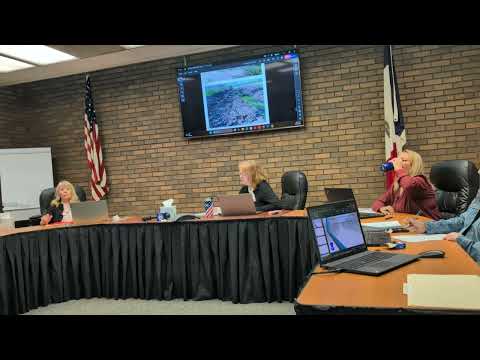
"They plowed into ditches and created lots of disturbance," Mike said, describing photos shared with the board and noting the permit requires restoration and allows the county to charge for inspection time. He said the contractor has moved staff out of the county but has a crew working to make repairs and that the department will use a PRN inspector to verify compliance once the crew returns.
The roads presentation also covered an ongoing problem with fugitive dust on a route used heavily by an aggregate vendor. Mike said a spot speed and truck-count study showed recent traffic of about 132'to'350 vehicles per day and an unusually high truck share (about 32 percent) compared with a historical baseline. He told supervisors the Iowa Department of Natural Resources (IDNR) fugitive-dust predictor tool and relevant Iowa administrative-code provisions assign responsibility for dust abatement to the public highway authority in cases of nuisance.
Citing the DNR predictor and local traffic and material characteristics, Mike said a 45 mph posting would not meet the tool's compliance threshold but a 35 mph speed limit would. "We tried 45 miles an hour and we would not be in compliance for 45 miles an hour," he said. "We ran 35 miles an hour. It's an acceptable limit." He recommended posting 35 mph until traffic returns to an ordinary baseline and said the county should update zoning and mitigation plans to reduce recurrence.
Mike warned that county-funded dust control is expensive and temporary: a single application over the full route was estimated at about $20,000, and repeated seasonal treatments could approach $100,000. He said residents may request dust-control applications at their cost under the county policy, and the county will continue to work with vendors on staggered deliveries or alternate routing where feasible.
The board discussed enforcement limits for secondary roads and asked the roads staff to coordinate with the Iowa DOT and the IDNR as needed. Mike said he would bring a resolution to employ or use a PRN inspector to ensure permit compliance at a future meeting.
Next steps: staff recommended posting a 35 mph limit for the affected route pending further engineering and DNR coordination and pursuing updates to local zoning and mitigation language.