Get Full Government Meeting Transcripts, Videos, & Alerts Forever!
Get email alerts on the Comprehensive Plan Update topic
No spam. Unsubscribe anytime.
Fairbanks North Star Borough planners present sub-area framework; commissioners, residents give map feedback
Summary
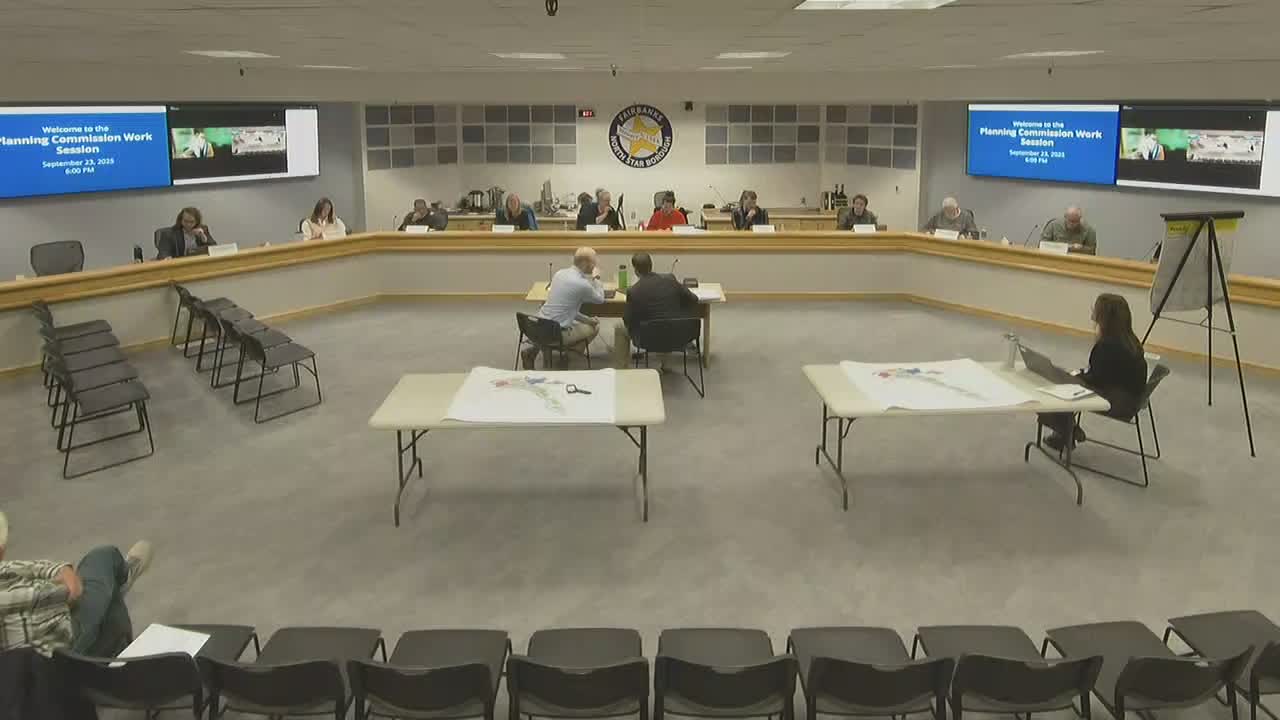
At a Sept. 23 work session the Fairbanks North Star Borough Planning Commission reviewed a draft sub-area planning framework for the borough's comprehensive plan update. Staff outlined how sub-area plans would guide land-use decisions, capital projects and grant applications and asked commissioners to help promote November roadshows for public input.
The Fairbanks North Star Borough Planning Commission heard a presentation on Sept. 23 about a proposed sub-area planning framework that staff say will be adopted as part of an updated boroughwide comprehensive plan.
Community Planning staff and consultants described the framework as a way to give individual neighborhoods and communities greater voice and more tailored land-use guidance. "This is our biggest, most important plan. This is the plan we're required to have by state statute," said Kellen Spelman, a planning staff member introducing the work session. Senior planner Beth McKibben said sub-area plans are intended to be "community driven" and to refine the boroughwide land-use designation map for specific areas.
Why it matters: staff said adopted sub-area plans will be used to prioritize capital projects, make rezones consistent with local visions and improve competitiveness for grant funding. Staff cited the adopted Salcha Badger Road area plan as an example where the land-use designations adopted in a sub-area plan shaped later rezones and capital investments.
The presentation outlined a proposed process and schedule: staff estimated each sub-area plan would take about 18 to 24 months to complete and suggested a cadence of updating sub-area plans every 10 to 20 years. The conceptual map shown to the commission included roughly 14 sub-areas; staff said the project team's working target is about 10 and no more than 15 subareas. Staff noted funding would come primarily from the borough's planning budget, with the possibility of grant funds to pay for specific plans.
Commissioners and residents raised questions about how boundaries and names were drawn and whether some areas should be grouped or split. Commissioner Muellin urged staff to differentiate "user profiles" for areas that differ by travel mode, access to trails or density; Commissioner Stepovich questioned whether a proposed "College" label would let the university-dominated area dominate a broader plan. Residents and commissioners at table exercises suggested many local neighborhood names and asked staff to preserve known neighborhood identities on maps presented to the public.
Staff set the next steps: another round of roadshows and an updated public survey are planned for early November; the advisory committee will reconvene and the draft comprehensive plan remains on schedule for early 2026. Spelman asked commissioners to encourage turnout but reminded them not to contact the full commission by email in a way that would create Open Meetings Act exposure: "Please don't send an email to the whole planning commission. We don't wanna get into Open Meetings Act stuff."
No formal votes or motions were taken at the work session. Staff collected table notes and will return to the advisory committee and the commission with a revised draft before public outreach. The commission adjourned after public remarks and a brief series of community updates.
The planning staff listed as contacts for additional input were Katie Whiteside and Kellen Spelman; staff said community roadshows will be scheduled and announced before the first week of November.