Get Full Government Meeting Transcripts, Videos, & Alerts Forever!
Get email alerts on the Land Use Church Expansion topic
No spam. Unsubscribe anytime.
Clark County approves phased expansion, parking plan for Saint Michael Ethiopian Orthodox Church with strict conditions
Summary
After hours of testimony from neighbors and congregants, the Clark County Zoning Commission approved a phased expansion and new parking for Saint Michael Ethiopian Orthodox Church with conditions including limits on outdoor events, a ban on amplified outdoor sound, neighborhood notifications, locked parking gates and a March 2027 compliance review.
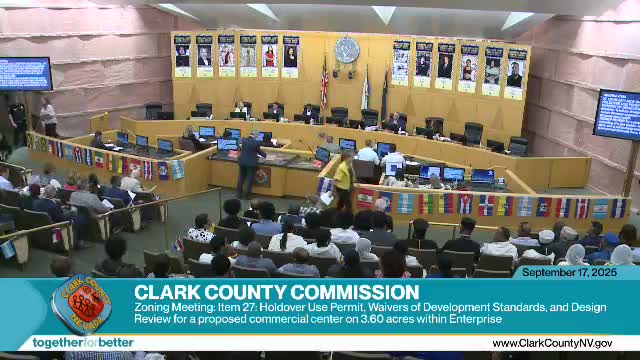
The Clark County Zoning Commission on Sept. 10 approved a phased expansion and parking plan for Saint Michael Ethiopian Orthodox Church in Spring Valley, imposing a package of conditions aimed at limiting neighborhood impacts while allowing the congregation to address persistent parking and crowding problems.
Attorney Bob Groenauer, representing the church, told the commission the project would consolidate development on about 8 of the church’s 10 acres and reduced the originally proposed building area from roughly 54,000 to about 32,000 square feet. Groenauer said the multipurpose facility was reconfigured from two stories to one and that parking was reduced substantially from earlier iterations while still adding more on-site spaces to reduce street spillover.
Neighbors and supporters filled the hearing. Opponents described the plan as out of scale for a rural preservation neighborhood and warned of increased traffic, noise and enforcement challenges; speakers used terms such as "megachurch" and said the proposed capacity and parking could overwhelm local streets. Among opponents, Howard Karsh — who lives adjacent to the property — raised specific concerns about fill, retaining walls and buffering along his parcel. Supporters, including longtime congregants and youth members, said the expansion is necessary to solve ongoing parking and crowding and to provide space for cultural, youth and community programs.
Several residents and an attorney for neighbors referenced the Religious Land Use and Institutionalized Persons Act (RLUIPA) and federal case law during testimony, warning that courts scrutinize denials and that the county must apply neutral land-use standards. County counsel and staff acknowledged that RLUIPA frames any denial and that the county must show compelling justification to deny a religious use outright.
To address the concerns, the commission approved the project subject to a phased approach and immediate operational conditions. Phase 1 requires construction of the parking lot, perimeter wall and perimeter landscaping (the record estimated the work could take about 18 months). The permit for the multipurpose building may not be issued until the county confirms compliance with the Phase 1 requirements and conditions at a public review expected around March 2027.
Conditions placed on the project and effective immediately include: a prohibition on amplified outdoor sound (including portable speakers and amplified bells); a limit of six outdoor religious events per year, with each procession limited to either 30 minutes (as later clarified in the record) or, as originally proposed by the applicant, one hour — the commission specified the processed time as part of the conditions; mailed notice to residents within a 1,500-foot radius 30 days before each approved outdoor event; parking areas restricted to vehicle patron parking only; no retreats or overnight stays on-site; parking gates locked during off hours; installation of mature trees along residential perimeters at the time of planting; trash receptacles at the ends of parking rows; licensed traffic control during services; and a requirement that the church establish a neighborhood committee to meet quarterly.
Code Enforcement explained the county responds to complaints filed through the Clark County system (including the Fix It Clark County app) and will investigate recurring violations, including weekend or Sunday activity if complaints allege repeated breaches of conditions.
The motion for approval, brought forward with the phased conditions, was adopted by the commission after a voice vote; Commissioner Jones recorded an "aye" on the record and the chair announced the motion adopted. The record does not list a full roll-call tally in the transcript provided.
The commission’s action allows the church to move forward with the Phase 1 site improvements; building permits for the multipurpose facility remain contingent on verification that the required conditions have been satisfied and on the public review due around March 2027.
The church and neighbors were urged to use the quarterly neighborhood committee and code enforcement reporting channels to address compliance questions going forward.