Get Full Government Meeting Transcripts, Videos, & Alerts Forever!
Get email alerts on the Transportation topic
No spam. Unsubscribe anytime.
Laguna Hills council adopts mobility-element amendment to align with OCTA, unlocking about $5 million
Summary
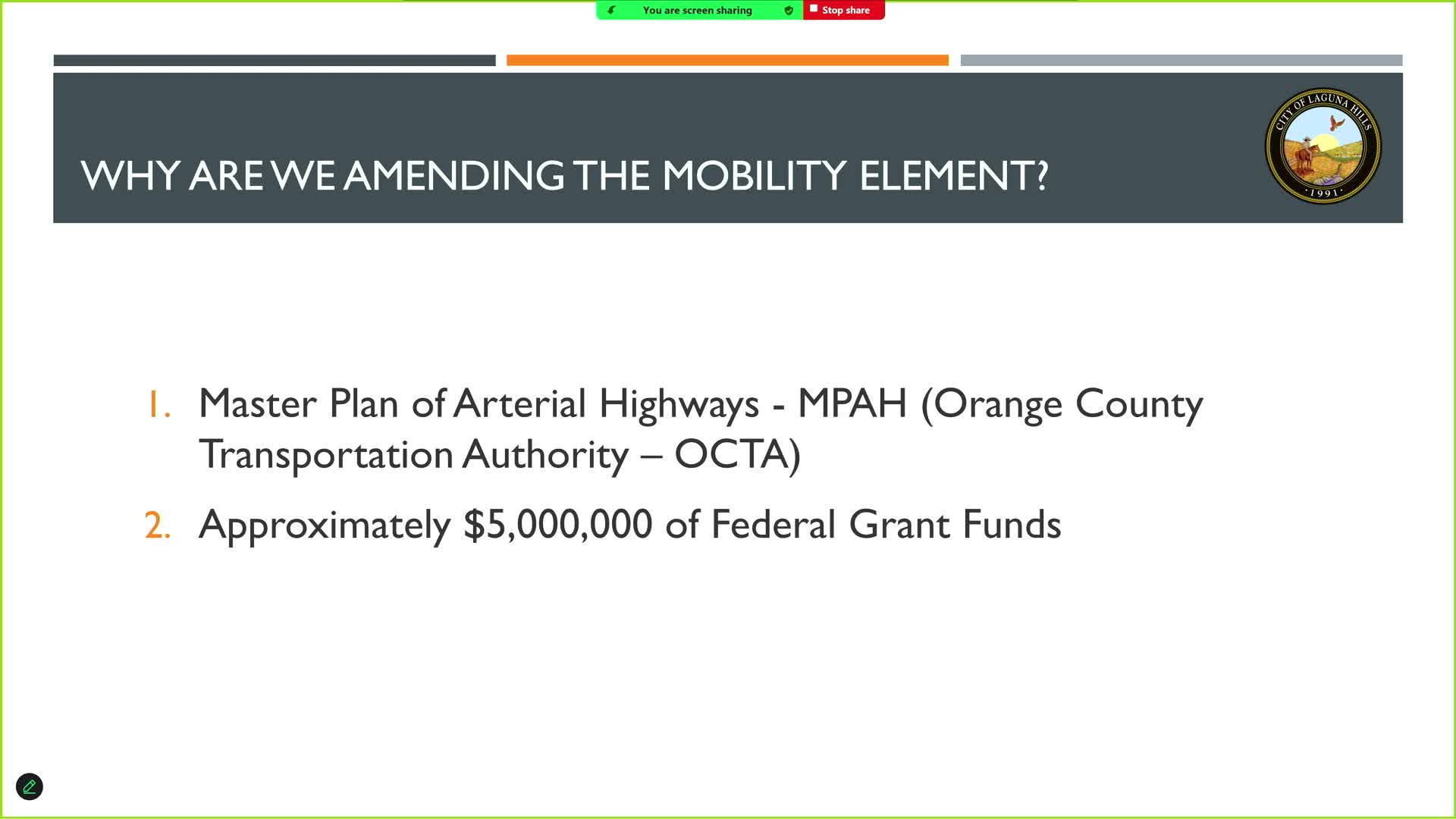
The Laguna Hills City Council approved a minor amendment to the general plan mobility element to align local roadway classifications with OCTA’s Master Plan of Arterial Highways, a change staff said is needed for the city to be eligible for roughly $5 million in transport grant funding and Measure M2 programs.
The Laguna Hills City Council on Sept. 9 approved a minor amendment to the city’s general plan mobility element to conform to the Orange County Transportation Authority (OCTA) Master Plan of Arterial Highways. Community Development Director Jennifer Lowe told the council the change is a policy reclassification — not immediate construction — and is intended to preserve eligibility for federal and OCTA-administered transportation funds totaling roughly $5,000,000.
Lowe summarized outreach that included three public workshops and SB 18 tribal consultation. She said OCTA identified portions of Paseo De Valencia (between Alicia Parkway and La Paz Road) and Cabot Road (between Paseo De Valencia and El Paseo) for downgrading from major arterials to divided collectors and that the amendment would incorporate design guidance including a Class 4 bike lane on the affected segments. Lowe said staff presented three alternatives to the community; Alternative 3 — which retains two travel lanes in each direction while accommodating bike lanes — was the most favored in public workshops, but Lowe emphasized tonight’s vote did not select a final design alternative.
Council members asked whether approving the amendment tonight included selecting a preferred alternative; staff answered no and said additional community workshops and environmental review are planned as part of design work. Several council members urged staff to expedite the next steps so conceptual designs can be presented sooner. After closing the public hearing with no public speakers, the council moved and approved the staff recommendation by roll call vote.
The amendment, as presented, changes the policy-level classification of the corridor segments and does not authorize any immediate changes to pavement, lane configuration, or traffic signals. Lowe said public works will continue community outreach during the roughly two-year design phase and will return to council with design-level proposals and environmental analysis. The council’s approval makes the city eligible for OCTA funding pools, including Measure M2, that staff said are tied to consistency with the MPAH.