Get Full Government Meeting Transcripts, Videos, & Alerts Forever!
Get email alerts on the Street Sweeping Policy topic
No spam. Unsubscribe anytime.
Laguna Hills traffic panel delays sweeping ordinance, orders data collection and outreach
Summary
After a staff presentation on a potential citywide street‑sweeping parking prohibition and two signage cost scenarios, the Traffic Commission directed staff to sample parked‑vehicle impacts, run a public‑awareness campaign on existing sweeping, and report back in four months. No ordinance was adopted.
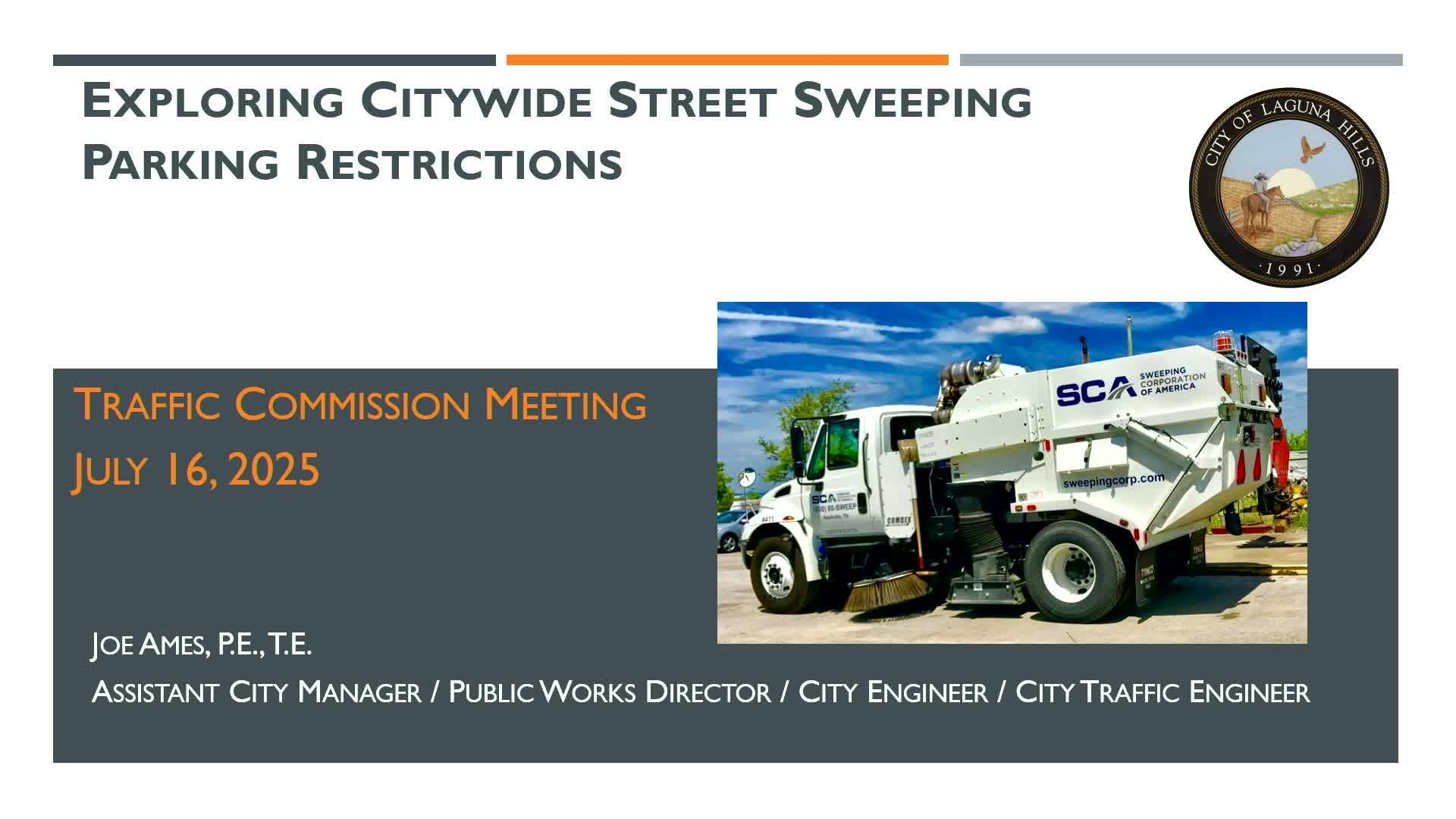
The Laguna Hills City Traffic Commission on July 16 heard a detailed staff presentation on a proposed citywide street‑sweeping parking restriction and voted to direct staff to gather data and run public outreach before pursuing an ordinance.
City Engineer (Mr. Ames) told commissioners that Council direction from Mayor Pro Tem Kaske had asked the commission to evaluate a citywide sweeping parking restriction with attention to costs, enforcement and coordination with trash pickup days. Staff outlined operational benefits — improved stormwater quality, removal of debris and better neighborhood appearance — while warning of resident inconvenience, enforcement demands and signage maintenance.
Staff presented two signage strategies: a comprehensive option to place signs approximately every 300 feet (staff estimated about $350,000 for citywide installation) and a lower‑visibility entrance‑only option (staff counted about 56 entrance locations and rounded to 60). The transcript records an estimated cost for the entrance option as “about $15” without specifying units; staff later said the 300‑foot option would be far more expensive. Commissioners asked staff to clarify the entrance‑sign cost figure in writing before any commitment.
A three‑phase enforcement model was described: an education period followed by a warning citation period, then strict enforcement. Staff provided a sample enforcement ramp‑up estimate of roughly $63,000 for overtime community‑service officers during the warning and strict enforcement phases, while noting annual contract costs for current sweeping are about $185,000 (staff did not split residential vs. commercial costs).
Engineers also explained a pending operational change: a joint procurement with Lake Forest and a new CR&R contract may consolidate Laguna Hills residential trash pickup to Mondays and Thursdays starting next July, which would shift street sweeping to Tuesdays and Fridays. Staff said that change and the current street‑sweeping contract (which expires 2026‑06‑30) mean any citywide parking prohibition should be deferred until routing and contract terms are settled.
Public comments from resident Lowell Reid criticized one‑off sign placements and warned against acting on isolated complaints without broader community outreach. Commissioners and staff echoed the need for better data and educational outreach before spending on major signage or adopting an ordinance. Commissioner Miller highlighted the potential to pursue variable digital signage and grants to reduce long‑term costs; other commissioners suggested once‑a‑month sweeping as a lower‑cost alternative worth studying but expressed concern about fire‑risk neighborhoods that may need more frequent sweeping.
On a motion from the chair, amended in discussion and seconded, the commission directed staff to: (1) sample and report how many parked vehicles materially impede sweeping operations (by sampling or CSO observations or other methods), (2) implement a public‑awareness campaign describing the current voluntary street‑sweeping program and maps, and (3) return with findings and recommendations at the November meeting (approximately four months). The commission voted to approve the motion by voice vote; commissioners did not record a roll‑call tally in the minutes.
The commission did not adopt any ordinance or change to parking law at the July meeting. Staff said future steps could include ordinance drafting, selection among signage options, refined enforcement cost estimates and coordination with the new CR&R trash routes and the forthcoming street‑sweeping contract procurement.
The commission also asked staff to clarify several figures in writing (including the entrance‑sign cost listed in the transcript), produce sample enforcement and signage amortizations, and include estimates of how proposed changes would affect the existing $185,000 annual sweeping cost. The commission’s immediate directive was limited and procedural: collect targeted data, run outreach, and report back in four months.