Get Full Government Meeting Transcripts, Videos, & Alerts Forever!
Get email alerts on the E Bike Regulation topic
No spam. Unsubscribe anytime.
Laguna Hills traffic commission backs draft e-bike rules, urges school partnership and education plan
Summary
The commission reviewed a draft regulated mobility-device ordinance drawn from Rancho Santa Margarita’s model, agreed to recommend edits (including an 8 mph sidewalk reference for education), and voted to forward the proposed language and annotated notes to city council with a request for an education and enforcement plan tied to the school district.
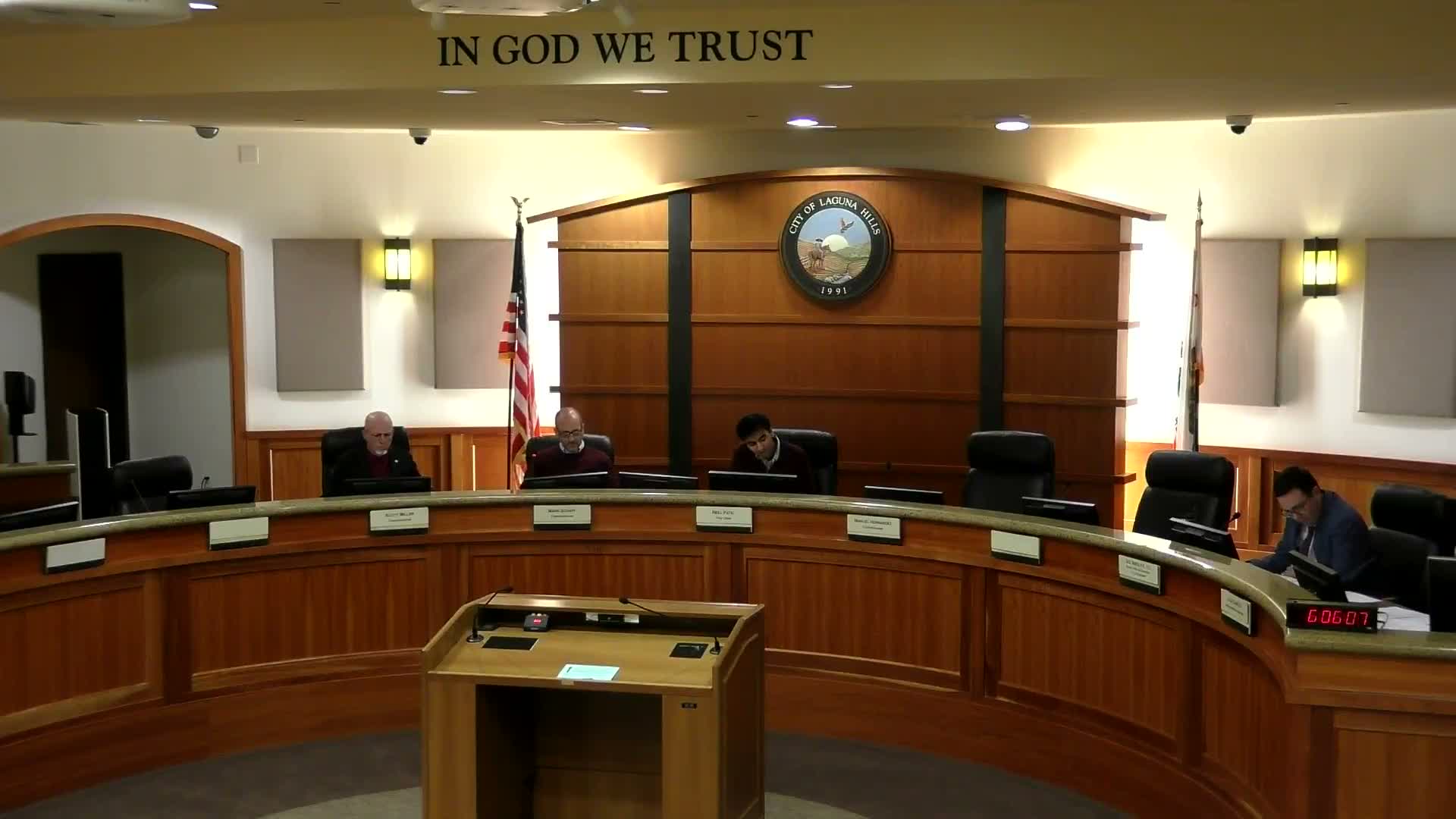
Laguna Hills — The Traffic Commission on Jan. 15 reviewed a draft regulated mobility-device ordinance (commonly used to regulate e-bikes and similar devices), recommended a set of local edits to the Rancho Santa Margarita model, and voted to forward its recommended language and detailed notes to the City Council along with a request that the council adopt a complementary education and enforcement plan.
Vice Chair Neil Patel opened the meeting and staff presented a packet that included the Rancho Santa Margarita ordinance, a comparison of South Orange County rules, and a memorandum describing the Saddleback Valley Unified School District’s student e-bike permit program. City staff told commissioners the packet was intended to give the commission structured checkboxes and comment fields to identify which provisions to keep, change or drop.
Commissioner Miller urged a close partnership with the school district, saying the district’s permit program already includes annual applications, parent sign-off, campus-specific tamper-evident stickers and training. “It is actually kudos to the sheriff’s department. It’s a very well put together program,” Miller said, urging the commission to align any city ordinance with school training so students and parents are not confused about rules and penalties.
Commissioners debated two related goals: setting a numeric sidewalk reference useful for education and creating an enforcement standard officers can apply in the field. Several members and police representatives warned that an arbitrarily low number is difficult to measure and enforce; police services said officers typically rely on observable unsafe riding rather than radar measurement for low sidewalk speeds. The commission reached a working consensus to use 8 miles per hour as the sidewalk reference in the draft language discussed with the city attorney, while preserving an overarching “unsafe manner” standard for enforcement.
The body reviewed a list of behaviors in the draft ordinance (items such as operation in drainage channels, towing or being hitched to another vehicle, riding on unpaved trails, helmet requirements, and tampering/modifying a device). Commissioners disagreed on several specific items and directed staff to transmit the commission’s positions and the range of votes (agree/disagree/neutral) to the City Council and City Attorney rather than unilaterally deleting contested provisions.
On penalties and compliance, commissioners said they favor an education-first rollout: police staff said verbal and written warnings are available but not always centrally tracked, and the commission asked the city attorney and staff to include a provision that enforcement officers should attempt to contact a parent or guardian when a minor is found in violation. Commissioners also recommended Spanish-language materials for the education program.
A motion to forward the commission’s recommended regulatory language, the commissioners’ annotated support/disagreement notes, and a recommendation that the City Council adopt an education and enforcement plan passed by voice vote. Staff will prepare an agenda report and the City Council will decide whether to direct the City Attorney to draft a Laguna Hills ordinance based on the commission’s input.
The Sheriff’s Department offered no verbal report. The commission closed with brief commissioner comments and adjourned; the next regular meeting is scheduled for March 19 in City Council Chambers.
Ending — The commission’s action sends a recommended, annotated ordinance and a formal request for an education-and-enforcement plan to the City Council; the council will determine legal drafting and final policy.