Get Full Government Meeting Transcripts, Videos, & Alerts Forever!
Get email alerts on the Local Economic Development topic
No spam. Unsubscribe anytime.
Fountain Valley council studies "Tuesday No Tax" rebate but declines to adopt plan as presented
Summary
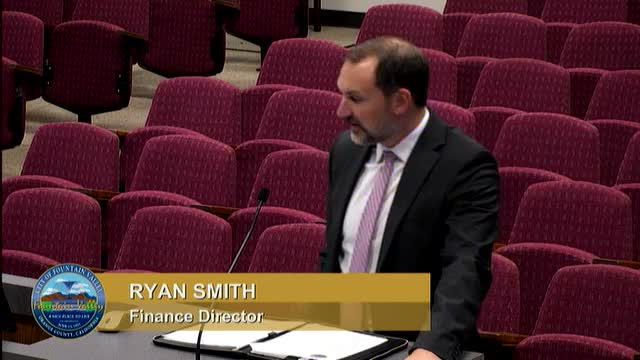
At a March 4 study session Finance Director Ryan Smith outlined a proposed one-day, post-Thanksgiving rebate of Fountain Valley's 2% sales-tax share. Councilmembers raised concerns about administrative cost, fraud risk and point-of-sale feasibility; the proposal received no formal approval.
Finance Director Ryan Smith told the Fountain Valley City Council at a March 4 study session that staff had drafted a proposal for a one-day "Tuesday No Tax" rebate aimed at encouraging holiday shopping in the city. The program would rebate the city’s portion of sales tax — described in the presentation as 2% of the 8.75% total sales tax (1% Bradley Burns and 1% from Measure HH) — for purchases made at businesses physically located in Fountain Valley on the Tuesday after Thanksgiving.
Smith described the proposed mechanics: residents would upload a copy of the receipt to a city web form, sign a consent attesting the purchase is final and not fraudulent, and supply a Fountain Valley mailing address. Staff estimated verification and payment processing would take 5–7 minutes per submission, checks would be mailed to residents, and a typical check, envelope and postage was roughly $1. The submission window in the draft was open through the following March 31. Smith said the city could process about 500 submittals per month in-house, and estimated longer timelines or outside contracting would be needed if submittals were substantially higher.
To illustrate variability in payouts, Smith showed examples: a $131 purchase at Sam’s Club that generated $11.54 in sales tax and a $2.64 rebate; a mixed taxable receipt yielding a 55¢ rebate; and an extreme example — an RV listed on a local dealer’s website at about $672,000 — that would create roughly $58,000 in sales tax and a rebate of a little over $13,000. Smith flagged other costs and design choices for council consideration, including web and database development, marketing, check stock and staff time, plus policy questions about minimum or maximum reimbursement amounts and whether to exclude categories such as gas, alcohol or vehicles.
Councilmembers voiced a mix of support for the idea’s intent and skepticism about the draft’s practicality. Councilmember Harper and others suggested pursuing a point-of-sale option — working with retailers to apply the rebate at checkout — to avoid the receipt-submittal burden on residents and staff. The city attorney advised that framing the proposal as an economic development program would mitigate concerns that it might constitute an unlawful gift of public funds. Vice Mayor Kuneen described the idea as "novel" and said he would support piloting it. Several councilmembers, however, raised repeated concerns: the administrative cost could exceed or closely match many small rebate amounts; the program could create substantial staff workload during the holiday season; fraud risks include altered or printed receipts and post-purchase returns; and the program might disproportionately be used for a small number of large-ticket purchases rather than broadly benefit lower-income residents.
Council members discussed possible mitigations: shortening the submission window so residents submit receipts promptly, setting verification thresholds (staff would call vendors for very large rebates), establishing per-transaction or program maximums, outsourcing processing to a rebate-clearing vendor, and allowing ACH deposits to reduce postage. Several members — after calculating sample rebate math during the meeting — concluded the time and cost to process small rebates would make the program inefficient in its current form. By the end of the discussion, enough council members expressed reservations or withdrew support, and no motion was made to implement the program as presented.
What happens next: staff will retain the study-session record and the council indicated interest in further work if the proposal is retooled (shorter submission window, point-of-sale exploration, or outsourcing). No ordinance was introduced and no binding action was taken at this meeting.