Get Full Government Meeting Transcripts, Videos, & Alerts Forever!
Get email alerts on the Sanitation topic
No spam. Unsubscribe anytime.
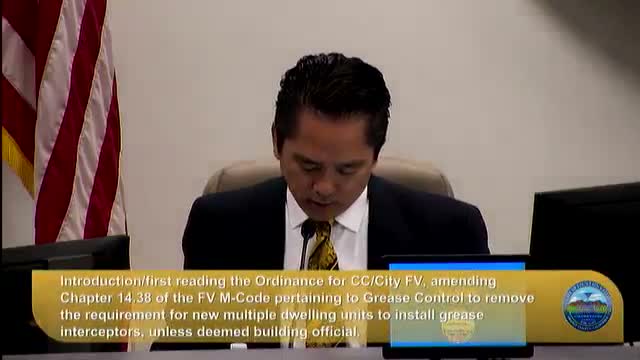
Fountain Valley council approves first reading to scale back grease-interceptor requirement for new multifamily units
Summary
Council voted 4–1 on first reading to amend the city—s grease-control code so building officials may, rather than must, require grease interceptors for new multiple-dwelling projects; staff and industry speakers told the council residential units typically generate negligible grease and mandatory interceptors are often impractical.
The Fountain Valley City Council on Feb. 18 approved, on first reading, an amendment to the city—s grease-control ordinance that removes a blanket requirement for new multiple-dwelling units to install grease interceptors and instead allows the building official to require them where necessary.
Scott Smith, the city—s public works director, told the council staff reviewed 20 years of local experience and compared Fountain Valley—s code with neighboring cities and concluded that mandatory interceptors for individual dwelling units are unnecessary and often impractical. He said the change replaces a —shall— requirement with a —may— so that installations are required only when warranted by site conditions.
Contractors and developers who spoke during the public-comment period supported the amendment. Alfonso Toledo, a plumbing contractor with AMPAM Parks Mechanical, said residential kitchens produce negligible amounts of fats, oils and grease (FOG) compared with commercial food-service operations and that the smallest UPC-rated grease interceptors start at capacities that do not fit typical unit layouts. Representatives from Holland Partner Group said they have not encountered residential-unit interceptors in their multifamily projects across the region and that forced installation would add substantial capital and operating costs and complicate maintenance.
Council members pressed staff on edge cases: very large multifamily projects (hundreds of units), enforcement if individual units cause blockages, and whether retrofitting after a problem occurs would prove cost-prohibitive. Staff and an industry expert cited the Uniform Plumbing Code provision that exempts individual dwelling units from grease-interceptor requirements and described available enforcement tools: preventive maintenance orders, notices of violation, required remediation by property owners, and posting bonds or other assurances where needed.
Councilmember Grandes moved to approve the ordinance—s first reading and the motion passed 4—1. Council directed staff to include preventive maintenance and monitoring provisions and to return with clarifying language on thresholds or conditions that would trigger a requirement for larger projects.
The ordinance will return for a second reading before becoming final; staff said the amendment aligns local code to plumbing code practice while preserving the city—s ability to require interceptors when public-health or infrastructure risks are identified.