Get Full Government Meeting Transcripts, Videos, & Alerts Forever!
Get email alerts on the Parking Grand Avenue topic
No spam. Unsubscribe anytime.
Buena Park weighs reconfiguring Grand Avenue parking and permit districts after years of neighborhood complaints
Summary
Residents at Adams and Jackson and homeowners near Grand Avenue told the council the street faces chronic overflow parking, blocked driveways and safety risks from event spillover and apartment overcrowding. Staff proposed red-curb reconfiguration and shifting frontage-road parking to gain about 47 spaces; council urged pursuing permit parking alongside enforcement and targeted code inspections.
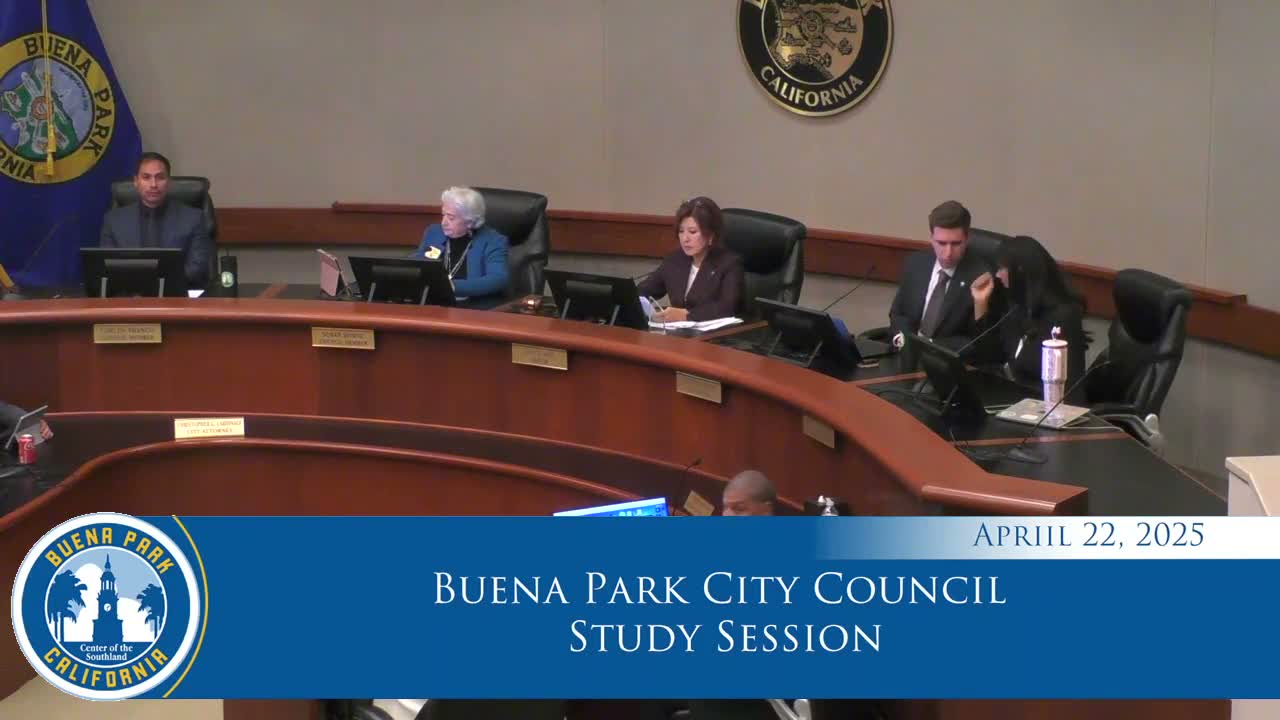
Buena Park City Council spent more than two hours during a study session and public comment period weighing short- and long-term fixes to chronic parking and safety problems around Grand Avenue, Adams and Jackson ways.
Staff recommended a package of changes including reconfiguring existing red-curb zones, shifting on-street parking from the side adjacent to homes to the frontage median, and exploring preferential (permit-only) parking in the most-affected blocks. Senior engineering technician Norm Ray said the recommended reconfiguration — removing some no-parking zones and allowing parking on the frontage-road median — would add roughly 24 spaces on Grand Avenue and 23 on the frontage road for a total of about 47 additional on-street spaces while preserving sight lines for driveways and intersections.
The proposal stems from a long-running set of complaints by homeowners who say apartment tenants and visitors to Knott’s Berry Farm routinely occupy neighborhood curb space and sometimes park in red zones, in front of hydrants and across driveways. In public comment, residents described vehicles left in place for days, blocked driveways and, in multiple accounts, isolated crimes and shootings they attribute to conditions in nearby rental properties. Pete North, a Jackson Way resident, said parking often blocks driveway access; another resident, Venice Versa, said she has called police repeatedly for cars blocking her driveway and described trash and safety issues behind nearby apartments.
Council members repeatedly told residents they hear the urgency. Several council members said permit parking remains a top priority for homeowners and urged staff to support any neighborhood petition that reaches the city’s threshold for a preferential parking district. Staff explained the city’s current policy requires signatures from two-thirds of affected homes to establish a permit district; permanent permits are typically limited to two per household and cost $10–$20 every two years, with $1 temporary permits available for events.
Council members and staff also stressed enforcement and code work. Director Matt Folkes described existing code enforcement and rental inspection efforts targeted to the area but acknowledged staffing limits have made enforcement intermittent. Folkes said the city maintains a code officer assigned to the neighborhood and that rental housing inspections include exterior reviews with interior follow-ups when warranted; however, additional, recurring enforcement would require more staff resources.
Opposition to some options was strong in the room. Residents rejected one-way street conversions and most angled-parking schemes, saying the changes would complicate access and could push parking problems elsewhere. A mailed survey to 144 homes produced only about 20 responses; of those, roughly 75% opposed one-way streets and about 75% favored permit parking — but staff cautioned the sample was small compared to the total number of affected properties.
Council direction: Council members signaled support for a multi-pronged approach: (1) support neighborhood petitions to start the permit-parking process, (2) consider implementing the staff-recommended red-curb reconfiguration to gain roughly 47 spaces as a near-term, low-infrastructure option, (3) step up targeted code enforcement and rental inspections in the worst-performing properties, and (4) pursue regional discussions with Knott’s Berry Farm and apartment owners on overflow parking. Vice Mayor Traut and others urged immediate, visible steps such as replacing worn “residents and guests” signs and adding temporary signage on the frontage road while permit petitions proceed.
Next steps: Staff will prepare follow-up materials explaining the permit-petition process (two-thirds support required), produce a refined cost and implementation plan for the red-curb reconfiguration and signage changes, and continue directed code enforcement sweeps in collaboration with police. Residents were encouraged to gather petition signatures, and the council said it will revisit the matter with more concrete options and timing.