Get Full Government Meeting Transcripts, Videos, & Alerts Forever!
Get email alerts on the Solid Waste topic
No spam. Unsubscribe anytime.
Brea council debates Republic Services contract and proposed overage-fee hike; no final contract vote
Summary
Council and Republic Services debated a proposed franchise amendment and rate adjustments, including raising commercial container "overage" charges (proposed to $79.95 per occurrence in year 2) and a staff-recommended residential curbside rate of $31.27; council asked for clearer invoice appeal language and outreach and did not record a final vote on the contract during the March 4 meeting.
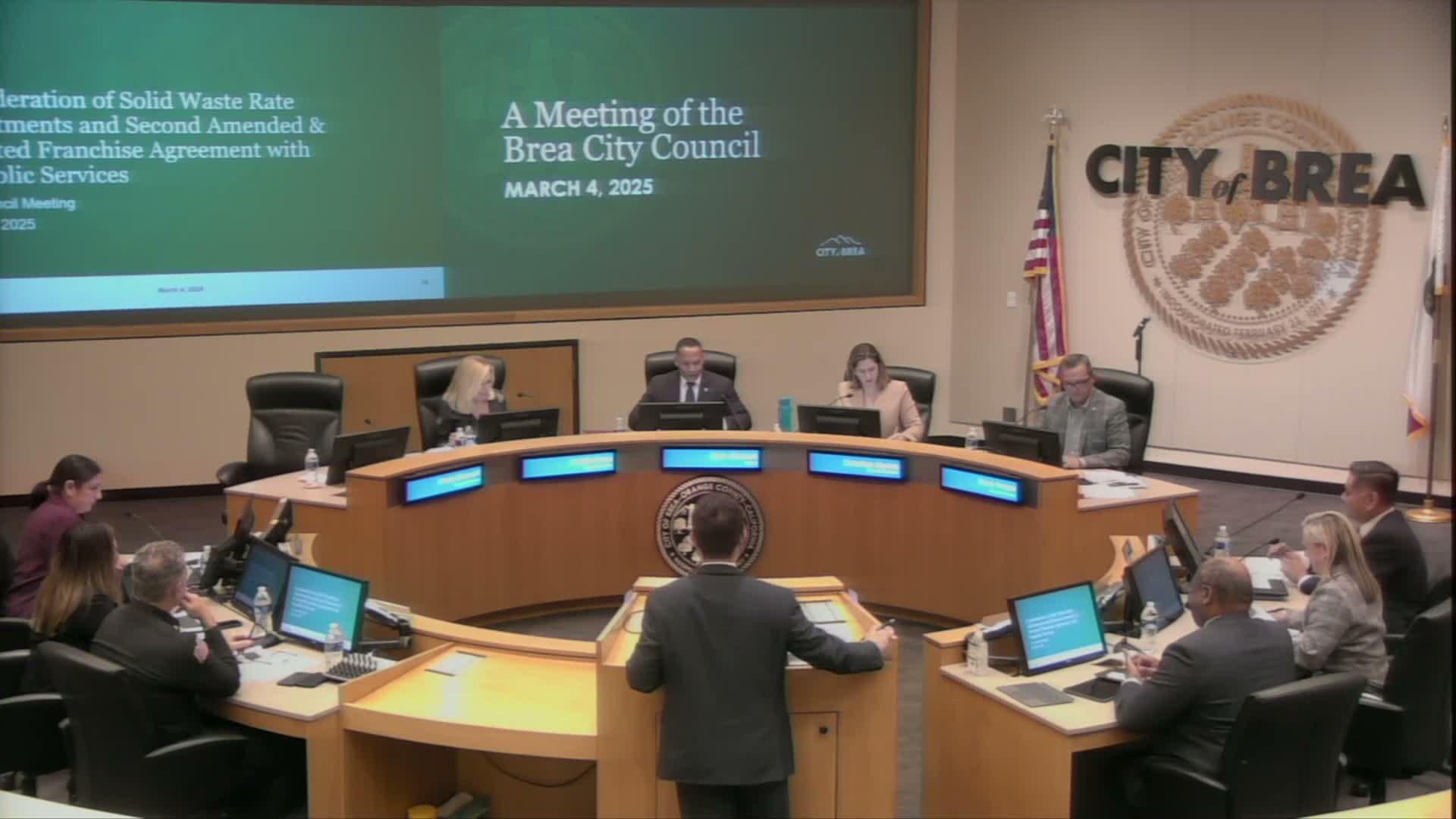
The City of Brea City Council spent substantial time on March 4 discussing a second amended and restated franchise agreement with Republic Services and proposed rate adjustments intended to conform to Senate Bill 1383 (organics and recycling rules).
Senior Manager Matt Cuevas summarized prior negotiations and Republic's latest counteroffer. He said Republic proposed increasing the commercial container overage charge beginning in year two from a negotiated $65 per occurrence to $79.95 per occurrence effective 07/01/2026 and that the revised overage would not be adjusted by an index until year three. "Republic is presenting its latest counteroffer, which is a request to increase the commercial container overage amount starting in year 2 from the negotiated rate of $65 per occurrence to $79.95 per occurrence starting on 07/01/2026," Cuevas told the council.
Cuevas and Director Michael Ho described the overage charge as a behavioral tool to reduce unsafe and unsanitary overflows, improve worker safety and recover cleanup costs; staff said Republic must provide photographic evidence and customer notice before charging. Michael Ho told the council the overage problem "is something that can be 100% preventable" and described staff plans to identify top commercial generators and perform targeted outreach.
Staff also presented the residential curbside context: a consultant (NewGen) had proposed a $32.59 curbside rate, and staff recommended $31.27; without a residential rate adjustment staff estimated Fund 440 would face an approximate $646,985 under-recovery in year one, while the $31.27 rate would reduce the under-recovery to about $158,938.
Council members raised several concerns: whether overage charges would penalize businesses hit by illegal dumping or one-time cleanouts; whether raising the fee substantially would be disproportionate for small commercial customers; how the garbage/trash collection index relates to landfill tipping fees; and how mobile-home parks are serviced. Residents and council members described problems at Bandera/Banderas Estates and other mobile-home parks where hand pickup or smaller carts are used. Republic representatives said the mobile-home parks in question are serviced by hand and that the company is swapping in compliant carts before the July rollout where vehicles can safely access roads.
Council asked for clearer implementation commitments from staff and Republic: proactive outreach to top offenders, a clear appeal and credit process for one-time incidents, and invoice language and bill messaging directing customers how to request photos and contest overage charges. Republic said it would provide pictures, coordinate outreach, issue credits in appropriate one-time cases and include contact information on invoices.
On procedure, one council member moved to approve the staff-recommended rate increase (the motion included an amendment asking Republic to include explicit invoice/bill language and an appeal pathway); the motion was seconded. Council members discussed conducting two separate votes because state law requires a four-vote two-thirds majority to approve rate increases while contract approval requires only a majority. The transcript records the motion and second but does not show a final recorded tally or formal contract-adoption vote before the meeting adjourned; council directed the matter be agendaized for follow-up at a subsequent meeting.
What happens next: staff and Republic will coordinate outreach and provide requested implementation language and documentation; the council will take further action on the rate increase and contract at a later meeting.