Get Full Government Meeting Transcripts, Videos, & Alerts Forever!
Get email alerts on the Flag Policy topic
No spam. Unsubscribe anytime.
Aliso Viejo council pulls proposed ban on non‑government flags after hours of public testimony
Summary
After more than three hours of public comment and legal warnings from staff, the Aliso Viejo City Council’s sponsor withdrew a resolution that would have limited flags on city flagpoles to federal, state and local banners. The council paused further action and will continue other agenda items at a later meeting.
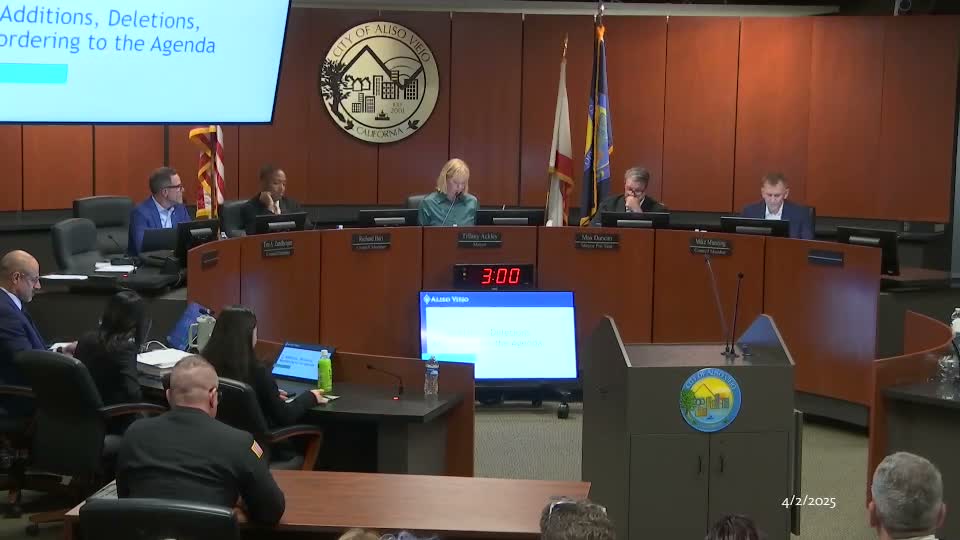
Aliso Viejo, Calif. — The Aliso Viejo City Council on April 2 withdrew a proposed resolution that would have limited flags flown on city flagpoles to government banners after hours of public testimony and legal caution from staff.
The proposal, introduced by Council member Mike Munzing, would have restricted displays on city-owned flagpoles to the U.S. flag, the California flag and the city flag (and originally included a POW/MIA exception before edits). Munzing said the intent was to “take politics out of this policy” and to ensure the city is not seen as advocating for particular causes.
The effort, however, drew sustained opposition from scores of residents, local LGBTQ organizations and political groups. Speakers said removing the pride flag — which the council has flown during Pride Month since 2018 — would be discriminatory and harmful to LGBTQ youth and other marginalized residents. “The pride flag is a beacon of hope,” Stephanie Camacho Van Dyke of a county LGBTQ organization told the council. Several residents said the change would signal that some community members are not welcome.
Mayor Tiffany Ackley described the resolution as poorly written and warned the council about legal exposure. The city attorney told the council the draft lacked clear definitions for terms such as “city property” and “flag,” and cautioned that public comments and online posts could be used in court to show discriminatory intent. Ackley said that if the measure could help even one person feel safe, the city should allow the flag to fly. “Anybody who says that this is not an attempt to silence a group is wrong,” she said in her closing remarks, summarizing the concerns raised during public comment.
Council debate focused on scope and enforceability. Some members supported a narrow policy limited to formal city flagpoles to avoid perceived advocacy, while others said the council should not be in the business of deciding which community symbols are legitimate. Mayor Pro Tem Max Duncan and others urged the council to prioritize budget and infrastructure issues rather than a contentious policy change.
After an abbreviated recess during which the city attorney prepared clarifying language, Munzing revised his proposal to narrow its reach and to remove some contested exceptions. Facing continued concern and a formal motion to pull the item, Munzing moved to withdraw the resolution and the council approved the motion. The council then adjourned and Mayor Ackley said nonrelated agenda items would be carried forward to the next regular meeting.
The council’s action leaves in place the council’s prior practice of flying the pride flag during Pride Month; any future changes would require a clearer, legally reviewed ordinance and a formal council vote. The city attorney advised that any new draft should state the council’s reasons explicitly in written recitals to reduce the risk that outside statements would be attributed to the council in possible litigation.