Aliso Viejo council pauses major traffic changes on Hummingbird Lane to evaluate new speed signs
Loading...
Summary
Council received an ad hoc committee report on Hummingbird Lane and agreed to delay permanent striping or other large-scale traffic-calming installations while staff monitors newly installed speed-feedback signs; the council discussed bulb-outs, full edge-lines, speed humps and crosswalk costs.
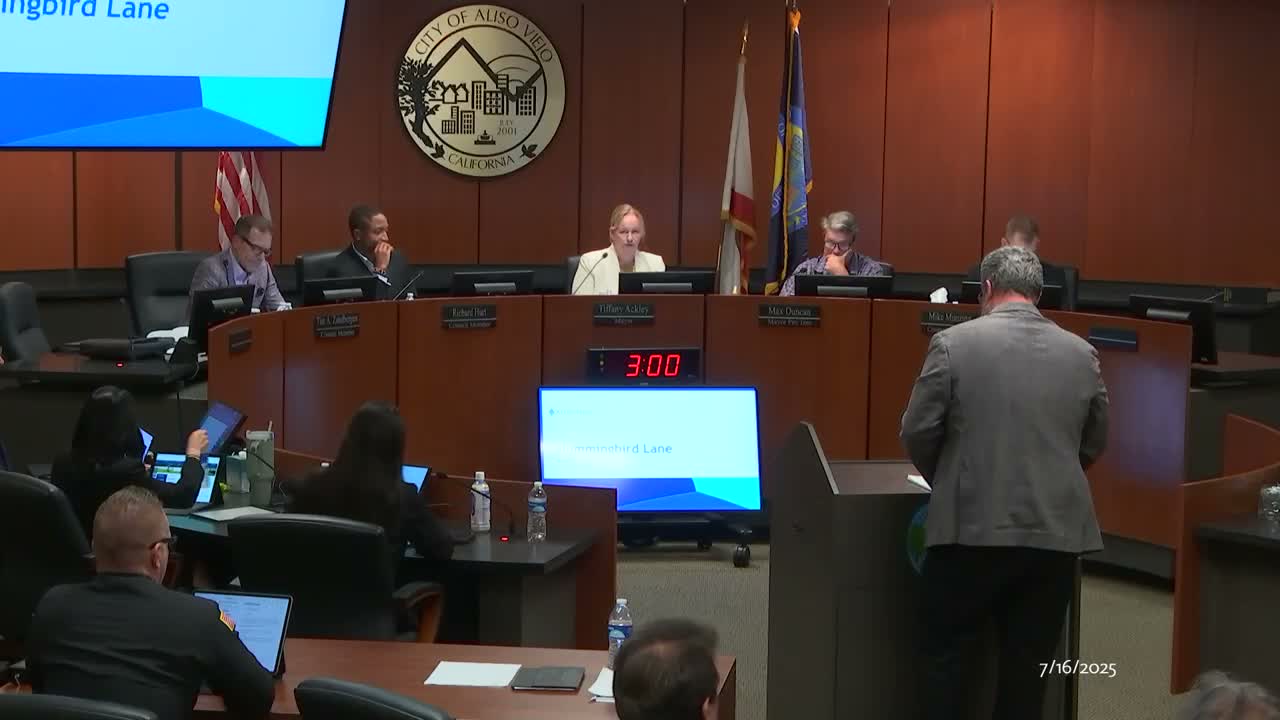
Aliso Viejo City Council agreed on July 15 to delay final approval of large-scale traffic-calming measures on Hummingbird Lane and monitor data from newly installed speed feedback signs before committing to permanent pavement work.
At a presentation from the ad hoc committee, staff said the city has spent about $39,000 on previous studies and physical improvements along Hummingbird Lane. Early data from permanent speed-feedback signs installed last week ‘‘indicate a positive change in lowering speeds,’’ the presenter told the council. The panel outlined alternatives including full-length edge striping to visually narrow lanes, intersection bulb-outs (curb extensions), speed humps and crosswalks; staff said stop signs do not meet legal warrants and crosswalks carry high costs because of curb ramp and private-property impacts.
Resident Brett Poole, who lives on Hummingbird Lane, told the council the new feedback signs have already slowed drivers near the midpoint and urged additional measures near the park where vehicles enter the neighborhood at higher speed. ‘‘This junction is begging for stop signs, a speed hump or even a wall,’’ Poole said, adding that earlier interventions have reduced speeding once drivers see the signs.
Council members discussed trade-offs between aesthetic impacts to homeowners and traffic safety. Staff emphasized there is no guarantee any single treatment will produce a uniform speed reduction and cited studies showing modest, variable decreases. The council majority favored a phased approach: keep monitoring the speed feedback data and, if it stabilizes at lower speeds, return with a narrower set of recommended improvements. Council directed staff to narrow options for council review, prioritize intersection bulb-outs and targeted edge lines at park approaches, and return with a follow-up report in about one month.
Next steps: staff will continue collecting speed data from the permanent signs, consult with emergency responders on potential physical treatments, survey adjacent residents as directed, and report back to the council with refined recommendations.