Get Full Government Meeting Transcripts, Videos, & Alerts Forever!
Get email alerts on the Colorado Baso topic
No spam. Unsubscribe anytime.
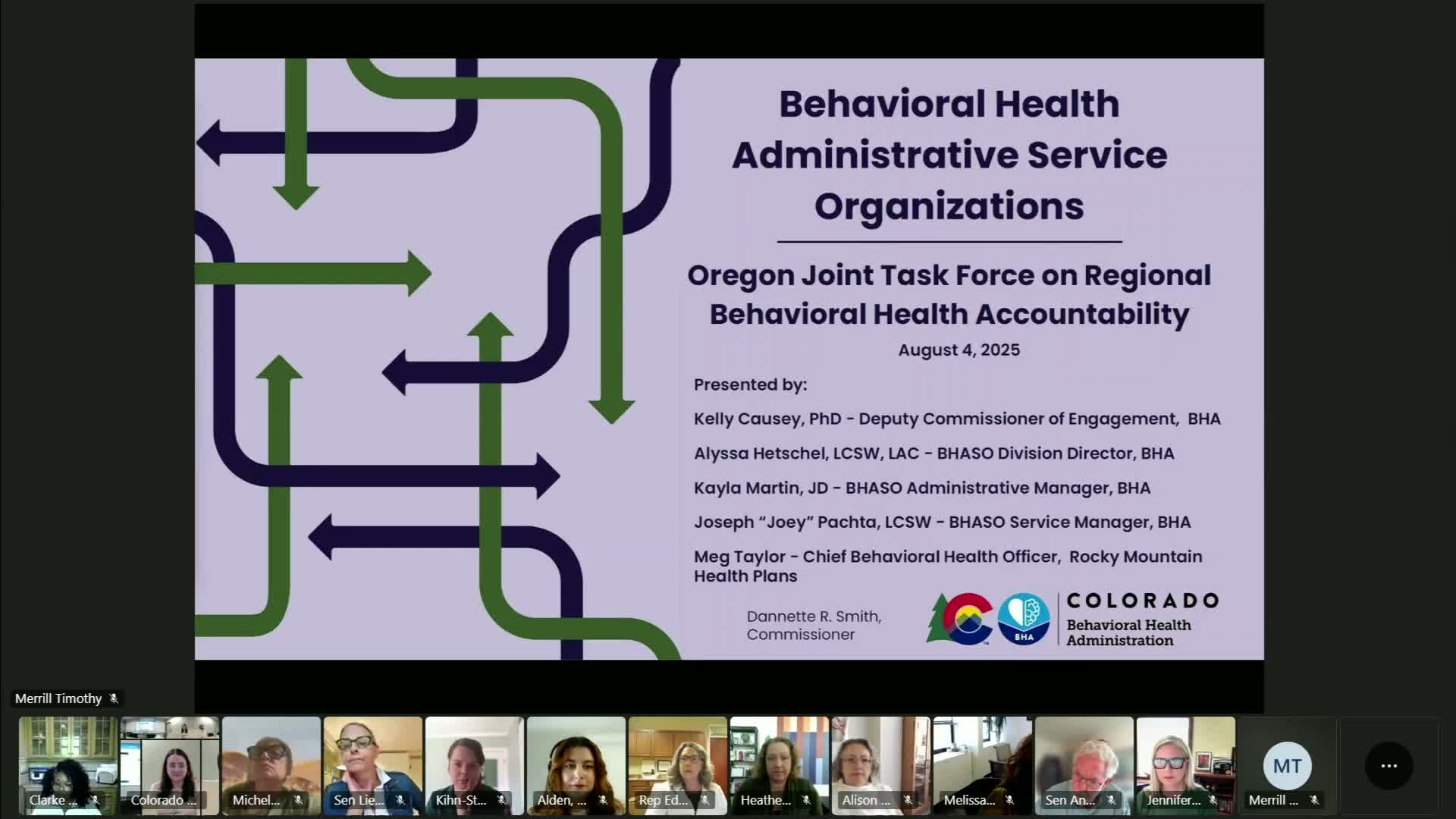
Colorado officials describe BASO model to centralize behavioral health access and oversight; presenters say braided funds and region design aim to improve care
Summary
Colorado officials briefed Oregon lawmakers on their Behavioral Health Administrative Service Organization model (BASOs/VASOs), explaining four regions, a statewide LIFTs network for crisis/substance use/mental health, braided funding to support providers and Year‑1 performance benchmarks.
Colorado officials told Oregon’s Joint Task Force that the state reorganized portions of its behavioral health purchasing to create regional Behavioral Health Administrative Service Organizations (referred to in the presentation as BASOs/VASOs) and a linked Colorado LIFTs network that launches July 1.
Kelly Conseil, introduced as a deputy commissioner, and Alisa Hechtel, identified as VASO Division Director at Colorado’s Behavioral Health Administration, said the BASO model grew from the state’s behavioral health task force and a 2020 blueprint for reform. The presentation credited stakeholder engagement, data analysis and alignment of regions with Medicaid benefit areas as key design decisions.
Hechtel described BASO responsibilities and financing: the Behavioral Health Administration will allocate braided state and federal funds through regional contracts and BASOs will contract with local providers. The presentation noted that federal grants totaling around $47,000,000 account for just under a quarter of the BASO budget, with the remainder coming from state general fund and other state sources; presenters also used an approximate program figure of $2–3 million in describing some regional allocations. The state projects that more than 110,000 Coloradans will need publicly funded mental‑health services in the BASO network’s first year.
Colorado’s model sets Year 1 performance benchmarks that are intended to reduce administrative burden where possible and to measure access and continuity of care: provider availability in the network, time to therapeutic intervention after crisis or non‑crisis events, and timely transitions from withdrawal management or residential treatment into follow‑on care.
Members asked practical questions about implementation. Colorado officials said the model was a mix of legislative and administrative actions, and that region boundaries were chosen based on utilization, population and travel‑time analysis; they acknowledged controversy in mapping and said data and competitive bidding influenced final lines. On payments, Colorado said it is exploring value‑based incentives but emphasized that early efforts focus on performance benchmarking and partner support rather than punitive measures.
Presenters acknowledged open questions: how to sustain bed capacity when demand spikes, how to integrate forensic or mandated populations into the model, and how to align BASO decisions with county and Medicaid systems. Task force members said Colorado’s experience offered concrete examples but also cautioned Oregon to define regional boundaries and outcome metrics before attempting to consolidate funding responsibilities.
Colorado did not request action from the Oregon task force; members asked staff follow‑ups and noted they would consult the documentation and linked materials provided by Colorado.