Get Full Government Meeting Transcripts, Videos, & Alerts Forever!
Get email alerts on the Regional Funding topic
No spam. Unsubscribe anytime.
Task force weighs regional approach to behavioral health funding after governor—s table work
Summary
Members of the Joint Task Force on Regional Behavioral Health Accountability heard a presentation on the governor—s regional tables and debated whether pooling dollars and formalizing regional networks could reduce duplication, improve access and ease administrative burden for providers.
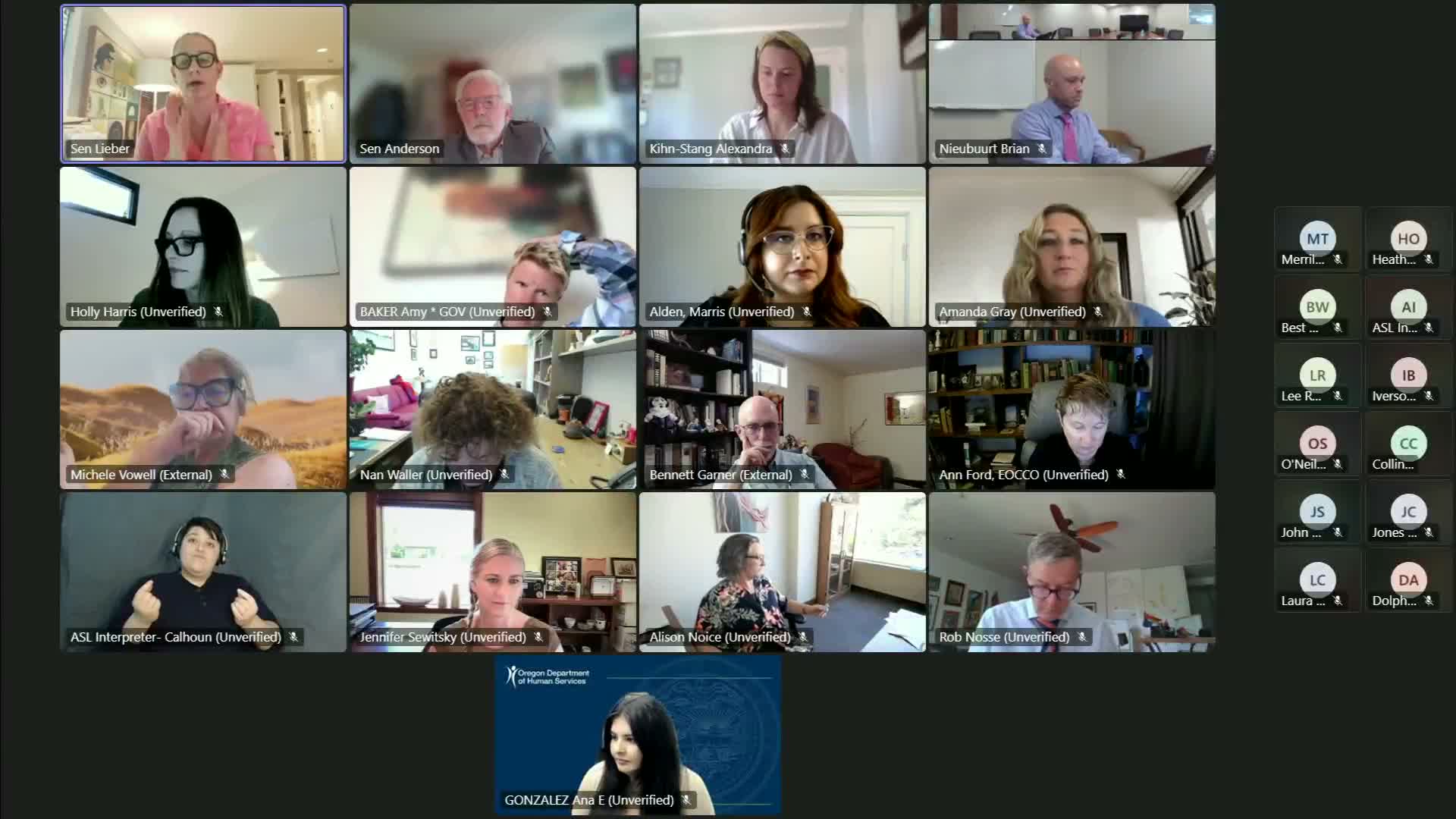
The Joint Task Force on Regional Behavioral Health Accountability on July 7 heard a presentation from Amy Baker about the governor—s regional behavioral-health conversations and the PCG gap analysis, then debated whether Oregon should shift more funding decisions to regional tables rather than separate county streams.
Baker, introduced by the task force co-chairs, said the governor—s office held short, focused regional conversations early this year to align community priorities with a PCG (res+ study) analysis and with prior OHA requests for information. "Governor Kotek had $90,000,000 in her in her, GRB," Baker said while summarizing the effort to identify where residential capacity is most needed. She said the process prioritized forensic and civil-commitment populations because of the Mink/Bowman injunction and sought projects with a high bed-to-cost ratio and geographic equity.
The central question raised by Co-chair Lieber was whether a regional process would make funding more transparent and collaborative. "We are going to, quite frankly, have less of them," Lieber said, warning that federal changes will reduce available federal dollars and that the state must become "more efficient with our dollars." Task force members said regions could help align disparate funding streams but insisted some services must remain local.
County and provider officials described both examples of successful regional work and practical barriers. Holly (a CMHP representative) pointed to Central Oregon—s regional child psychiatry solution as a model that succeeded through existing intergovernmental relationships and shared funding; Heather Jeffries and other provider representatives said regionalization can reduce duplication but can also increase administrative burden for providers if multiple payers keep separate reporting requirements.
Participants debated how regions should be defined. Lisonbee proposed steering committees responsible for a short list of measurable regional metrics (for example, maximum travel distance to a service) and financial accountability to align incentives for providers and purchasers. Others suggested trauma regions or CCO service areas could be starting points but warned those boundaries sometimes do not reflect everyday referral patterns or transportation realities in rural Oregon.
Staff said service-mapping and better data would be essential to determine sensible region boundaries. The co-chairs and staff asked OHA and LPRO to check whether prior mapping exists and to provide tools and examples from other states for the next meeting. The group scheduled a follow-up meeting on Aug. 4 to continue focused discussion and to review staff-prepared visualizations and statutory coordination points.
The task force did not take any formal votes on regionalization. Members left the session with a clear set of next steps: gather service maps, test potential region boundaries against transportation and referral data, and explore opt-in structures so counties could choose to participate in regional tables without mandating a statewide realignment.