Get Full Government Meeting Transcripts, Videos, & Alerts Forever!
Get email alerts on the State Budget Forecast topic
No spam. Unsubscribe anytime.
Oregon forecast trims revenues; LRO estimates HR 1 will cut current‑biennium receipts by $888 million
Summary
The Office of Economic Analysis and Legislative Revenue Office told the joint House and Senate revenue committees the September forecast lowers projected general‑fund receipts by $621 million versus May, driven largely by federal tax changes (HR 1) that LRO estimates reduce current‑biennium revenue by about $888 million.
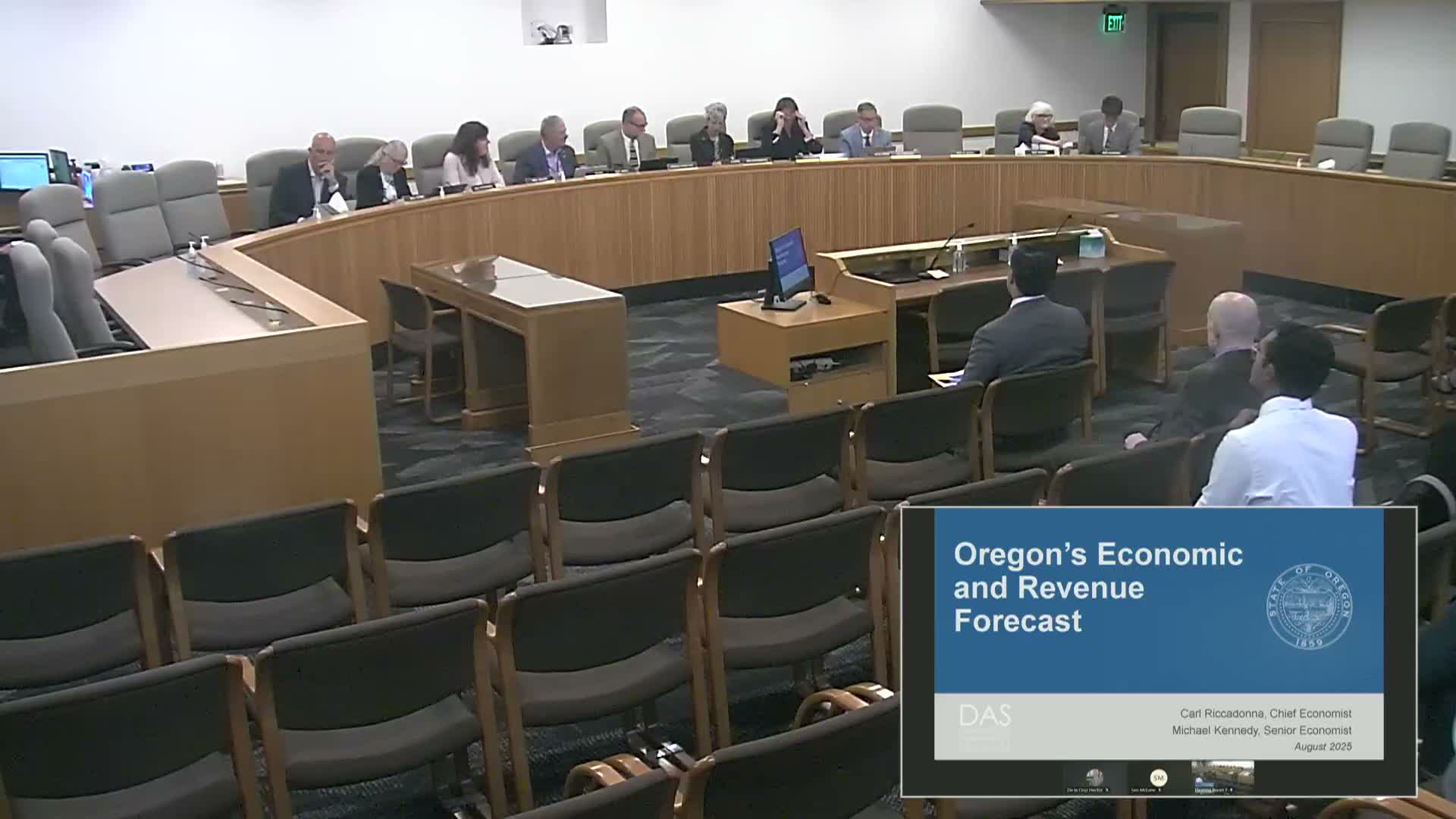
The joint House and Senate revenue committees heard on Aug. 27 that Oregon —aces weaker near‑term revenue prospects after the Office of Economic Analysis (OEA) and the Legislative Revenue Office (LRO) updated the September economic and revenue forecast.
"We have not specifically incorporated" high‑profile one‑off asset sales into the forecast, OEA said, but LRO and OEA said the headline change to the state revenue outlook stems from federal tax legislation known in the briefing as HR 1 and from recent state data revisions. Michael Kennedy of the Legislative Revenue Office said the forecast revision lowers projected revenues by $621 million since May and reduces the projected ending general‑fund balance for the current biennium by $845 million to a deficit of about $372.7 million.
Why it matters: LRO's current scoring attributes the largest single effect to HR 1, which it estimates reduces current‑biennium revenue by roughly $888 million. LRO staff highlighted several provisions as key drivers: a temporary exclusion of overtime and taxed tips, expanded first‑year depreciation for business investment, and changes to research‑and‑development expensing. "The current estimate as we've seen before is that the revenue impact for the current biennium is $888,000,000 negative," Kennedy said.
Forecast and economics: OEA chief economist Carl Ricadana told lawmakers that national data show a modest slowdown this year followed by a rebound in 2026–27 — a pattern he described as a "hockey stick" profile — but OEA's state data revisions have reduced payroll gains into net losses. "We've lost 25,000 jobs over the last year," Ricadana said, adding that roughly 2 million Oregonians remain employed, which moderates revenue vulnerability because revenue flows from the employed stock.
Tariffs and timing: Presenters said tariff policy is acting as an effective near‑term tax increase, raising prices and slowing growth, while many HR 1 benefits to corporations and higher‑income households are scheduled to take effect in 2026. LRO and OEA noted some HR 1 provisions (notably the overtime and tip exclusions) are temporary and sunset after four years, while bonus depreciation shifts deductions earlier in time, creating early revenue losses and later gains.
Scenarios and risk: LRO presented alternative scenarios and probability weights. The baseline used for planning carries the most weight, but a mild recession would lower revenues by about $2.4 billion relative to baseline and a severe recession — judged low probability by presenters — could produce larger shortfalls (roughly $4.8 billion). The offices stressed uncertainty from data lags and the need to wait for 2025 tax returns before fully reconciling the HR 1 effects.
Distributional and policy questions: Lawmakers pressed presenters about who benefits from the federal changes and whether Oregon can capture reshoring investment. OEA said some HR 1 components (overtime and tip exclusions) primarily help lower‑ and middle‑income households, while other changes benefit businesses and higher‑income taxpayers. On reshoring, presenters said national headlines show some manufacturing investment coming to other states and that capturing those opportunities will depend on Oregon business site readiness and broader policy choices.
What comes next: OEA and LRO said they will monitor incoming Q2 state data, the 2025 tax returns, and evolving tariff and trade developments to update forecasts. Kennedy said LRO will update its scoring as tax‑return data arrive; OEA said the next official state data point is expected around Sept. 27.
The committees adjourned after the presentations with no formal votes or legislative actions taken at the hearing.