Get Full Government Meeting Transcripts, Videos, & Alerts Forever!
Get email alerts on the State Budget Revenue Forecast topic
No spam. Unsubscribe anytime.
OEA warns of $621 million revenue downgrade; HR 1 drives large near‑term hit to Oregon forecast
Summary
At a joint House and Senate informational session Aug. 27, the Office of Economic Analysis reported a $621 million downward revenue revision for the current forecast and said federal tax changes (HR 1) reduce biennium revenues by roughly $888 million, while labor‑market revisions and capital gains volatility shape future risk.
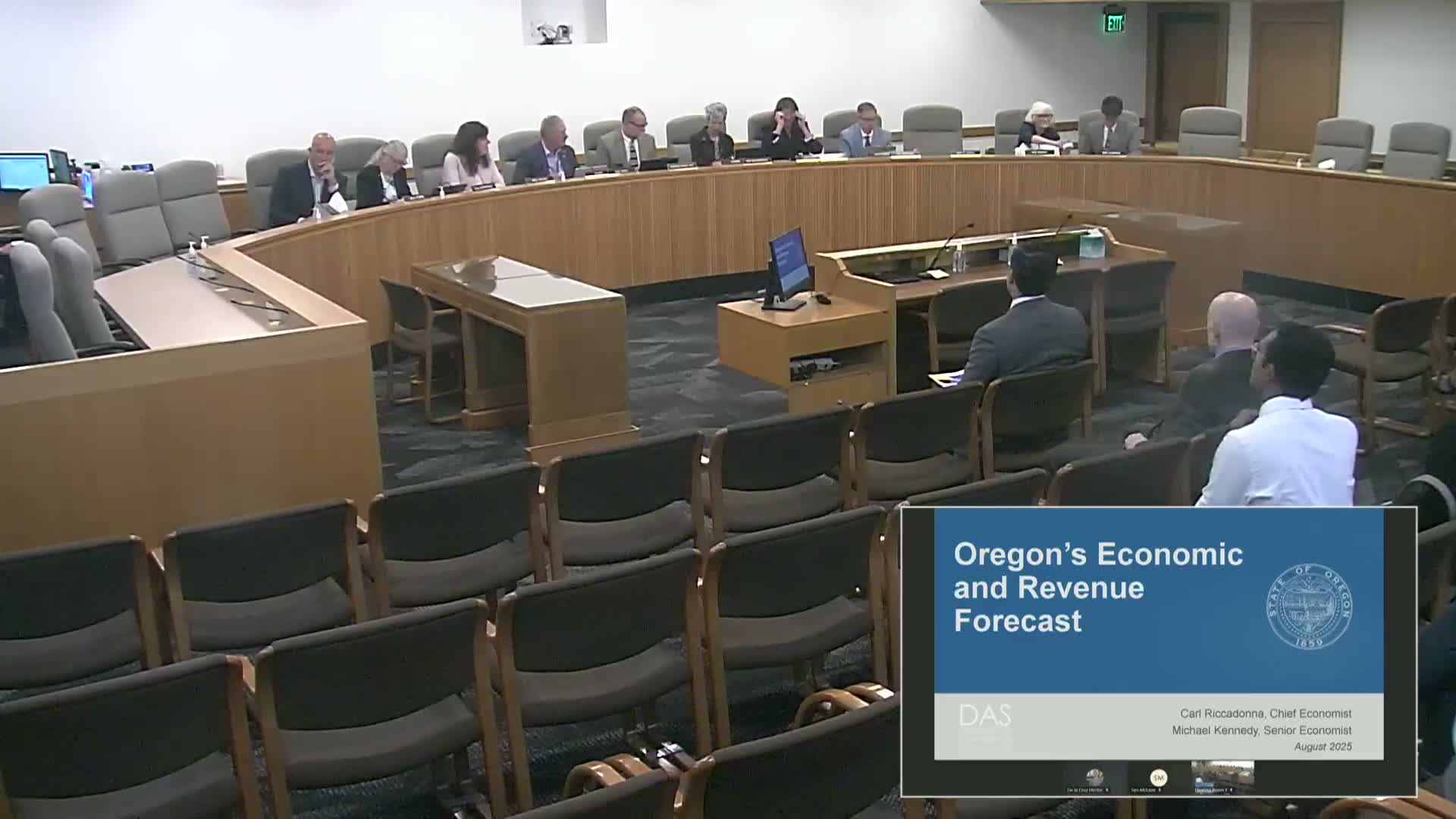
SALEM, Ore. — On Aug. 27 the House Committee on Revenue met jointly with the Senate Finance & Revenue Committee to hear the Office of Economic Analysis (OEA) update Oregon’s September economic and revenue forecast. OEA officials said the state’s revenue outlook has weakened by about $621 million and that Legislative Revenue Office scoring of federal tax changes (commonly referred to in the hearing as HR 1) shows an $888 million negative impact for the current biennium.
“The bottom line is that the ending balance has fallen $845,000,000,” OEA analyst Michael Kennedy said during the presentation, summarizing the combined effects of weaker closing‑biennium receipts and the changes fed through by HR 1. Chief economist Carl Riccadonna told the committees that while payroll revisions show a net loss of roughly 25,000 jobs over the past year, robust financial‑market gains (and resulting capital‑gains taxes) have helped offset some withholding shortfalls.
Why it matters: The forecast drives the state’s budget outlook and choices about reserves and spending. OEA and LRO staff told lawmakers that HR 1’s major provisions — including temporary exclusions for taxed overtime and tips, accelerated bonus depreciation and new R&D expensing — produce large near‑term revenue reductions because of timing and sunset rules, even though some provisions can raise activity later.
Key figures and mechanics: OEA and LRO quantified near‑term impacts and budget mechanics: a $621 million revenue shortfall relative to the prior forecast, an $845 million reduction in the projected ending balance for the biennium, and LRO’s current estimate of an $888 million negative impact from HR 1. Kennedy explained the “kicker” mechanics: because last biennium’s actuals came in lighter than expected, the kicker calculation feeding into the current biennium changed, freeing roughly $228 million back into the forecast even as HR 1 and economic changes exerted downward pressure.
Economic drivers: Presenters said tariff policy, which they described as a near‑term effective tax increase, and revised labor data were principal drivers of slower near‑term growth. Riccadonna framed the outlook as a “hockey‑stick” profile with additional slowing into late 2025 followed by a moderate rebound beginning in 2026, but he warned recession risk remains elevated: the consensus private‑sector probability of recession over the next 12 months was described as about one‑in‑three.
Scenarios and risk: OEA presented alternative scenarios. A mild recession would lower revenues about $2.4 billion relative to the baseline; a severe recession — which presenters assigned a roughly 2% probability — could reduce revenues by about $4.8 billion. OEA emphasized that large capital‑gains realizations in strong market years can materially affect volatility in Oregon’s revenue streams.
Distributional and policy questions: Committee members repeatedly asked who benefits from HR 1. OEA and LRO staff said certain provisions (overtime and tips exclusions) most directly benefit lower‑wage and working‑class households, while business provisions such as bonus depreciation affect investment timing and therefore shift revenue between years. LRO staff noted many of the largest individual provisions are time‑limited (four years for several personal‑income related exclusions), which explains a steep upfront fiscal hit that eases over time.
Data and next steps: OEA stressed data limitations. State labor and GDP series lag; OEA leans on national data for timelier signals and expects Q2 state statistics around Sept. 27. Staff told the committees that once 2025 tax returns arrive they will be able to reconcile and refine estimates and dynamic scoring; they emphasized tax‑return data (rather than survey or revised estimates) will be critical for correcting forecasts.
Other items: OEA flagged a decline in video‑lottery receipts (-$109 million impact for the biennium) and projected combined balances in the Education Stability and Rainy‑Day funds of roughly $3.4 billion (~9.8% of general‑fund revenues) after recent transfers and legislative actions.
What lawmakers said: Lawmakers pressed OEA on whether large, high‑profile transactions (for example, the sale of a professional sports franchise) are captured in the forecast; OEA said such transactions are case‑specific and depend on owner residency, basis and filing details and that they had not specifically modeled the Portland Trail Blazers sale. Several members warned that reshoring and manufacturing investment appear to be favoring other states and urged tracking business births, permit filings, and county‑level patterns.
Outlook: OEA and LRO said they will continue updating forecasts as additional state data and 2025 tax returns arrive; they also signaled LRO will release updated scoring for HR 1 and staff will monitor tax‑return evidence to revise dynamic effects. The committees adjourned without a vote.
Sources: Office of Economic Analysis presentation and Legislative Revenue Office scoring, presented to the House Committee on Revenue and the Senate Finance & Revenue Committee on Aug. 27, 2025. Direct quotes and figures are attributed to OEA chief economist Carl Riccadonna and OEA analyst Michael Kennedy as spoken in the hearing.