Get Full Government Meeting Transcripts, Videos, & Alerts Forever!
Get email alerts on the Regional Funding Models topic
No spam. Unsubscribe anytime.
Minnesota officials outline regional Adult Mental Health Initiative and equitable funding formula to Oregon task force
Summary
Minnesota Department of Human Services staff described AMHI, a regional Medicaid‑adjacent safety‑net that sends roughly $54 million a year to 19 regional mental‑health authorities and now uses an actuarial funding formula to distribute a larger statewide pool; Oregon lawmakers pressed presenters on eligibility, tribal participation and accountability for forensic cases.
Minnesota Department of Human Services officials told Oregon’s legislative task force on Oct. 6 that the state’s Adult Mental Health Initiative (AMHI) is a long‑standing regional safety net that sends roughly $54,000,000 a year to local mental‑health authorities and that the state recently adopted an equitable funding formula to distribute a larger funding pool across regions.
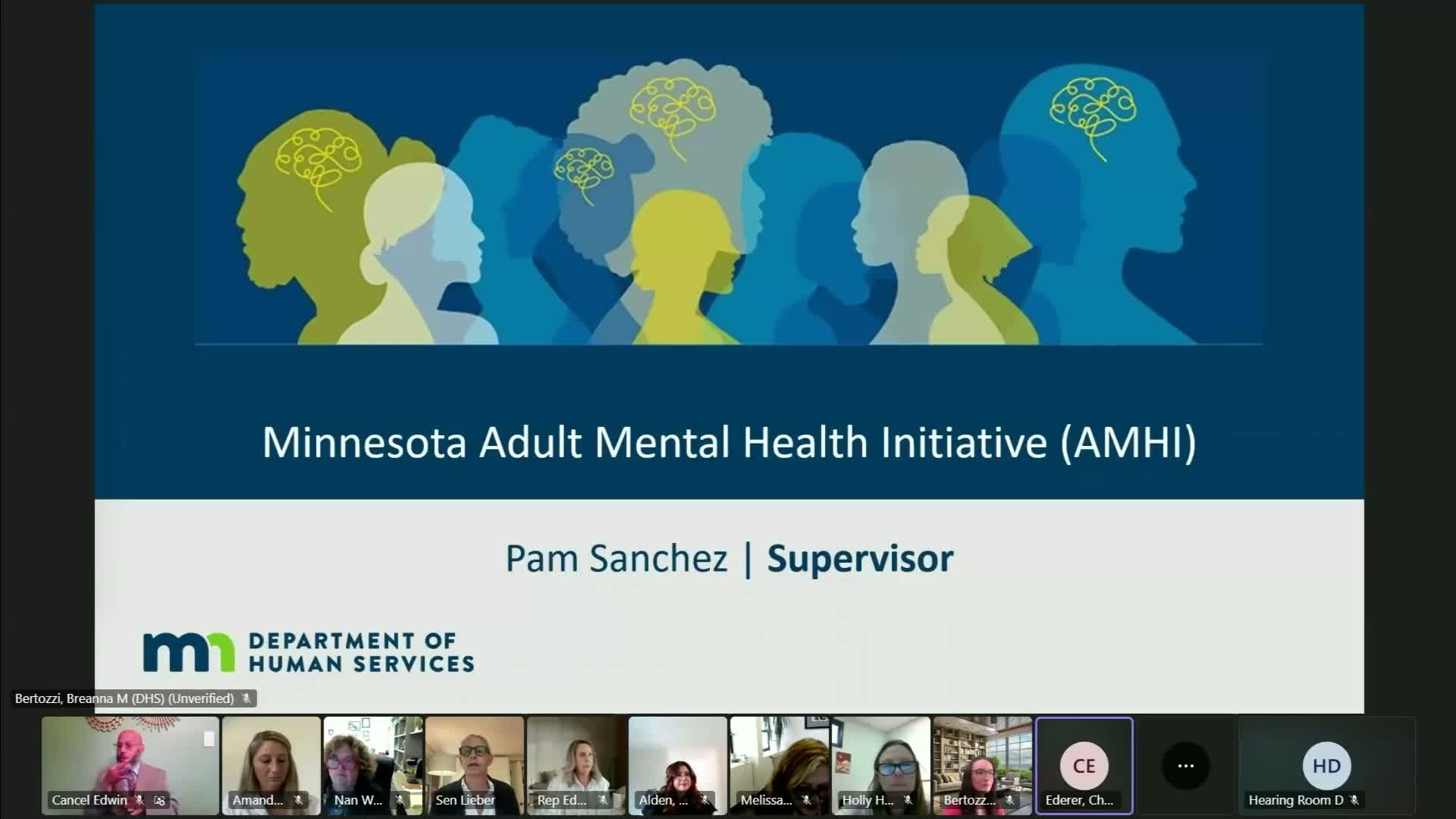
"It is a safety net, funding," Hannah Sanchez, supervisor for Minnesota’s Adult Mental Health Initiative, said during a 50‑minute overview of AMHI and how regions use their allocations. Sanchez said AMHI funds services that fall outside medical assistance or that serve people during benefit gaps, including people who are undocumented or newly engaging with services.
Sanchez described 19 AMHIs (single‑county, multi‑county regions and one tribal nation) and said regions are able to manage and disburse funds through a local fiscal agent. She said Minnesota implemented an equitable funding formula earlier this year that uses social‑determinant and population variables to allocate funds; in the presentation staff stated the methodology redistributed a large statewide pool across regions.
Presenters told the task force the AMHI model supports purpose‑built regional programs — for example, higher‑acuity residential or partial‑hospitalization programs — by letting regions prioritize services that local systems need but Medicaid will not pay for directly. The state also requires AMHIs to perform a gaps and needs assessment every two years and report results to the legislature.
Task force members asked specific questions about eligibility and regional selection. Senator Kate Lieber asked whether the AMHI focus is limited to people with severe and persistent mental illness; Sanchez confirmed that AMHI eligibility is targeted to SPMI under current statute and that any expansion would require legislative action. Sanchez added that regions largely organize themselves and may opt into regional arrangements that make sense for their local context.
The Minnesota presenters said the AMHI program has some tribal participation (one tribe currently) and that the state is working to increase tribal inclusion and to adapt funding practices to tribal evidence and community approaches. Sanchez also noted recent changes permitting some AMHI funds to cover court‑related work when providers are engaged in targeted case management or court proceedings — an operational change aimed at maintaining continuity of care for justice‑involved clients.
Minnesota officials cautioned that other states’ systems differ in important ways, especially inpatient capacity and statutory timelines governing competency and civil commitment. The presentation and subsequent Q&A highlighted tradeoffs Oregon members raised — including how to balance narrowly targeted supports for court‑involved populations with prevention and broader community services.
The Minnesota slide deck and supplemental materials will be provided to the task force and uploaded to OLIS, staff said. Task force members said they would use the Minnesota example as background while considering whether a narrower focus on SPMI or forensic populations would produce more feasible legislative recommendations by the December deadline.