Get Full Government Meeting Transcripts, Videos, & Alerts Forever!
Get email alerts on the Hb4086 Cecsb Jac topic
No spam. Unsubscribe anytime.
House panel reviews HB 4086 reports urging statewide trauma‑informed response to children exhibiting complex behaviors
Summary
Committee facilitators presented HB 4086 study findings that Oregon’s responses to children with complex/problematic behaviors are fragmented and inequitable and offered 20 specific recommendations including a statewide response pathway, statutory clarifications, and funding strategies.
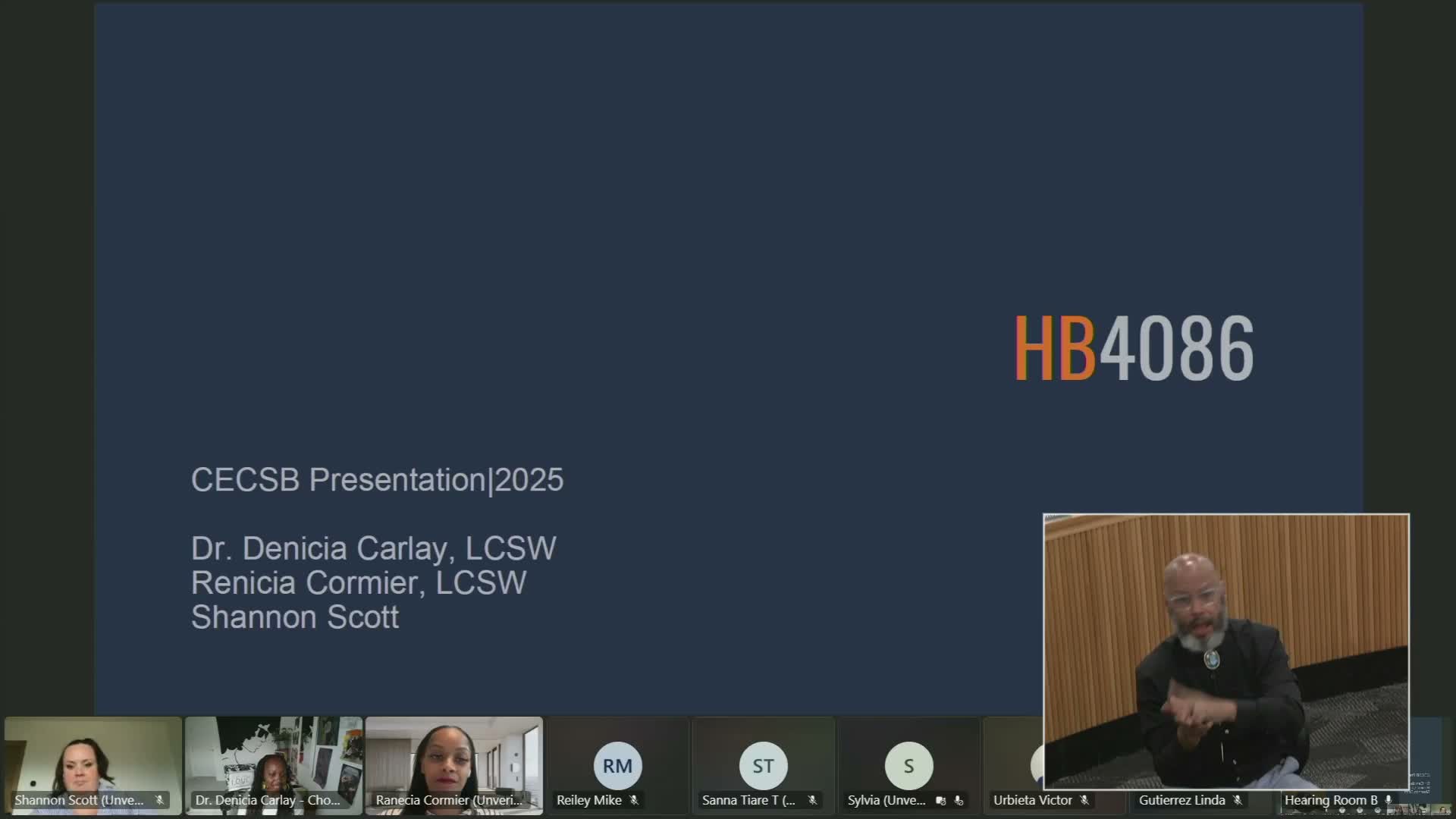
Committee facilitators for House Bill 4086 presented two interlinked reports on Sept. 29 calling for a coordinated, trauma‑informed statewide response to children exhibiting complex behaviors and for clearer jurisdictional rules in child abuse investigations.
Dr. Denisha Carley, a co‑facilitator, said the CECSB committee found inconsistent protocols across agencies and counties, scarce early prevention and significant data gaps. “Nationally the prevalence of PSB is difficult to quantify,” Carley said, and noted Oregon lacks a statewide cross‑system data system to measure prevalence and outcomes.
Shannon Scott and Renisha Cormier described the committee’s three‑part methodology: a state review of current responses, listening sessions with families and providers, and examination of national best practices. The committee’s top recommendations include: establishing a statewide response pathway with consistent intake and assessment protocols; investing in workforce and evidence‑based treatment (pilots then statewide rollout); standardizing CSB/PSB terminology in statute and policy; clarifying mandated‑reporting expectations; and creating an OHA‑led implementation task force with a phased roadmap and public reporting.
Presenters cited cost comparisons to justify prevention investments: one year of foster care costs roughly $30,000–$36,000 per child, juvenile‑justice placements can exceed $100,000 per youth, whereas evidence‑based treatment was estimated at $6,000–$10,000 per child with better outcomes, figures the presenters said are in their report.
Sylvia De Porto, facilitator for the Jurisdiction Advisory Committee (JAC), outlined 19 recommendations on the investigation side. The JAC suggested narrowing child‑welfare investigative scope so strangers and unrelated third parties are primarily handled by law enforcement, consolidating abuse definitions and disposition language in statute, expanding alternative referral pathways, and improving appeals, repositories and expungement procedures. The JAC also recommended studying a higher evidentiary standard (preponderance) for some dispositions while bolstering structured decision‑making and multidisciplinary teams to reduce harms from investigative activity.
Committee members asked for written follow‑up clarifying specific data points, historical payment/error charts and the alignment between the report’s recommendations and the bill’s original scope. Presenters said the full report contains 20 detailed recommendations and that some implementation actions could proceed administratively without immediate legislative change.
What happens next: presenters offered to provide supplemental data and slide decks; the committee said it will continue the topic in November legislative days and in the short session to resolve legislative follow‑ups and potential implementation planning.