Get Full Government Meeting Transcripts, Videos, & Alerts Forever!
Get email alerts on the Travel Oregon Oversight topic
No spam. Unsubscribe anytime.
Lawmakers Press Travel Oregon on Grants, Staffing and Executive Pay During Oversight Hearing
Summary
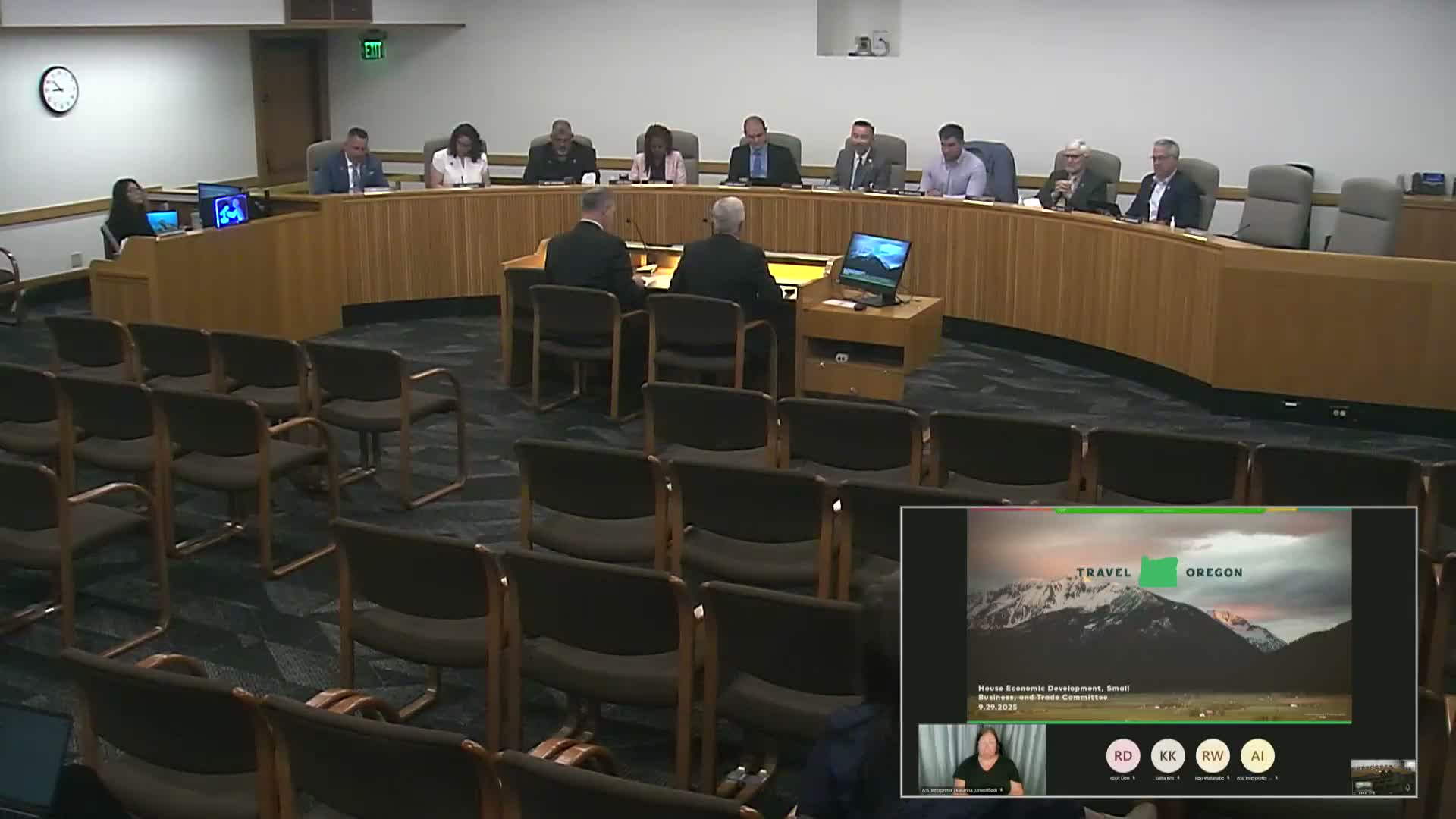
Travel Oregon officials outlined the agency's mission, a projected $24 million in regional grant payments and a biennial payroll of roughly $28 million; lawmakers pressed the agency on delayed grant disbursements, staff costs and CEO compensation during an informational hearing.
Travel Oregon officials told the House Interim Committee on Economic Development, Small Business and Trade that the agency’s mission is to "inspire travel that uplifts Oregon communities" and that its work is funded primarily through the state transient lodging tax. The agency highlighted a $24,000,000 special payments line for regional grants and said it expects slower revenue growth this biennium because of international and post‑pandemic market shifts.
Committee members focused questioning on accountability and spending. Representative Jeff Osborne asked how a biennial payroll figure of roughly $28,000,000 and a staff of 75 employees could produce an average "$186,000 per employee" figure. "How is it that you can spend $186,000 on average per person?" Osborne asked during the hearing. Travel Oregon responded that the figure is biennial and includes loaded payroll costs; the agency said some roles are market‑rate, competitive positions and pointed to the tourism sector’s overall economic impact to justify pay bands.
Lawmakers also raised delays in the agency's competitive grant cycle. In reply to questions about roughly $9,000,000 in small grants that were slow to be distributed, Travel Oregon said it repurposed staff to meet a separate, legislature‑directed $10,000,000 outfitter and guide grant with an accelerated reporting deadline, which deferred other grant activity into the next fiscal year.
Commissioner Scott Youngblood and CEO Todd Davidson defended the organization's oversight and measurement tools. Davidson noted Travel Oregon’s public KPI dashboard and county‑level economic tracking, while Youngblood described regular commission review of grants and budget decisions. Youngblood also said the former CEO’s base pay had been $365,000 and argued that tourism investment returns are substantial: "If you compare the entire revenue budget of $42,000,000 to $691,000,000 in state and local tax revenue generated as a direct result of tourism, that's a 15 to 1 ROI," he said.
Travel Oregon outlined strategies to reduce seasonal employment gaps by shifting marketing investment to shoulder seasons (fall, winter and spring) and by supporting community projects through regional cooperative tourism programs. The agency said its public dashboard (industry.traveloregon.com) holds performance data and strategic plan progress reports.
The committee recorded a commitment to follow up. Members asked Travel Oregon to return for additional, more detailed oversight and indicated budget and compensation questions would be examined by both policy and budget committees in the coming months.