Get Full Government Meeting Transcripts, Videos, & Alerts Forever!
Get email alerts on the Transmission And Interconnection topic
No spam. Unsubscribe anytime.
Lawmakers hear that transmission and interconnection bottlenecks threaten Oregon’s renewable procurement goals
Summary
Renewable Northwest and corporate buyers told the committee that permitted projects are awaiting transmission and interconnection; developers cite BPA queue backlogs, wildfire liability and permitting complexity as primary barriers to meeting HB 2021 procurement targets and federal tax-credit deadlines.
Renewable Northwest and corporate buyers told legislators that a shortage of near-term buildable capacity and transmission constraints are a central barrier to meeting Oregon’s clean-energy mandates.
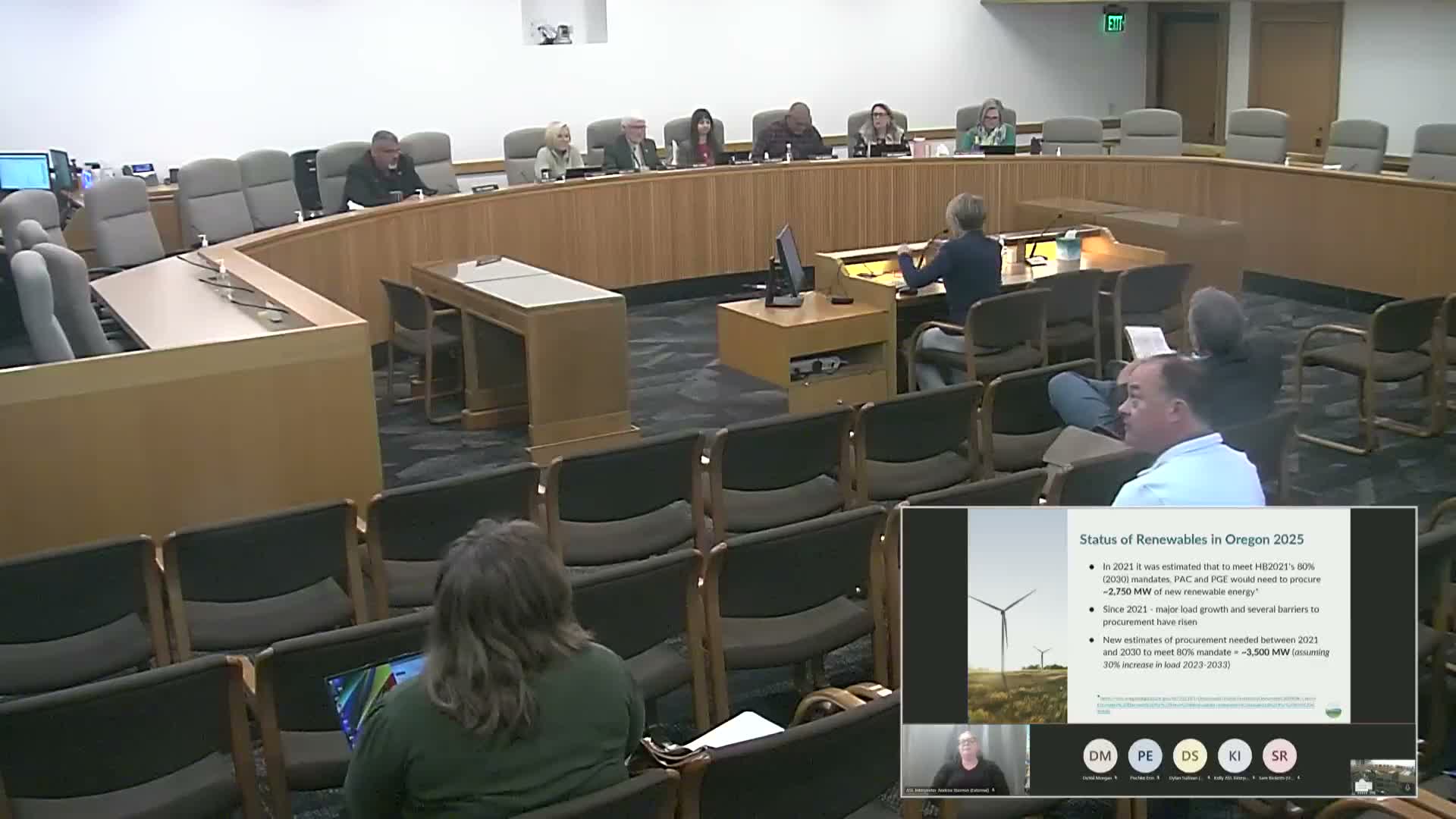
Nicole Hughes, Executive Director of Renewable Northwest, estimated that Oregon may need about 3,500 megawatts of new renewable generation between 2021 and 2030 to meet an 80% standard and said roughly 2,800–3,000 MW of projects have state permits but face delays because transmission upgrades are not scheduled until near 2030. Hughes said those permitted projects are unlikely to be built before federal tax-credit phaseouts unless transmission and interconnection queues move faster.
Dylan Sullivan, Google’s lead for energy policy in the West, described the buyer perspective: strong demand exists for clean capacity but supply and transmission expansion lag. Sullivan said Google has invested in regional projects and pays for necessary interconnection and transmission costs, but the market’s limited supply and queue friction make procurement difficult.
Nicole Hughes and other presenters identified three structural barriers: (1) a long backlog in the Bonneville Power Administration interconnection queue, (2) wildfire-liability concerns that affect utilities’ off-take and financing, and (3) permitting complexity with appeals that extend timelines.
Committee members discussed whether streamlining state permitting or encouraging utilities to expedite interconnections would help; Renewable Northwest suggested state coordination with utilities, targeted financing and fast-track siting as near-term mitigations.