Get Full Government Meeting Transcripts, Videos, & Alerts Forever!
Get email alerts on the Solar Industry topic
No spam. Unsubscribe anytime.
Solar installers warn of layoffs after federal residential tax credit ends
Summary
Installers told the committee that the federal residential solar tax credit’s elimination and tighter commercial-start rules will create a sharp post-deadline drop, putting thousands of installer jobs at risk and prompting requests for a state 'soft landing' rebate program.
Installers and industry groups told the House interim panel that the end of the federal residential tax credit and the rapid changes to commercial tax-credit rules are producing an immediate business shock that could cost jobs across Oregon.
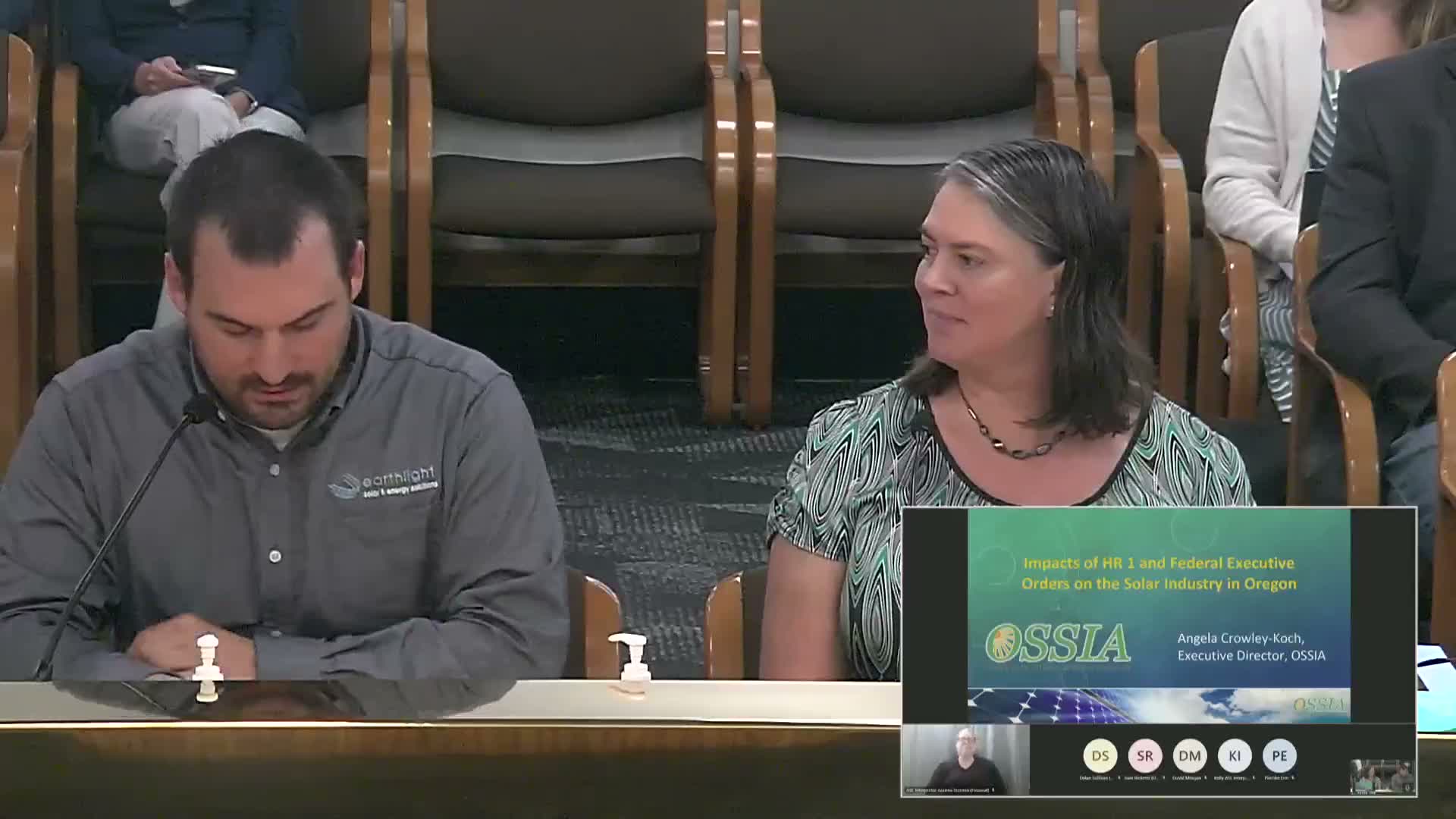
Tristan Kinsey, director of sales and operations at Earthlight Technologies, described a surge in sales after the federal change was announced and said the company is now at a "cliff," with install schedules full for the year and an expectation he may need to lay off 10–15 employees. Kinsey said most Oregon residential solar customers are moderate to middle income and rely on the tax credit to make systems affordable.
Angela Crowley Cook, executive director of the Oregon Solar and Storage Industries Association (OSEA), reiterated industry estimates that thousands of jobs could be lost statewide and urged lawmakers to fund a refill or replacement of the state solar and storage rebate program administered by the Oregon Department of Energy as a short-term measure to soften the transition.
Janine Benner of ODOE and other presenters clarified timing: residential systems generally must be installed by Dec. 31, 2025 to claim the residential credit; smaller commercial projects under 1.5 MW may meet a 5% investment-start test by July 4, 2026; larger projects generally must 'commence construction' earlier to qualify. Witnesses also warned that foreign-entity-of-concern rules and supply-chain constraints are complicating procurement and causing some shipments to be delayed or canceled.
Lawmakers did not vote on a remedy at the hearing, but industry witnesses urged the committee to consider a targeted state rebate or other short-term funding to mitigate layoffs and maintain access for moderate-income customers.
If lawmakers take up a soft-landing rebate, ODOE and OSEA asked to be consulted on program design to ensure statewide reach beyond the largest investor-owned utility territories.