Get Full Government Meeting Transcripts, Videos, & Alerts Forever!
Get email alerts on the Veterans Behavioral Health topic
No spam. Unsubscribe anytime.
OHA details Measure 96 spending for veterans behavioral health, cites reporting gaps and administrative limits
Summary
Oregon Health Authority officials told the House committee how Measure 96 lottery dollars have been allocated to veteran behavioral‑health grants since 2019, explained that funds go to grants and contracts (not OHA administrative costs), and said outcome reporting and staffing remain areas for improvement.
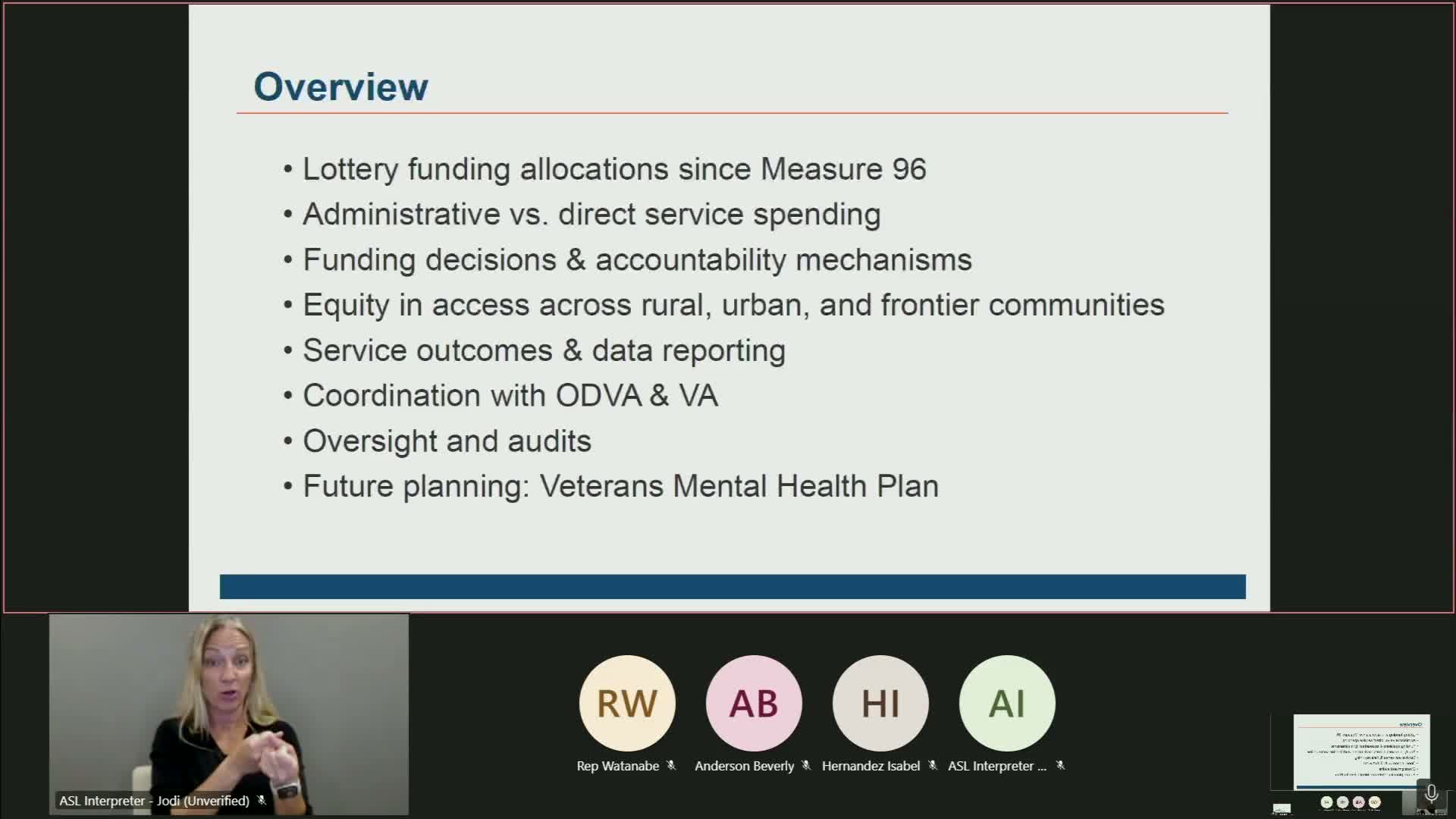
Oregon Health Authority officials briefed the House Interim Committee on Emergency Management and Veterans on Sept. 29 about how Measure 96 veteran‑dedicated lottery funds have been used. Dr. Krista Jones, deputy director of OHA’s Behavioral Health Division, and Susan Davis, the Veteran and Military Behavioral Health liaison, outlined allocations and program practices.
OHA reported allocations to OHA’s Veteran and Military Behavioral Health (VBH) Program of $2,500,000 in the 2019–21 biennium, $2,100,000 in 2021–23 and $2,200,000 in 2023–25. Officials said those dollars have been used for competitive grants and direct awards to veteran‑serving organizations to fund peer‑support certification, suicide‑prevention training, pilot caregiver programs, clinical services in underserved areas and other programs. OHA said allocation decisions use panels of subject matter experts and that direct awards are used when competitive options are limited by geography or service type.
OHA told the committee that VBH allocates funds to grants and contracts and does not use the Veterans Services Fund dollars to pay the program’s administration. Grantees’ contracts cap administrative expenses at 10 percent, with tribal grants using federally negotiated indirect cost rates. OHA acknowledged limited internal staffing (about 1.5 FTE in the VBH program) and said reporting and outcome tracking need strengthening; some earlier biennia were affected by reduced reporting requirements. Officials said they would follow up with the committee on past biennial allocations and on how many applicants typically apply to VBH competitions.
Committee members asked whether peer support leads veterans to clinical care. OHA said peer support is an evidence‑based adjunct to clinical care that supports engagement and retention in treatment but is not itself a clinical therapy. OHA also said it would be open to studying a consolidated veterans mental and dental health plan but that designing such a defined‑benefit plan would require actuarial analysis and legislative direction.
OHA noted the existing Veterans Dental Health Plan as a model for centralized benefit design and reiterated its willingness to work with the Legislature and ODVA on feasibility, data systems and potential future direction.