Get Full Government Meeting Transcripts, Videos, & Alerts Forever!
Get email alerts on the Adaptive Reuse topic
No spam. Unsubscribe anytime.
Experts pitch office‑to‑residential co‑living conversions as lower‑cost option; code and retrofit hurdles cited
Summary
Pew and land‑use experts told the committee office‑to‑residential conversions and co‑living micro‑units could produce lower‑cost housing and stretch subsidies, but they identified seismic retrofit rules, building‑code incompatibilities, parking and minimum unit size mandates and rent‑control uncertainty as key barriers.
The Senate Interim Committee on Housing and Development heard Sept. 29 from national researchers and local attorneys on converting office and commercial buildings to residential uses, including co‑living and micro‑unit models.
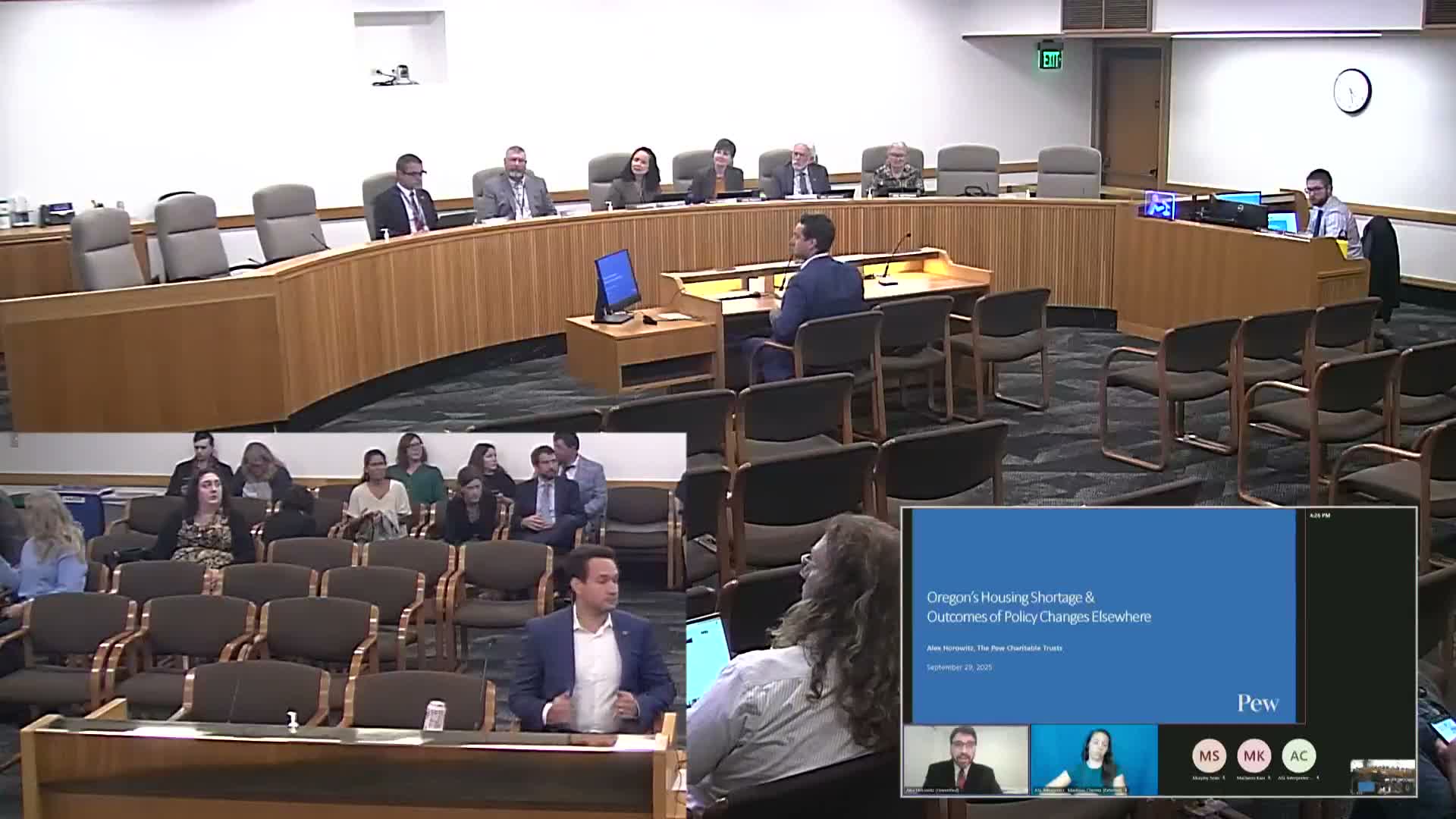
Alex Horowitz, director of the Housing Policy Initiative at the Pew Charitable Trusts, presented Gensler‑designed floor plans and cost comparisons for co‑living conversions. He said the U.S. housing shortage has driven prices up — "half of renters spending more than 30% of income on rent, a quarter spending more than 50%" — and argued that adaptive reuse can add lower‑cost units near jobs and transit. Horowitz showed examples (Denver, Chicago, Washington, D.C.) where deep floor plates and centralized plumbing enable compact rooms with shared core bathrooms and kitchens, producing many more rentable units per floor than typical apartment conversions and reducing conversion cost per square foot by 25–35 percent in his models.
Ezra Hammer, a land‑use attorney with Jordan Ramis, described three broad impediments to conversions: onerous earthquake retrofit standards and the cost of seismic upgrades; lenders’ caution in underwriting untested unit types and resulting financing risk; and numerous zoning and building‑code requirements that create many variance and exemption touchpoints (historic preservation, window operability, height/setbacks, parking). "These regulations are well intentioned," he said, "but there are real costs associated with that." He recommended a statewide look at retrofit standards, targeted building‑code relief focused on life‑safety, and clarification on how rent‑control rules apply to conversions so capital can underwrite projects with certainty.
Committee members asked whether the cost examples assumed prevailing wage; Horowitz said the slide estimates did not assume prevailing wage and therefore could change if public funding triggered prevailing‑wage requirements. Both presenters said some upfront subsidy is likely needed to make many conversions financially feasible, but that subsidy dollars could stretch further under co‑living than under conventional apartment development.
No formal votes were taken. Senators indicated interest in additional detail on retrofit standards, prevailing‑wage interactions with subsidy programs, and local examples of successful conversions.