Get Full Government Meeting Transcripts, Videos, & Alerts Forever!
Get email alerts on the Islanding Resilience topic
No spam. Unsubscribe anytime.
ODOT, Portland officials and researchers warn islanding risks; funding and triage approaches emphasized
Summary
ODOT and Portland emergency‑management officials told the House committee islanding can arise from earthquakes, landslides, extreme storms and wildfire; speakers emphasized a triage approach, targeted corridor hardening, cross‑agency planning and gaps in funding for bridge replacements and prevention work.
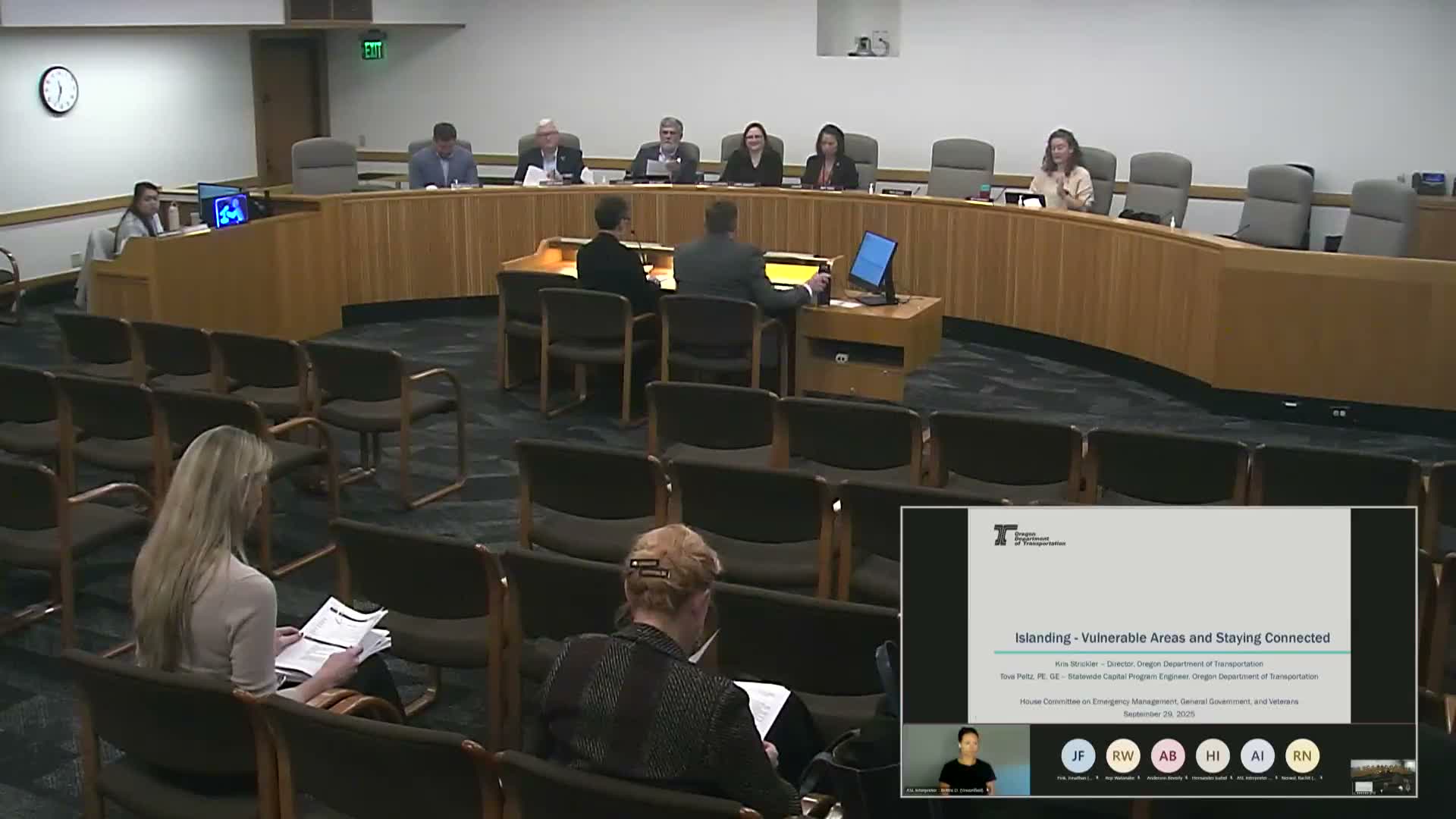
State transportation and emergency‑management officials told the House Interim Committee on Emergency Management and Veterans on Sept. 29 that ‘‘islanding’’ — when communities are cut off from essential services — can arise from earthquakes, landslides, floods and wildfires, and that Oregon must set priorities because it cannot harden every route.
ODOT Director Chris Strickler and statewide capital program engineer Tova Peltz described a two‑pronged strategy that combines prioritized corridor hardening (the agency’s seismic triage program and targeted bridge replacements) with planning and operational preparedness for response and recovery. Peltz cited ODOT’s 2021 seismic implementation plan and the Southern Oregon Seismic Triage Project as examples, and said a future phase would include triage investments on routes such as OR‑99W between Portland and Eugene; she noted seven bridge replacements tied to that phase are planned but not yet funded.
Portland Bureau of Emergency Management Chief Resilience Officer Richard Narwal and Portland Bureau of Transportation planners presented city maps showing liquefaction and critical‑facility vulnerabilities and said multi‑agency coordination is required where bridges, rail and water lines cross jurisdictional boundaries. Narwal highlighted neighborhood volunteer emergency teams and two‑week readiness programs as near‑term resilience measures and said the city is evaluating ShakeAlert, an earthquake early‑warning system.
Jonathan Fink, a geology professor, told the committee wildfire is an ‘‘equally serious’’ islanding hazard for many urban and rural communities because fires can both prevent aid from entering and block evacuation. Fink said wildfire risk is increasing with climate change and recommended redundant evacuation routes, prestaging during forecast windows and clearer coordination among municipal, state and federal firefighting assets.
Committee members asked about fuel distribution after an event and whether airports could be re‑supplied for evacuation. ODOT said large stockpiles are positioned along inland corridors such as US‑97 and in Eastern Oregon and that in an emergency fuel would be prioritized for fire and life‑safety uses. Several presenters stressed that prevention work takes longer and costs more over time, and that funding constraints are the principal barrier to faster progress.
The presenters urged the Legislature to support cross‑agency planning, to fund early design and local matching for bridge projects where multiple owners (state, city, railroad) complicate capital grants, and to consider more robust monitoring and outcome data for recovery planning. The informational session closed with committee members thanking presenters and requesting follow‑up on specific funding and interagency coordination questions.