Get Full Government Meeting Transcripts, Videos, & Alerts Forever!
Get email alerts on the School Safety topic
No spam. Unsubscribe anytime.
Oregon’s school‑safety systems, threat assessment model and grants outlined to Senate committee
Summary
LPRO and ODE officials briefed the Senate committee on statewide school‑safety work: the Safe Oregon tip line, the Salem cascade behavioral threat assessment model, ESD‑based specialists and grant programs for panic alarms and prevention, plus requests for follow‑up on floor‑plan security and seismic issues.
The Senate Interim Committee on Education concluded its Sept. 29 hearing with briefings on Oregon’s school‑safety infrastructure, behavioral threat assessment capacity and grant programs available to districts.
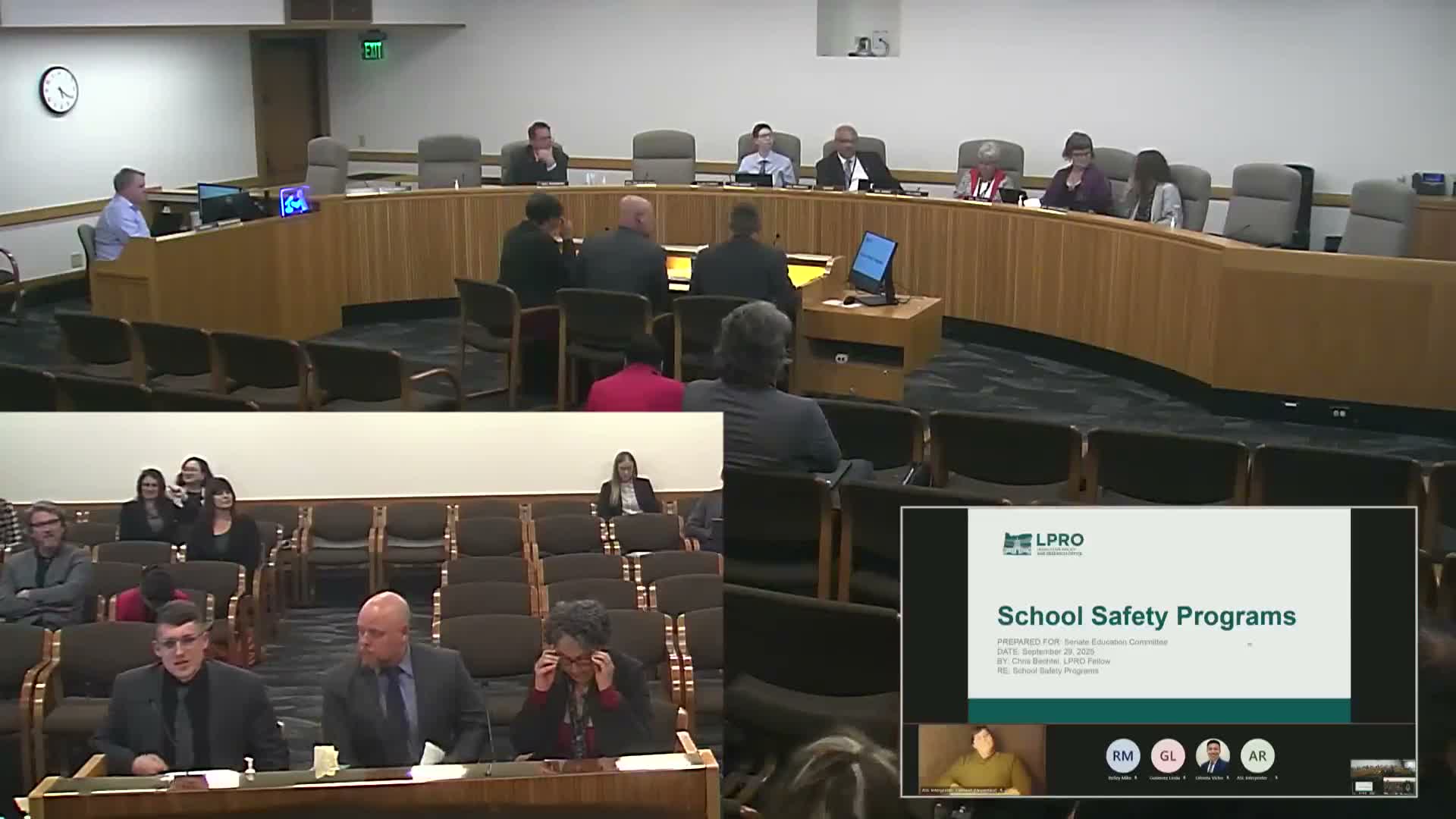
Chris Bechtel of the Legislative Policy and Research Office summarized the School Safety Task Force’s origins (created by HB 4,087 in 2014) and its recommendations: a statewide tip line (Safe Oregon), standardized incident response terminology, an inventory of school floor plans and a statewide assessment program. He reviewed statutes enacted since 2014 that require districts to consider panic‑alarm systems and to provide electronic communications to families during safety incidents.
Katia Mosley (ODE) and Alex Hayslip (program manager, School Safety & Emergency Management Program) described ODE’s coordinated approach: a School Safety and Emergency Management Program that provides regional coordinators, a School Safety and Prevention System that implements multi‑disciplinary behavior safety assessments (the state’s model is the Salem cascade), and an ESD‑based network of specialists who perform level‑2 assessments and support schools. Mosley said the model focuses on identifying situations — not labeling students — and ODE is working to infuse equity, cultural responsiveness and restorative practices into assessments.
Hayslip described on‑the‑ground support: four regional staff, visits to about 40 districts this year, tabletop exercises with county emergency managers and ongoing technical assistance. ODE noted the program has increased capacity for level‑2 assessments through ESSER funding and a regional learning collaborative that helps districts share practice and billing tools for school‑based Medicaid.
Senators asked for written follow‑up on whether floor plan inventories could be made public, how safety plans intersect with the governor’s cell‑phone executive order and how seismic vulnerabilities are being addressed. The committee also emphasized the need for sufficient investigatory capacity at TSPC (Teacher Standards and Practices Commission) to respond to educator‑related safety allegations.
The hearing closed with Chair Frederick thanking staff and presenters and adjourning for caucuses.