Get Full Government Meeting Transcripts, Videos, & Alerts Forever!
Get email alerts on the HR1 K12 Nutrition topic
No spam. Unsubscribe anytime.
Oregon officials warn HR 1 could shrink direct certification, strain school meal programs and chip away at early‑intervention Medicaid funding
Summary
State education, health and human services officials told the Senate committee HR 1’s SNAP and Medicaid changes may reduce direct certification, put Community Eligibility Provision participation at risk and reduce billing revenue for school‑based Medicaid services, with potential immediate and long‑term effects on children's nutrition and services.
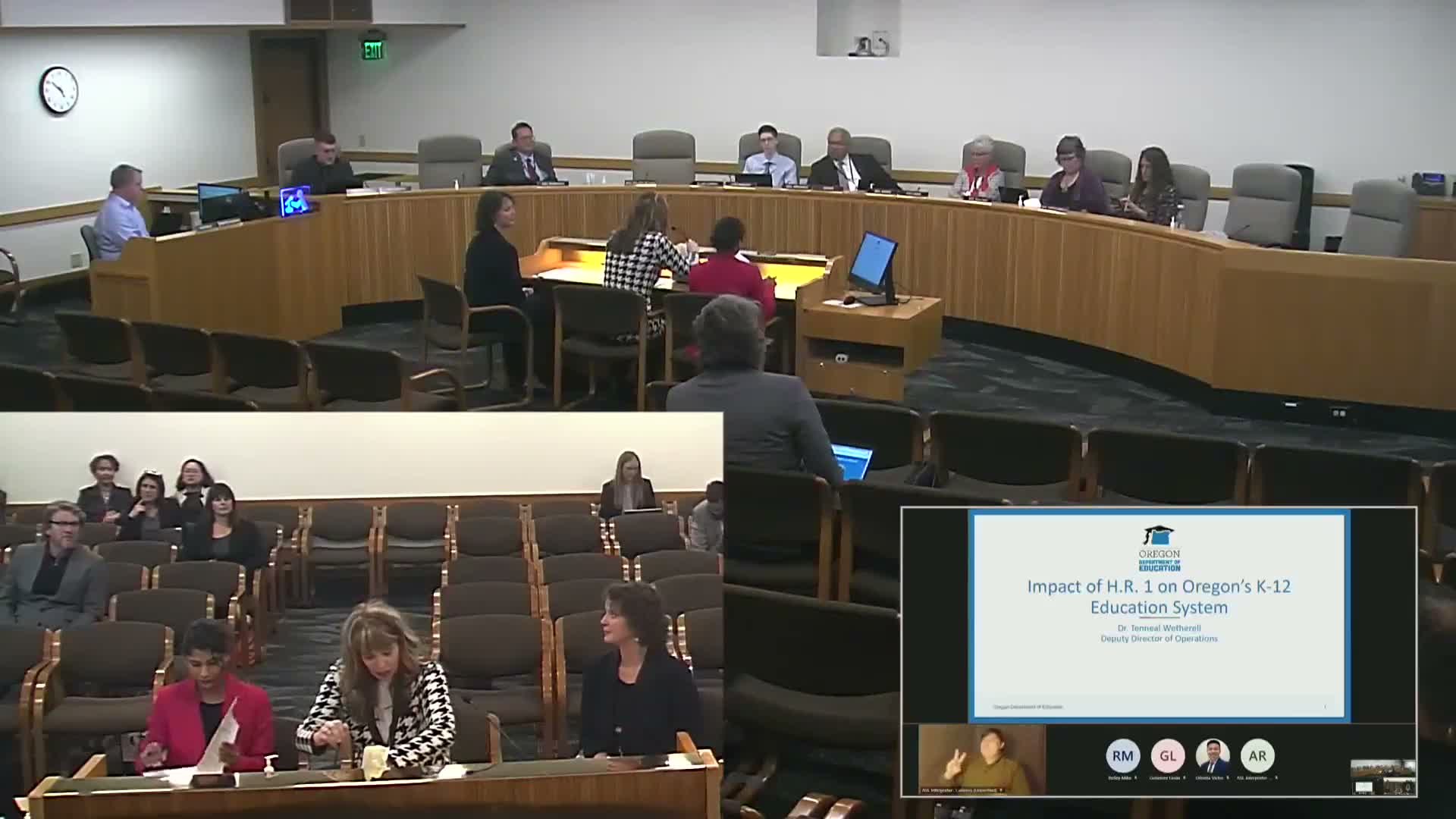
State officials told the Senate Interim Committee on Education on Sept. 29 that changes to SNAP and Medicaid in the federal reconciliation bill will carry immediate and long‑term consequences for school nutrition, school‑based health services and early intervention in Oregon.
Teneal Weatherall (Deputy Director of Operations, Oregon Department of Education) explained how direct certification — the automated match of student enrollment with SNAP, TANF, foster care and Medicaid records — drives automatic eligibility for free or reduced‑price school meals. "If a child shows up in these records, they are directly certified and automatically eligible for free or reduced price meals," Weatherall said, and she warned that reductions in SNAP or Medicaid eligibility could mean fewer children are picked up by the matching process, which would increase paperwork for families and could reduce access to meals.
Rusha Grinstead (Medicaid policy manager, Oregon Health Authority) described school‑based Medicaid (direct services and administrative claiming), noting Oregon has expanded billable providers to include counselors, school psychologists and social workers and that 90 education agencies now participate in some form. She said reductions in Medicaid eligibility or reimbursement would directly reduce reimbursements that fund services for infants, toddlers and students with special needs, and could force programs to shift limited funds, reduce staff, or curtail service frequency.
Jessica Amaya Hoffman (Deputy Director for Self Sufficiency, Department of Human Services) presented Oregon SNAP figures and HR 1 impacts: about 757,000 Oregonians (roughly 18% of the state population) participate in SNAP, and 54% of SNAP recipients are children. She listed HR 1 changes that will affect Oregon: a cost‑neutral requirement for the Thrifty Food Plan reevaluation (making benefit increases unlikely), elimination of the federal SNAP Education & Obesity Prevention grant, counting some utility assistance as countable income (an estimated benefit loss averaging $58 per month for about 29,000 households) and a change in immigration eligibility that will remove roughly 3,000 individuals from SNAP beginning Nov. 1. Hoffman and Weatherall warned that these changes could shrink Community Eligibility Provision (CEP) participation and undermine summer EBT and other nutrition programs.
Officials said ODE will recertify CEP sponsors in 2026 to lock in participation percentages through 2030, a stopgap measure to protect near‑term meal access. But they cautioned that program eligibility changes that take effect in later years could erode CEP eligibility at recertification and force schools and families to complete application paperwork again.
Senators expressed alarm over the child‑nutrition impacts and requested geographic breakdowns and maps showing district‑level exposure. Committee members argued that loss of SNAP access is a policy choice with consequences for child safety and education outcomes.
Presenters recommended continued coordination between ODE, OHA and DHS to model impacts and prepare mitigation plans; the committee asked for written follow‑up on specific implementation questions, including whether floor plans or certain safety details would be made public and how school safety plans intersect with other executive directives.
No committee votes were taken; senators requested additional data and follow‑up analysis to inform policy options.