Get Full Government Meeting Transcripts, Videos, & Alerts Forever!
Get email alerts on the HR1 Snap Impacts topic
No spam. Unsubscribe anytime.
ODHS warns HR1 changes could remove SNAP benefits for tens of thousands and shift admin costs to state
Summary
Oregon Department of Human Services told the subcommittee that HR1 will enlarge SNAP work requirements, change exemptions and shift administrative costs to states; ODHS estimates 310,000 adults will be reviewed, an illustrative $347 million in household benefit loss over the biennium and increased state SNAP admin costs.
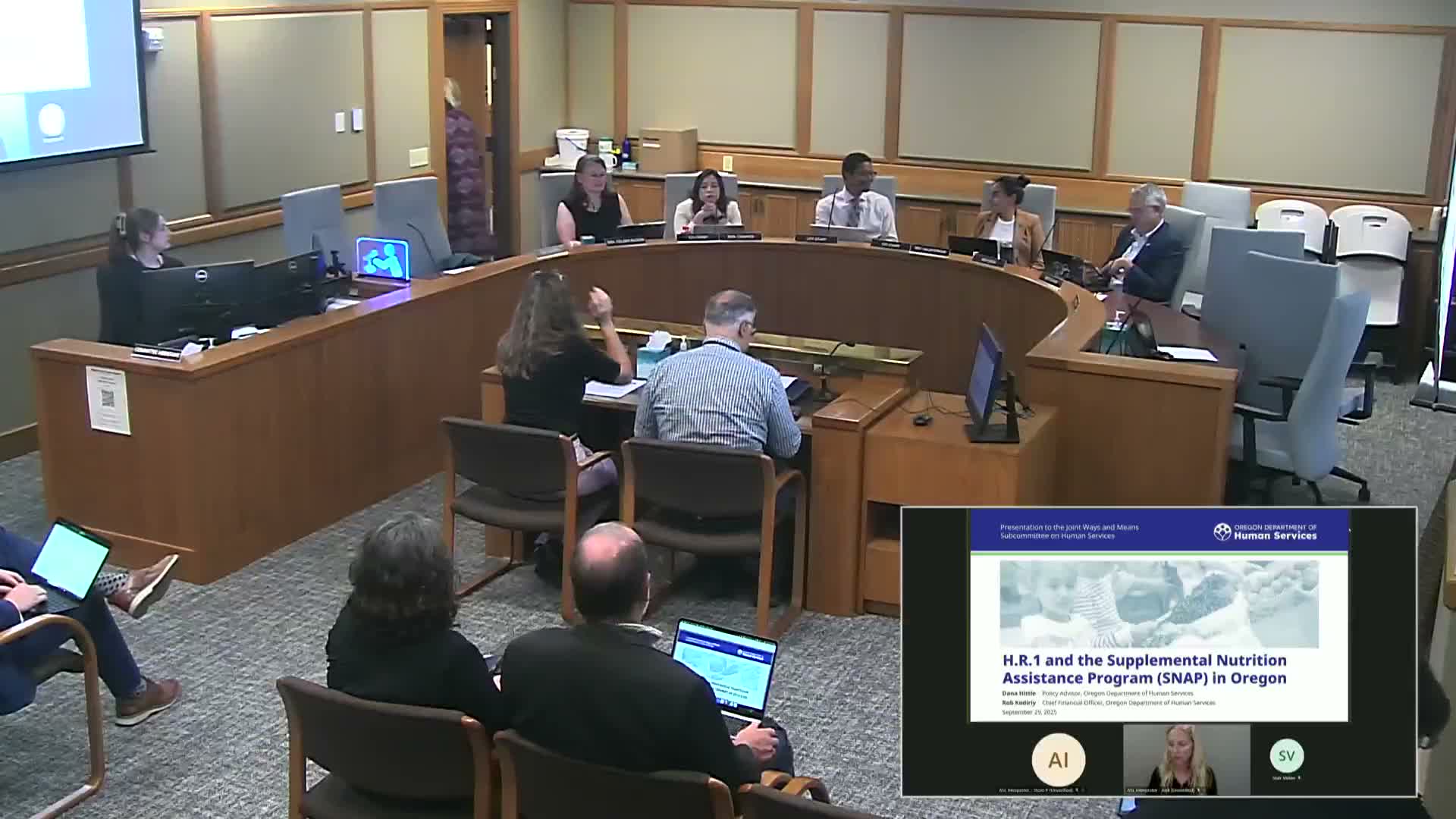
Oregon Department of Human Services officials told the Interim Joint Subcommittee on Human Services on Sept. 29 that HR1 will alter SNAP eligibility and funding in ways that could reduce benefits for many Oregonians and increase state administrative burdens.
Dana Hittle, senior advisor at ODHS, opened the department’s presentation by describing joint ODHS–OHA governance and coordinated work streams to implement HR1. "In Oregon, the SNAP program helps 757,700 Oregonians put food on their tables," Hittle said, noting how widespread SNAP participation is across rural counties and vulnerable groups.
Rob Kadiri, ODHS chief financial officer, and Maior Salar, who manages Oregon’s SNAP program, outlined preliminary estimates and mechanics: ODHS identified roughly 310,000 SNAP participants aged 18–64 who will be reviewed for new work requirements; using historical non‑exemption rates and average monthly benefits, the agencies calculated an illustrative biennial reduction in benefits of $347,000,000 if affected participants lose SNAP over the period. Kadiri also described administrative impacts: a prorated SNAP administration cost shift this biennium of up to $95,000,000 and an estimated ongoing administrative increase of about $125,000,000 annually, together with a potential payment‑error cost share that could reach hundreds of millions depending on Oregon’s Quality Control payment error rate.
On program specifics, ODHS said HR1 raises the upper age for able‑bodied adults without dependents (ABODs) from 55 to 65, reduces the dependent‑age threshold to under 14, and narrows waiver eligibility by using county‑level unemployment thresholds; ODHS estimated that approximately 310,000 adults will require screening and that historically 20–30% of those reviewed may not meet exemptions.
Maior Salar clarified a key administrative question about retroactivity and repayments: because agencies did not have the required screening in place between July 4 and Sept. 30, "there will be no overpayments to pay back of snap benefits" and there will be no counting months applied for that period, the manager said. Salar added that starting Oct. 1, case screenings will be part of certification and recertification interactions.
Budget and risks: Rob Kadiri framed major uncertainties as pending federal guidance, staggered effective dates (July 4, Oct. 1, Oct. 1, 2026 and beyond), and the potential for long‑term cost shifts to state budgets. He said ODHS is preparing an implementation investment plan and emphasized that payment error rate dynamics are a key financial risk: if the QC error rate exceeds set thresholds, the state could face substantial cost shares.
What’s next: ODHS said it will continue joint work streams with OHA, finalize analyses of overlapping SNAP and Medicaid impacts, produce written answers to committee questions and provide more precise budget and population estimates in October.
Source and attribution: Figures and direct quotations above are taken from ODHS testimony before the Interim Joint Subcommittee on Human Services on Sept. 29, 2025. Presenters included Dana Hittle (senior advisor), Rob Kadiri (CFO) and Maior Salar (SNAP program manager).