Get Full Government Meeting Transcripts, Videos, & Alerts Forever!
Get email alerts on the HR1 Highered Loans topic
No spam. Unsubscribe anytime.
Committee hears HR 1’s higher‑education and student‑loan changes could reshape borrowing and accountability
Summary
NCSL and Oregon regulators told the Senate Education Interim Committee HR 1 will reshape SNAP/Medicaid links to schools, create a federal scholarship tax credit states may opt into, expand Pell to short workforce programs and add new student‑loan limits and repayment rules; Oregon officials warned of significant implementation and borrower confusion.
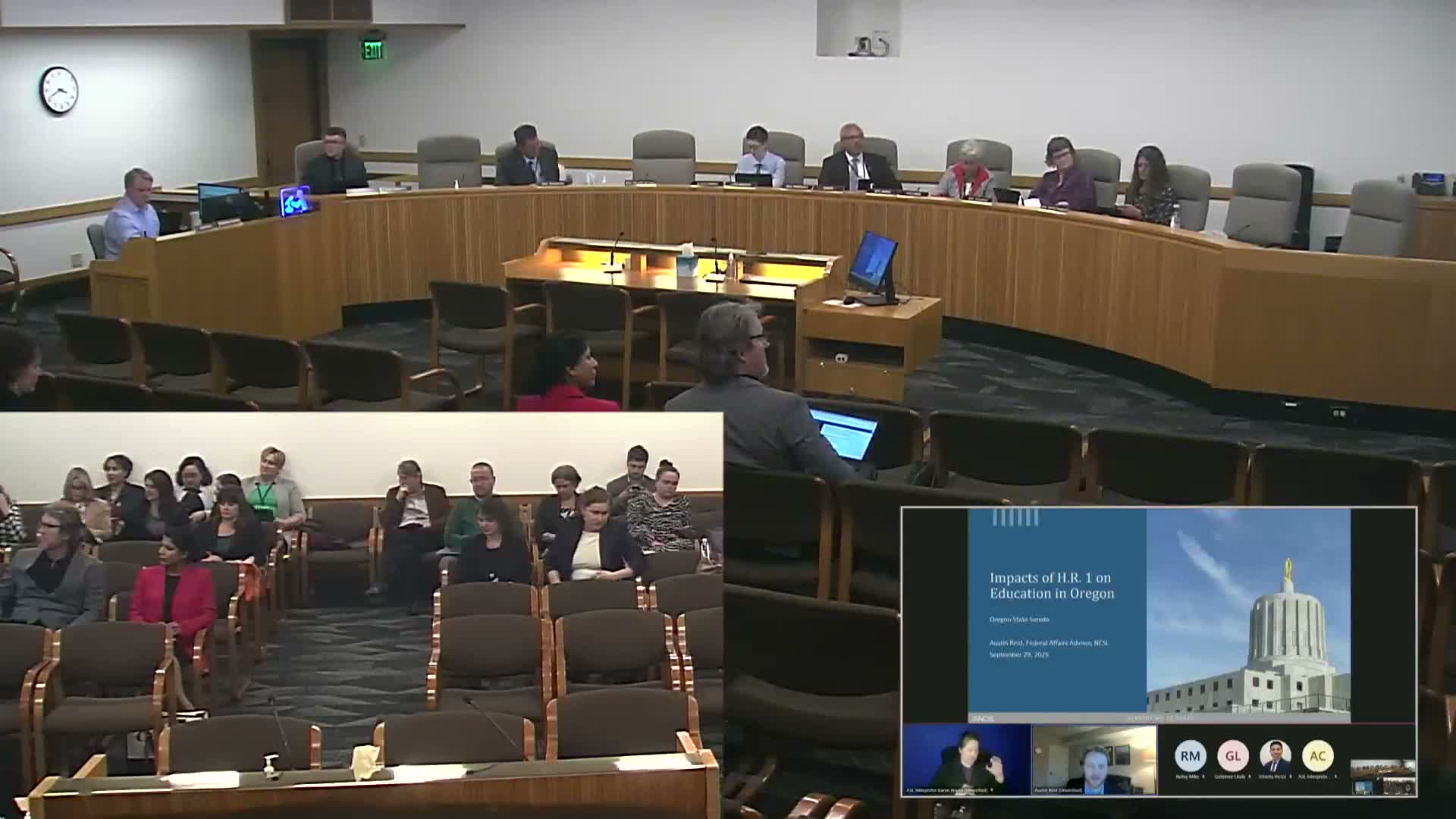
On Sept. 29 the Senate Interim Committee on Education received a detailed briefing on the national reconciliation measure known in Congress as HR 1 and how its provisions could affect Oregon students, postsecondary institutions and borrowers.
Austin Reed of the National Conference of State Legislatures (NCSL) summarized the federal bill’s scale and its education‑sector implications, saying the Congressional Budget Office estimates roughly $3.4 trillion of deficit impact over 10 years and identifying Medicaid, student loans and SNAP as major areas of change. He described three education policy elements with direct state implications: a new federal scholarship tax credit, expansion of Pell for short workforce programs ("workforce Pell") and sweeping student‑loan reforms.
On scholarship tax credits, Reed said the federal credit could allow individual donors a tax credit up to $1,700 for donations to scholarship granting organizations; federal eligibility could cover families up to 300% of area median income and might reach roughly 90% of the student population in some areas. He emphasized states must opt in and create lists of eligible scholarship granting organizations and that regulatory guidance from the U.S. Treasury will determine how much discretion states will have in setting eligibility criteria.
Reed said workforce Pell would permit Pell awards for short, 8–14 week workforce programs and creates a significant state role: governors and state workforce boards will have authority to identify programs that meet federal criteria for job placement and credentials. The NCSL presenter warned the program’s implementation timeline is compressed and states may have only a few months after final federal rules to identify eligible programs.
On student loans, Reed outlined major reforms: institutions can set loan limits below current federal maximums; loan amounts will be prorated by enrollment intensity; new graduate borrowing caps include $100,000 lifetime for graduate loans and $200,000 lifetime for professional programs; Parent PLUS borrowing is limited; and new repayment plans will reshape income‑driven repayment (IDR) for both new and existing borrowers. He described a new accountability standard that could make some programs ineligible for federal loans if program completers’ earnings fall below comparison cohorts over multiple years, with an appeals process and negotiated rulemaking to define implementation details.
State regulators then described on‑the‑ground borrower risks. Jesse O’Brien (Division of Financial Regulation, DCBS) summarized Oregon’s student‑loan oversight, including licensure of servicers and the state ombuds function established by 2021 legislation. Lane Thompson, Oregon’s student loan ombuds, told the committee more than 500,000 Oregonians hold student loan debt and that complaints center on borrowers seeking forgiveness and confusing, inconsistent servicer information. Thompson warned that many borrowers are in forced collections for the first time since the COVID‑era pause and said HR 1 will likely reduce lending, narrow protections for some borrowers and require many borrowers to move into new repayment plans by 2028.
Chuck Nepfley, vice president for enrollment management at Portland State University, discussed institutional impacts. He said graduate students may be most affected by the elimination of the Grad PLUS program and by new graduate borrowing caps. Nepfley noted PSU has 5,700 graduate students and about 400 current Grad PLUS borrowers representing roughly $4 million in loan debt this year; institutions are already adjusting outreach and financial counseling to help students navigate the upcoming changes.
Committee members asked whether Oregon will opt into the scholarship tax credit (no state decision yet) and requested state‑level Pell participation figures and default statistics. NCSL and state staff agreed to provide further data and follow‑up analysis to help the legislature consider whether to opt in and how to prepare for compressed rulemaking timelines.
No formal committee actions or votes were taken on HR 1 matters during the hearing; senators requested more state data and follow‑up briefings to inform future policy choices.