Get Full Government Meeting Transcripts, Videos, & Alerts Forever!
Get email alerts on the HR1 Medicaid Impacts topic
No spam. Unsubscribe anytime.
Oregon health officials outline HR1 effects: up to $490M federal cuts and work‑requirement rollout
Summary
Oregon Health Authority officials told a legislative subcommittee that HR1 could reduce federal Medicaid funding by an estimated $665 million this biennium (net $490 million after adjustments), upend eligibility with work requirements starting Dec. 31, 2026, and risk coverage losses for hundreds of thousands of people while the state refines implementation plans.
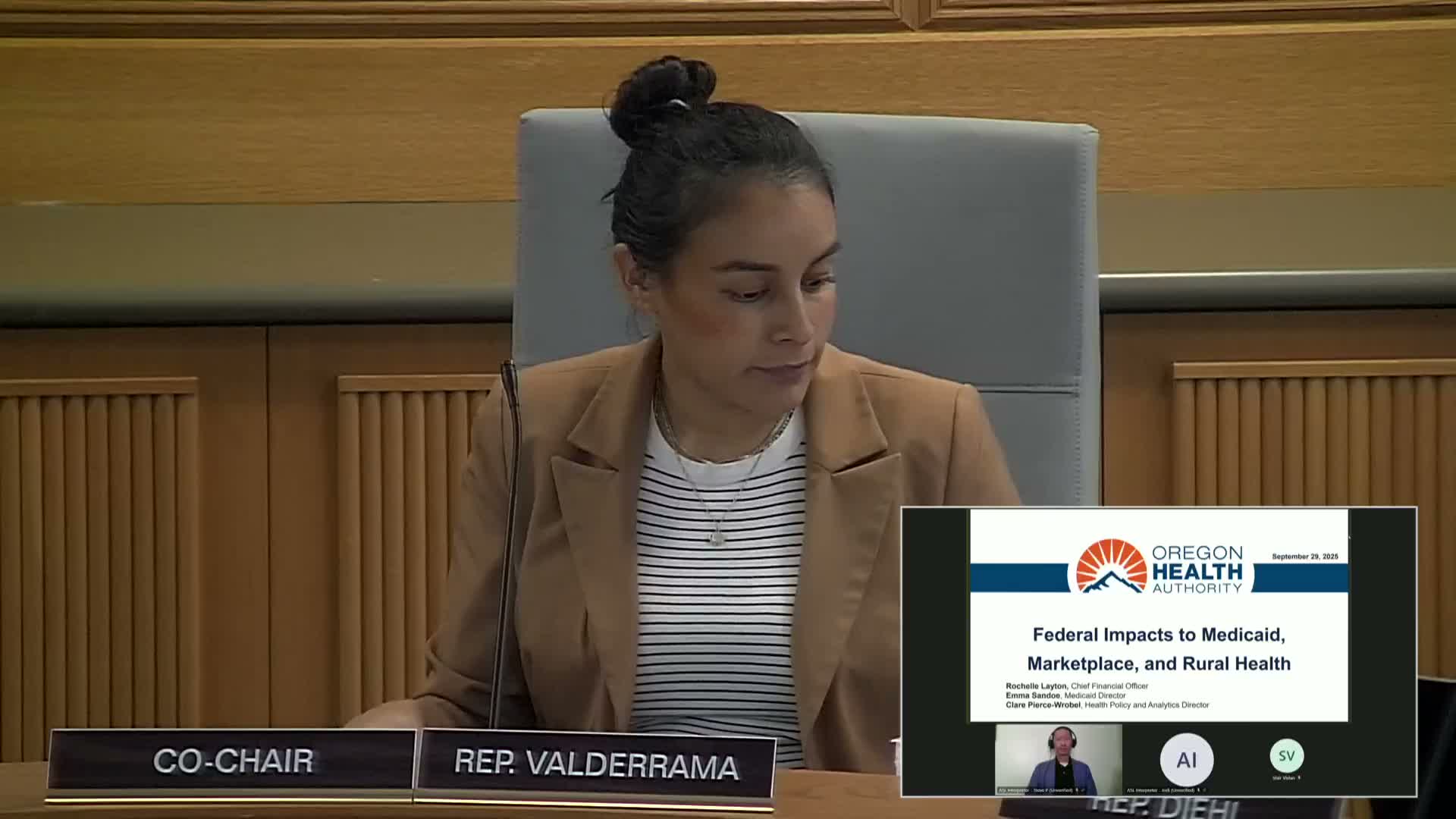
Oregon Health Authority officials on Sept. 29 told the Interim Joint Subcommittee on Human Services that federal changes in HR1 will require substantial policy, IT and implementation work and could sharply reduce federal funding to state health programs.
"We estimated, around approximate up to 200,000 people may lose coverage as a result of the work requirements once and, redetermination policies once fully implemented," said Emma Sando, Medicaid director for OHA. Rochelle Layton, OHA chief financial officer, said OHA is using Department of Administrative Services federal estimates and currently projects total federal cuts in this biennium of about $665,000,000 and a net reduction of $490,000,000 after adjustments.
Why it matters: OHA said the policy changes will affect the Medicaid expansion population (adults age 19–64 newly eligible under expansion), who are currently estimated at roughly 700,000 people in Oregon, and could reduce enrollment through more frequent redeterminations and the introduction of work requirements. Officials said the net budget impact and required state spending to replace lost federal dollars remain preliminary pending the fall caseload forecast and federal guidance.
What presenters described: OHA outlined separate work streams for implementation and program pricing, noting that some estimates will be refined after the fall Medicaid caseload forecast and CMS guidance. The agency listed several major HR1 changes that will drive both operational and program costs: redeterminations every six months for the Medicaid expansion group (versus a current two-year cadence for many groups), new work‑requirement exemptions and definitional questions (for medically frail status, substance use disorder treatment, tribal members, pregnant/postpartum individuals, parents with children under 13 and others), and reductions in certain federal reimbursements.
On timing and technical challenges, Emma Sando warned that required IT integrations and claims adjudication will complicate automated determinations: "None of that happens instantaneously," she said, describing lags between provider billing and system updates that affect eligibility and exception statuses.
Rochelle Layton emphasized that OHA expects to provide more detailed program pricing by late October and that many numbers presented to the subcommittee are preliminary. The agency is coordinating with the Department of Human Services on shared work streams for eligibility and redetermination.
Marketplace and rural health: Claire Pierce, director for health policy and analytics at OHA, outlined a separate rural health transformation program authorized by HR1. The state intends to submit an application (due Nov. 5) for a portion of a five‑year funding opportunity that could total at least $100 million to the state, with discretionary additional funding based on federal scoring. Pierce also warned that the scheduled end of enhanced premium tax credits would likely raise marketplace premiums for many enrollees in 2026.
What’s next: OHA said it will refine estimates after the October caseload forecast, continue cross‑agency work streams with ODHS, and await federal rulemaking and CMS guidance that are expected in 2026. The committee requested additional written follow‑up on litigation and program‑specific clarifications that were raised during questioning.
Source and attribution: Direct quotes and figures above come from OHA testimony before the Interim Joint Subcommittee on Human Services on Sept. 29, 2025. The first presentation began with Emma Sando (Medicaid director), followed by Rochelle Layton (CFO) and Claire Pierce (health policy and analytics director).
The informational session concluded without committee votes on HR1 policy; OHA officials said they will return with updated financial estimates in October.