Get Full Government Meeting Transcripts, Videos, & Alerts Forever!
Get email alerts on the Summer Learning topic
No spam. Unsubscribe anytime.
Oregon expands state summer‑learning grants under House Bill 2,007; outcomes due this winter
Summary
The Senate Education Interim Committee heard ODE and district leaders describe rapid expansion of state summer‑learning grants under HB 2,007 — $35 million for 2025–26 — and a plan for multi‑year grants, peer review scoring and an evaluation with grantee outcomes due Nov. 14 and a legislative report in January/February.
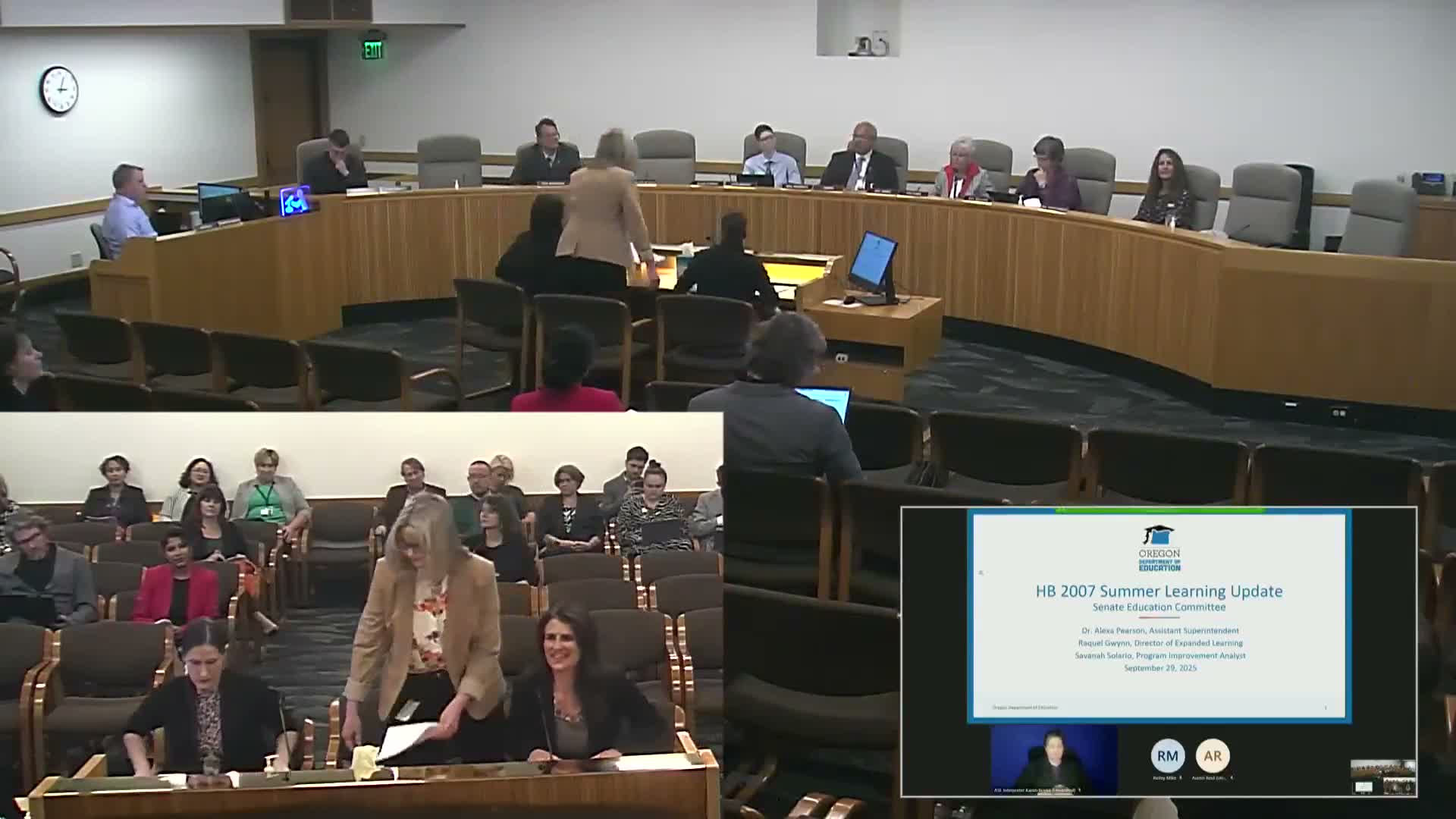
The Oregon Senate Interim Committee on Education on Sept. 29 received an update from the Oregon Department of Education on state summer‑learning grants and how recent legislation has changed program stability and scale.
Assistant Superintendent Alexa Pearson and the ODE expanded learning team told senators that emergency funding in 2021–22 and House Bill 4,082 (2024) helped restart programs, but that House Bill 2,007 creates multi‑year grant stability. "House Bill 2,007 represents a $35,000,000 investment in summer 2025 and 2026," the department said, noting multi‑year awards will allow more planning, stronger program quality and expanded access.
ODE said grantee numbers more than doubled from 66 under last year’s program to 139 this summer, reaching 105 school districts, 15 education service districts (ESDs), 13 charter schools and six tribes. The department described minimum program conditions that grantees had to meet: an explicit focus on improving literacy proficiency for students not yet at grade level, measurement of outcomes, daily evidence‑based instruction for elementary programs and limits on enrichment that is not intentionally tied to academic growth. ODE added that among elementary grantees 70% set goals in foundational reading skills and 86% offered 30–90 minutes of daily evidence‑based instruction; student‑teacher ratios averaged 7:1 with a median of 5:1.
ODE outlined a two‑phase rulemaking for the 2026 grants: Phase 1 (foundational rules for award process and grant length) concluding in October and Phase 2 (program quality evaluation, partnerships and professional development) beginning early next year. The department said applications will be scored by a peer review panel and that entities with lower ELA proficiency will receive priority points; applications and final grantee budgets may be "right‑sized" to align capacity and impact.
The department noted that full outcome data will not be available until grantee reports are submitted on Nov. 14, after which ODE will "clean and scrub" the data and produce a legislative report for the committee in January and a final report in February.
Dr. Jennifer Cabista, superintendent of Central School District, described how her rural district used HB 2,007 funds. She said the district received $455,000 this summer (and $1,165,000 across two summers), braided those dollars with federal funds such as Title IV and migrant education, provided about 100 minutes of daily evidence‑based instruction and reported that participants in the summer program posted higher growth percentiles on the district's universal screener than their peers.
Committee members praised the investments but pressed ODE and district staff for quantitative evidence of literacy gains. "Can we measure how much better students can read after the program?" asked a senator; ODE responded that the November submissions will feed a logic model and evaluation plan developed with an expanded learning advisory committee.
Senators also asked for more disaggregated information about which students were served and how grantees selected participants; ODE said the department will include student‑voice survey results (required of grantees) and recommended the committee review both participant and non‑participant perspectives in future reporting.
Chair Frederick closed the summer‑learning segment and moved the committee to consider federal HR 1 impacts on education.
The committee did not take formal action on policy during the update. ODE officials asked the committee to await the November outcomes before drawing firm conclusions about program impact.