Get Full Government Meeting Transcripts, Videos, & Alerts Forever!
Get email alerts on the Crime Trends topic
No spam. Unsubscribe anytime.
Criminal Justice Commission: Oregon past post‑pandemic crime peak, recent data show modest declines
Summary
CJC research director Kelly Officer told the joint Judiciary committees that reported violent and property index crime in Oregon peaked in 2021–22 and declined in 2023–24; she recommended Real Time Crime Index estimates for more timely trends through July 2025 while noting limitations of reported data.
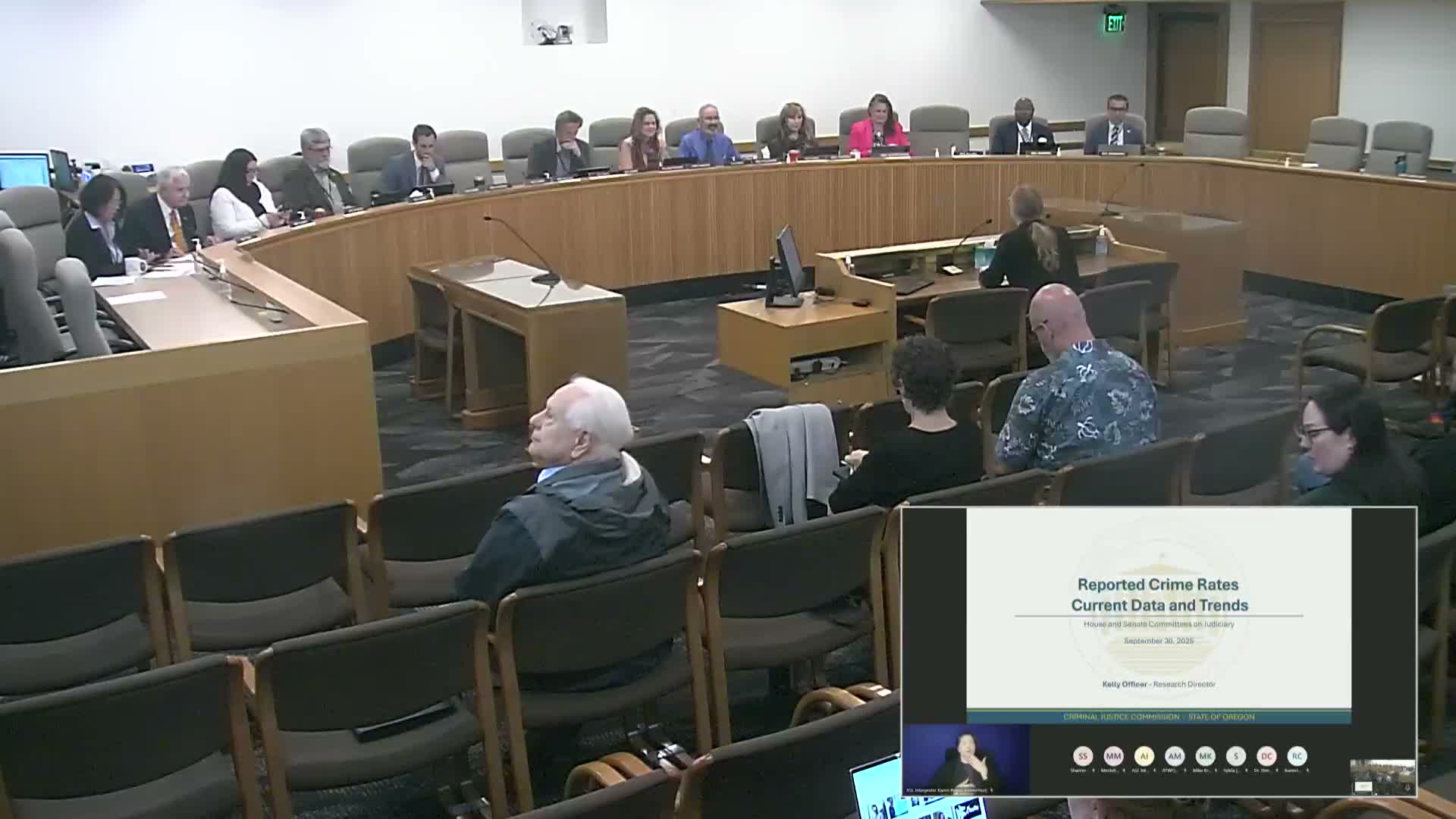
Kelly Officer, research director at the Criminal Justice Commission, briefed the combined Senate and House interim Judiciary committees on Oregon’s reported crime trends and available near‑real‑time estimates.
Officer reiterated that the presentation relies on reported crime submitted by law‑enforcement agencies to the FBI’s Uniform Crime Reporting program, which carries processing lags. Using FBI‑based measures through 2024, she said Oregon experienced a post‑COVID peak in violent and property index crimes in 2021–22 and modest declines in 2023 and 2024. Officer described the 10‑year trend (2014–2024) showing increases from 2014 to 2019, a further increase in 2021–22, and a subsequent easing.
To address timeliness, Officer showed examples from the private Real Time Crime Index (DataLytics), which synthesizes reported data and produces monthly estimates through July 2025. She said city‑level estimates (for Portland and Hillsborough) provide useful leading indicators but cautioned that the index is an estimate and will not perfectly match the FBI’s later releases. Officer noted the index is publicly accessible and that the CJC has reviewed its methods.
In committee Q&A, members raised limitations: domestic violence and trafficking are often underreported, and some counties or agencies report more consistently than others. Officer said DV flags and simple‑assault categories can be extracted and that trends in highly reported crimes (murders, motor‑vehicle theft) can help interpret underreporting. She acknowledged survey evidence of underreporting and cautioned against overinterpreting short‑term signals.
The presentation concluded with recognition that more timely tools can supplement but not replace the FBI’s official counts; members asked for follow‑up on disaggregated DV data and trafficking counts.