Get Full Government Meeting Transcripts, Videos, & Alerts Forever!
Get email alerts on the Crime Trends topic
No spam. Unsubscribe anytime.
Criminal Justice Commission: Oregon saw post‑COVID crime peaks in 2021–22 and declines through 2024; Real Time Crime Index offers timely estimates
Summary
The Criminal Justice Commission reported that Oregon’s violent and property index crimes peaked in 2021–22 and have shown modest declines in 2023–24; the commission recommended using a private Real Time Crime Index for more timely monthly estimates through July 2025 while noting limitations and underreporting concerns.
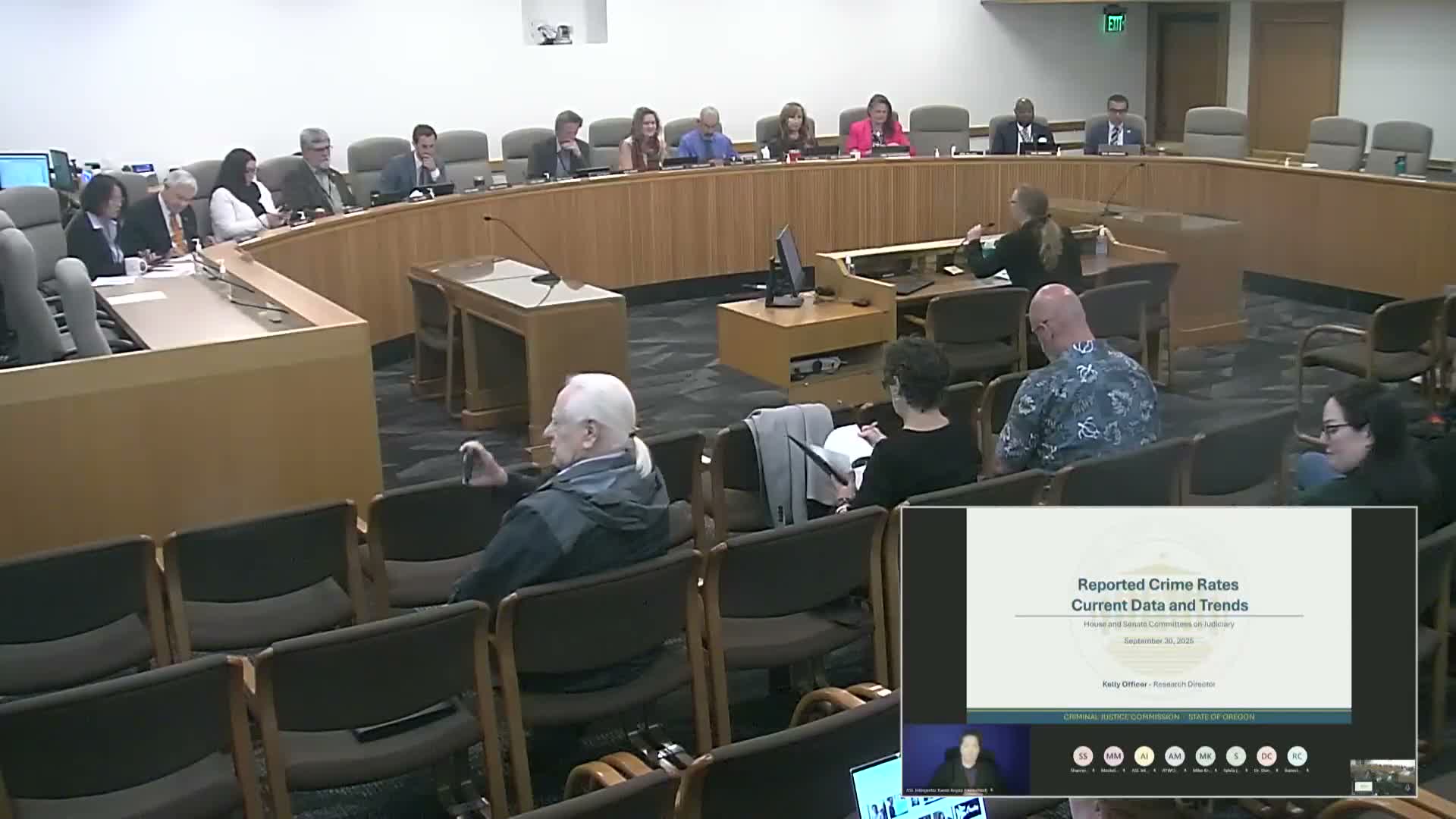
Kelly Officer, research director at the Criminal Justice Commission, presented the commission’s most recent analysis of reported crime in Oregon and emphasized two points: statutory UCR data maintained by the FBI are lagged through 2024, and a private Real Time Crime Index (Datalytics, with funding from Arnold Ventures) provides more timely monthly estimates through July 2025. Officer noted that UCR counts only crimes reported to law enforcement and that underreporting is especially acute for domestic violence and trafficking.
The commission’s historical charts show violent-index crime declined substantially from the mid-1990s through the 2010s, then rose from 2014 to 2019 (+13 percent for Oregon) and spiked again in 2021–22 (an additional ~17 percent). Officer said 2023 and 2024 registered slight declines, and the Real Time Crime Index trends through July 2025 show continuing declines in Portland’s violent and property crimes. She also showed that trends vary by city — Hillsborough did not follow the same post‑COVID pattern and experienced a separate peak in late 2024/early 2025.
During questioning, representatives asked whether declines reflected real reductions or changes in reporting. Officer recommended examining high‑reporting crime categories (murder, motor vehicle theft) as corroborating indicators and said the trend lines in survey data and reported data tend to move together; she offered to provide additional DV‑flagged statistics and noted state police releases and the Real Time Crime Index as complementary sources.
The commission urged caution in interpreting short‑term monthly volatility and offered the Real Time Crime Index as a leading indicator to inform policymakers while acknowledging it will not exactly match the FBI’s later releases.