Get Full Government Meeting Transcripts, Videos, & Alerts Forever!
Get email alerts on the Workers Compensation topic
No spam. Unsubscribe anytime.
MLAC co-chairs describe consensus process, stakeholder role in workers' compensation
Summary
MLAC co-chairs and DCBS staff told the committee that the Management‑Labor Advisory Committee meets regularly, seeks unanimous or near‑unanimous recommendations through balanced management/labor caucuses, and uses subcommittees and stakeholder engagement to study workers' comp policy.
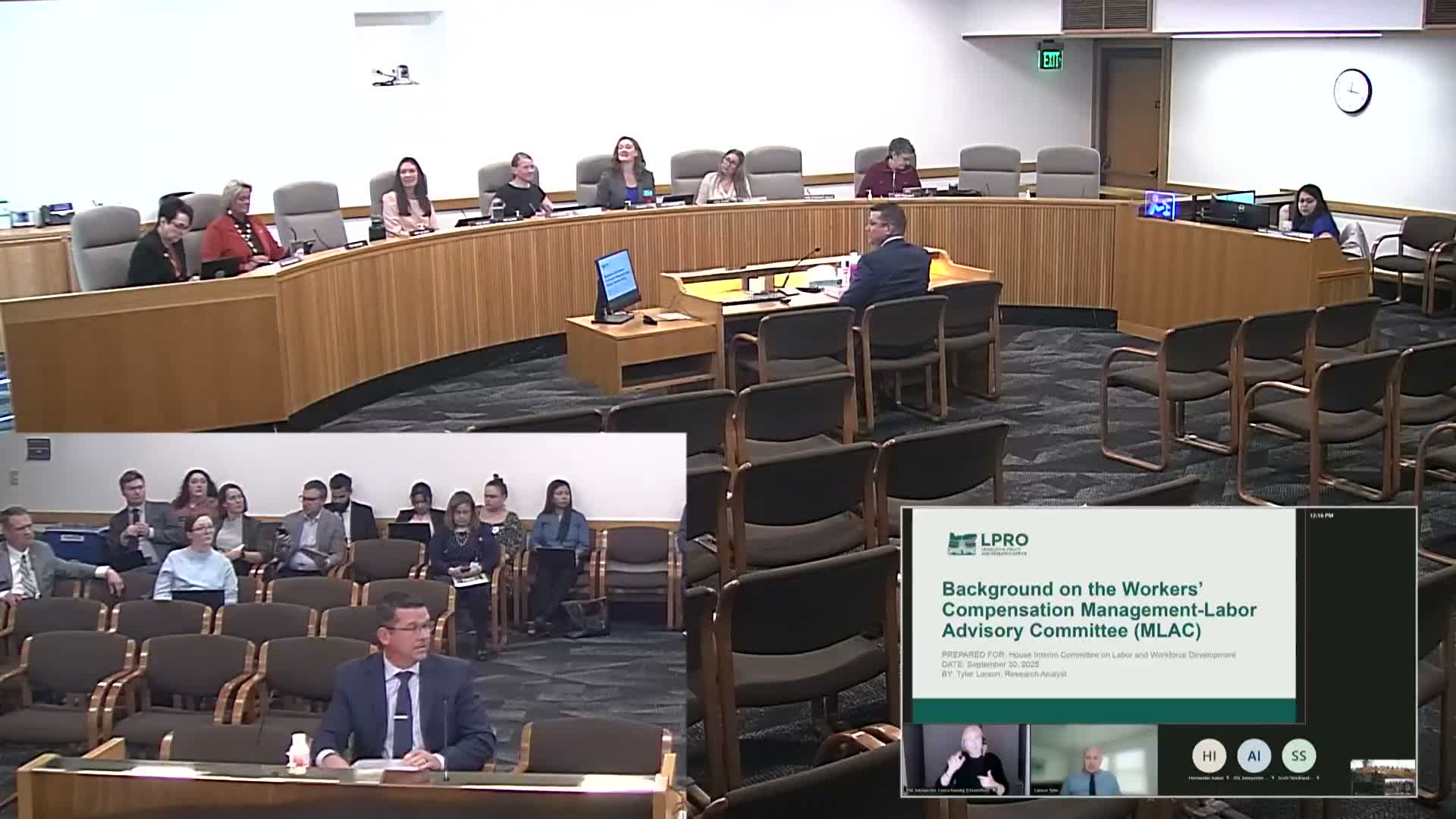
Officials from the Department of Consumer and Business Services and the Management‑Labor Advisory Committee (MLAC) told the House Interim Committee on Labor and Workforce Development that MLAC is a longstanding stakeholder advisory body that reviews workers' compensation statutes, administrative rules and system performance.
LPRO analyst Tyler Larson summarized MLAC’s origin in the 1990 Mahonia Hall reforms and said it is composed of 10 appointed members with equal employer and employee representation. Matt West, administrator with the Workers' Compensation Division, explained that MLAC operates under DCBS, typically meets monthly (and weekly during the legislative session when needed), and provides analysis, meeting minutes and letters of support or non‑support to the Legislature.
Labor co‑chair Scott Strickland described the committee’s decision norms and membership expertise, saying MLAC seeks to reach consensus and benefits from extensive stakeholder participation — he said typical MLAC meetings draw roughly 40–70 stakeholders. Management co‑chair Patrick Priest explained that MLAC includes small‑business voices and that subcommittees focus on issues such as access to care and average weekly wages.
When asked how to bring a policy idea to MLAC, members said the usual route is to contact the MLAC administrator (Terry Watson) with a well‑formed idea, data and, if available, bill language. MLAC representatives noted members serve as volunteers and are unpaid; the committee provides a forum to vet proposals before they move through the legislative process.
Chair Graber thanked MLAC representatives for their time and said the presentation demystified the committee’s role for legislators.