Get Full Government Meeting Transcripts, Videos, & Alerts Forever!
Get email alerts on the Employment Department Update topic
No spam. Unsubscribe anytime.
Oregon Employment Department outlines customer‑service metrics, previews 'pizza tracker'
Summary
OED Director Andrew Stolfi told the committee the agency will deliver a 150‑day report to Governor Kotek with recommendations to improve customer service and previewed a web-based 'claim status' tracker; he cited call‑center and claims metrics and acknowledged areas needing improvement.
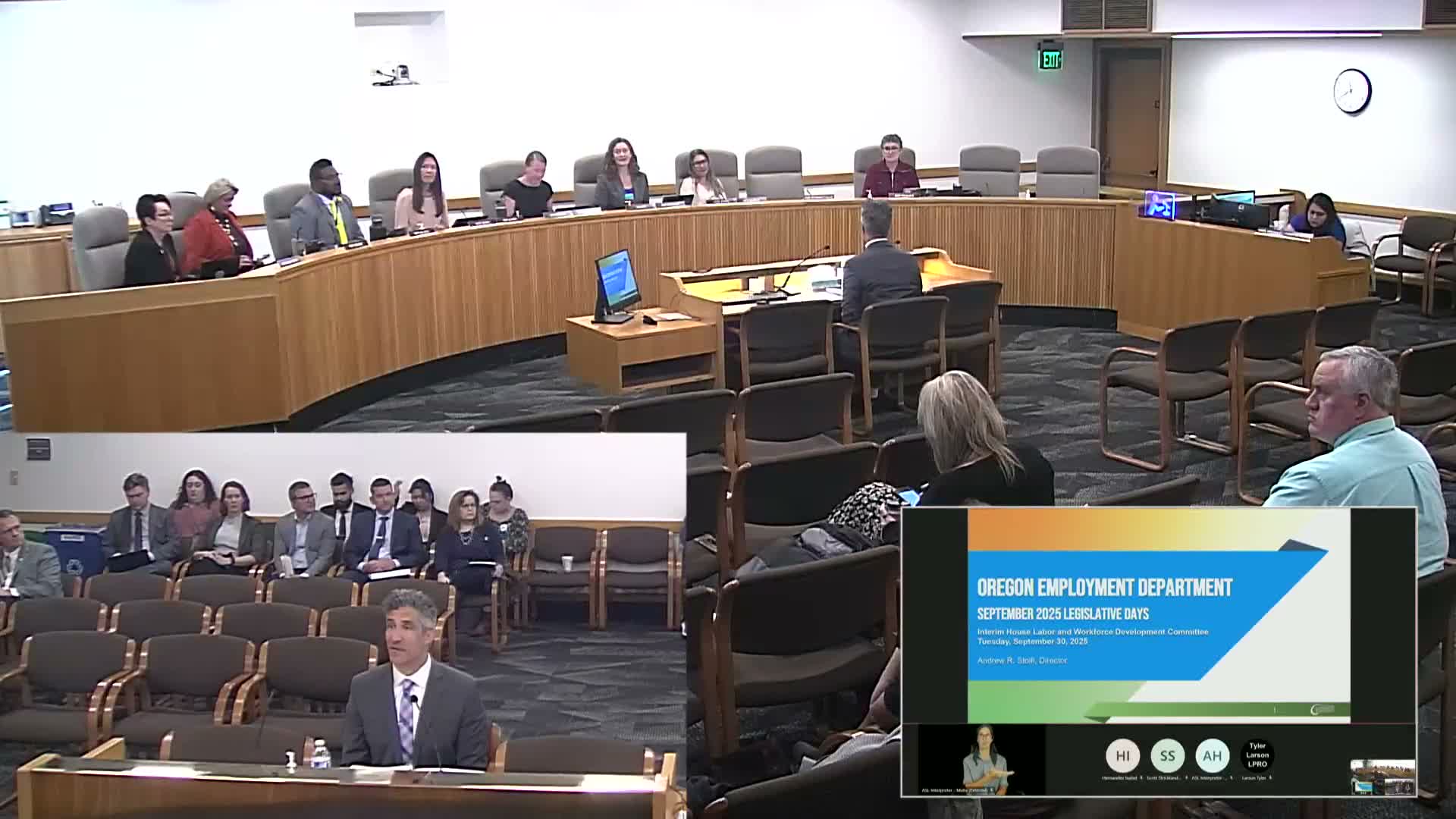
Andrew Stolfi, director of the Oregon Employment Department, told the House Interim Committee on Labor and Workforce Development on Sept. 30 that he will deliver a report to Governor Tina Kotek around Thanksgiving with prioritized recommendations to improve customer service and strengthen workforce development efforts.
Stolfi, describing his first roughly 90 days at OED, said staff are "service oriented" and that the agency published a public dashboard this spring to show core customer-service metrics that are updated monthly. He said OED is meeting targets on two metrics but needs to improve others: "We're exceeding our target in just 2 of the metrics on the dashboard," he said.
On unemployment insurance performance, Stolfi said first-payment timeliness declined after the implementation of the Francis system in 2024 and that timeliness improved across January–June 2025 likely because of seasonal claim patterns. He gave specific claim counts: "We've seen an influx of initial claims in June to nearly 17,000, but [it] dropped each month to about 14,800 in July; we're about 12,100 in August." He said OED averages roughly 12,000 answered calls a month and that average wait time has fallen "from a high of around 1 and a half hours at the start of the year to around an hour and 11 minutes now." He added that OED's goal is to "answer 80% of calls within 30 minutes," and that the agency is currently at roughly 64% on that metric with 51% of calls answered in less than 15 minutes.
Stolfi also described a pilot for live chat that underperformed and was adjusted, and he said paid‑leave application processing rose in the summer because of higher volumes and staff leave but declined in September with an expectation to return to a 21‑day processing target soon.
To help customers track progress, Stolfi previewed a claim‑status web page — nicknamed the "pizza tracker" — that would let claimants see "where they are in their journey and what needs to be done." He said the governor asked for plans to stabilize Francis, improve customer service for paid leave and UI (including exploring AI and innovative approaches), and strengthen WorkSource Oregon business services.
During questioning, Representatives asked about collaboration with higher‑education workforce partners, the interaction between SNAP work‑requirement tracking and OED services, and whether draft UI rule language would allow jobseekers to search only for remote work. Lindsay Leahy, unemployment insurance division director, said OED seeks to clarify rules so they reflect current practice: RESEA assessments evaluate individual skills, appropriate job types and whether a remote‑only search is reasonable for a particular claimant.
Stolfi said the agency will convene a rulemaking advisory committee this week with balanced employer and labor representation and will post drafts, meeting agendas and registration links on the OED website; he said OED expects U.S. Department of Labor review of any final UI rule and will revise as needed.
The committee encouraged stakeholder participation in the RAC and asked OED to return with implementation updates on small‑business services and other items.