Get Full Government Meeting Transcripts, Videos, & Alerts Forever!
Get email alerts on the SACU Redesign topic
No spam. Unsubscribe anytime.
ODDS outlines SACU redesign, stakeholders warn about long stays, capacity and privatization risks
Summary
ODDS presented its plan and timeline to redesign the Stabilization and Crisis Unit (SACU) to shorten stays and meet HCBS requirements; ombudsman, union and Disability Rights Oregon urged transparent data, community engagement, and attention to long average stays and transition supports.
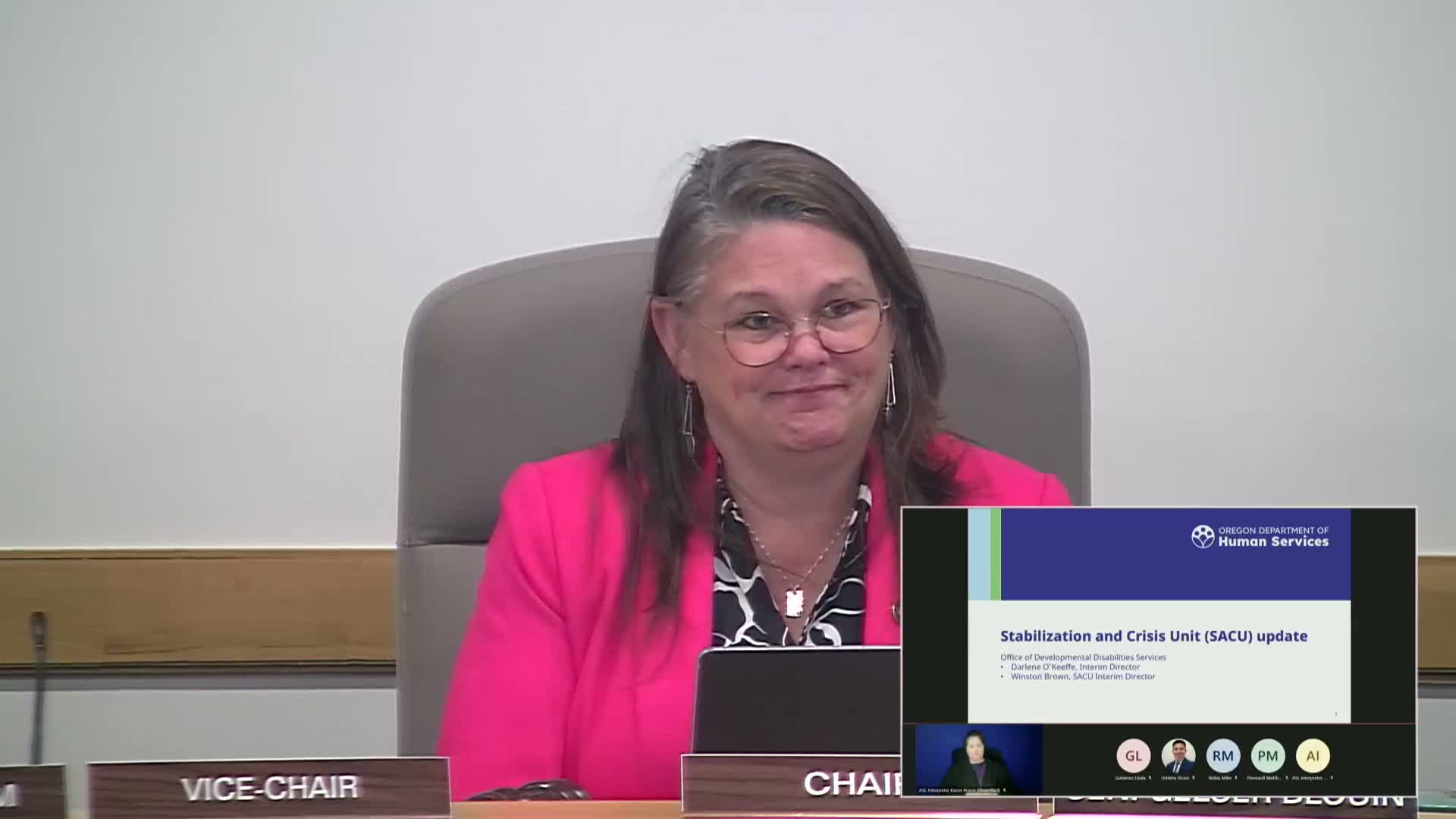
State officials told the Senate Committee on Human Services on Sept. 30 that the Stabilization and Crisis Unit (SACU) will be redesigned to prioritize shorter stays, HCBS compliance and stronger transitions to community settings.
Darlene O'Keefe, interim director with the Office of Developmental Disability Services, said the 2025 enacted budget (House Bill 5,006) requires a new operational plan to be presented to the Legislature by Sept. 30, 2026, and proposes a phased implementation beginning July 1, 2027. ODDS described SACU as a 24-hour residential program intended for short-term stabilization of individuals with intellectual or developmental disabilities who have co-occurring mental-health or complex medical needs.
Winston Brown, interim director of SACU, summarized internal planning work, community engagement and projects to address HCBS compliance and service gaps. When asked about average length of stay, a program speaker said, "The average length of stay is about 8 years," a figure senators called surprising and requested be broken down by age and service group. ODDS pledged to follow up with written data on length-of-stay distributions and the number of residents under ID civil commitment.
Stakeholders urged caution and community-centered planning. Leslie Sutton, Oregon's residential facility ombudsman, emphasized that stabilization planning must proceed alongside long-term support planning and that crisis is usually the system's failure. Christina Steinstryker Brown, a SACU local union leader, said staff want to collaborate but worry that leadership is pushing residents to move to private care before community services are ready. Beth Brownhill of Disability Rights Oregon urged transparency, a public data system on average lengths of stay and wait lists, and early transitional planning for residents.
Committee members asked for clearer entry-and-exit criteria, improved access to medical and mental-health services for SACU residents, and details on staffing ratios and HCBS remediation efforts. ODDS said it is hiring a contractor to write the operational plan and will hold community listening sessions in SACU regions to center resident and family voices.
The committee did not vote on policy changes; ODDS agreed to provide follow-up data and to continue recurring briefings as the redesign effort develops.