Get Full Government Meeting Transcripts, Videos, & Alerts Forever!
Get email alerts on the Business Tax Conformity topic
No spam. Unsubscribe anytime.
Business groups warn disconnecting on expensing would raise compliance costs and shift revenue timing
Summary
Industry witnesses told the committee that HR 1’s expensing and depreciation changes mainly shift the timing of deductions; disconnecting would force businesses and the Department of Revenue to track separate state rules, increasing complexity and administrative cost.
Business and accounting representatives told the committee that many of HR 1’s business provisions — especially bonus depreciation, Section 179 expensing and research expensing — change the timing, not the total amount, of deductions and that disconnecting would impose significant compliance and administrative burdens.
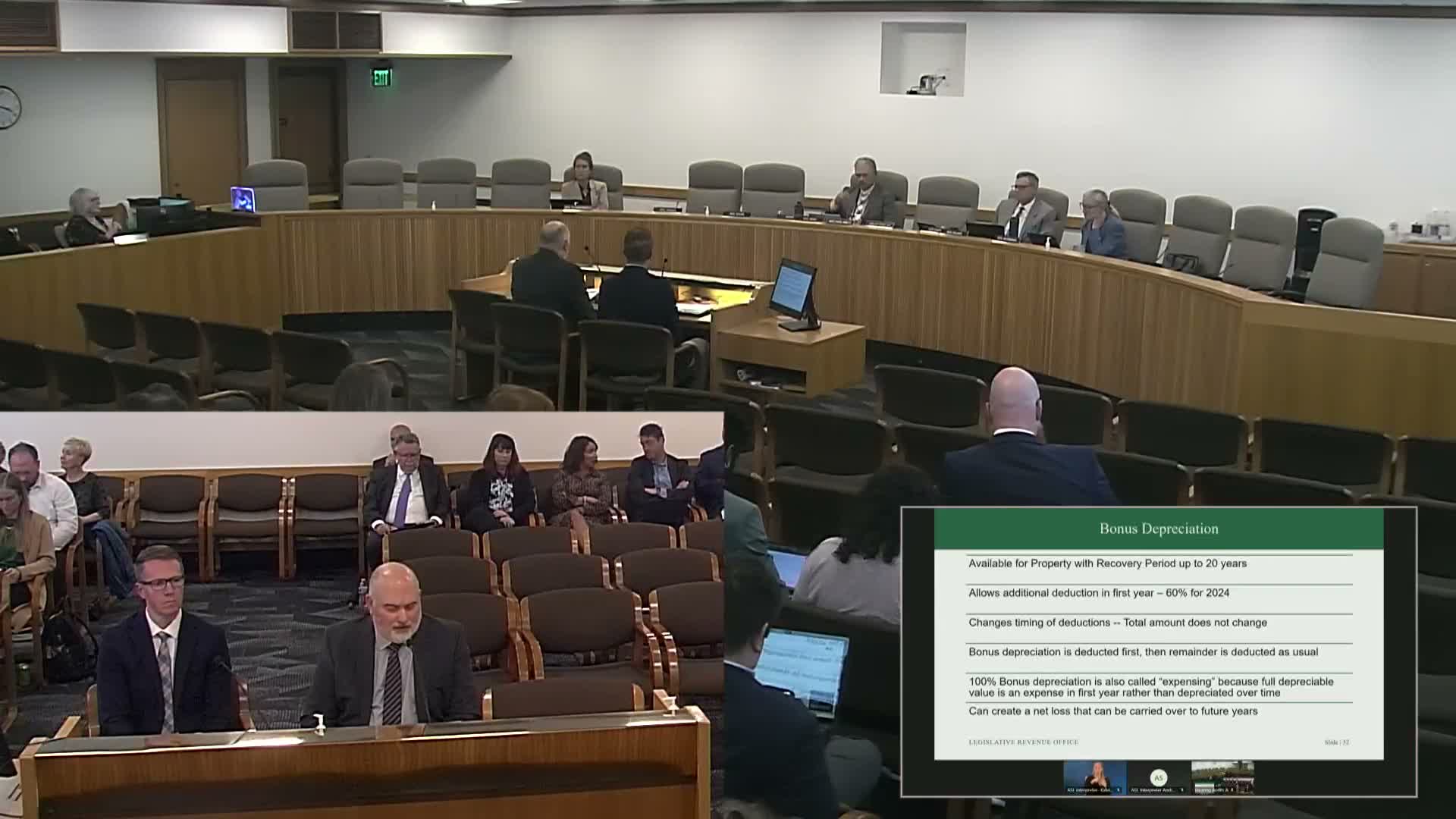
John Hart (LRO) explained that bonus depreciation (now 100% under HR 1 beginning Jan. 20, 2025) accelerates deductions into the first year but does not change the total deductions over an asset’s life. "It doesn't change the total amount of the deductions," Hart said, illustrating with a $10,000, 5‑year property example.
Representatives from Oregon Business & Industry and the Smart Growth Coalition warned that disconnecting from federal depreciation and expensing rules would require taxpayers and the Department of Revenue to maintain two sets of accounting books and separate depreciation schedules, increasing preparer time and compliance costs. Jeff Newgarden said disconnecting "simply accelerates the collections in the short term at the expense of future revenues," and Derek Sangston stressed that conformity reduces administrative friction.
John Hawkins of the Oregon Society of CPAs told the committee disconnects create long-lasting tax schedule differences and can force retroactive amendments; he cited Oregon’s 2010 disconnect from bonus depreciation as an example of persistent recordkeeping effects. Hawkins urged the committee to preserve rolling reconnection for practical compliance reasons and offered the society as a technical resource.
Committee members did not adopt any statutory change at the meeting; the presentations framed the tradeoffs — near-term revenue acceleration versus longer-term revenue timing and higher administrative costs — for future legislative consideration.