Get Full Government Meeting Transcripts, Videos, & Alerts Forever!
Get email alerts on the Tax Policy Tips Overtime topic
No spam. Unsubscribe anytime.
Senate committee hears split views on tipping and overtime deductions as possible 'disconnect' targets
Summary
Committee members and panels debated whether Oregon should ‘disconnect’ from HR 1 provisions that exempt overtime and tips from federal taxation — and whether any disconnection could be tailored to avoid burdening low‑income workers.
Senators heard competing views on whether Oregon should preserve its automatic connection to federal taxable income or selectively "disconnect" from parts of HR 1 that reduce Oregon revenue, focusing especially on overtime and tip income provisions.
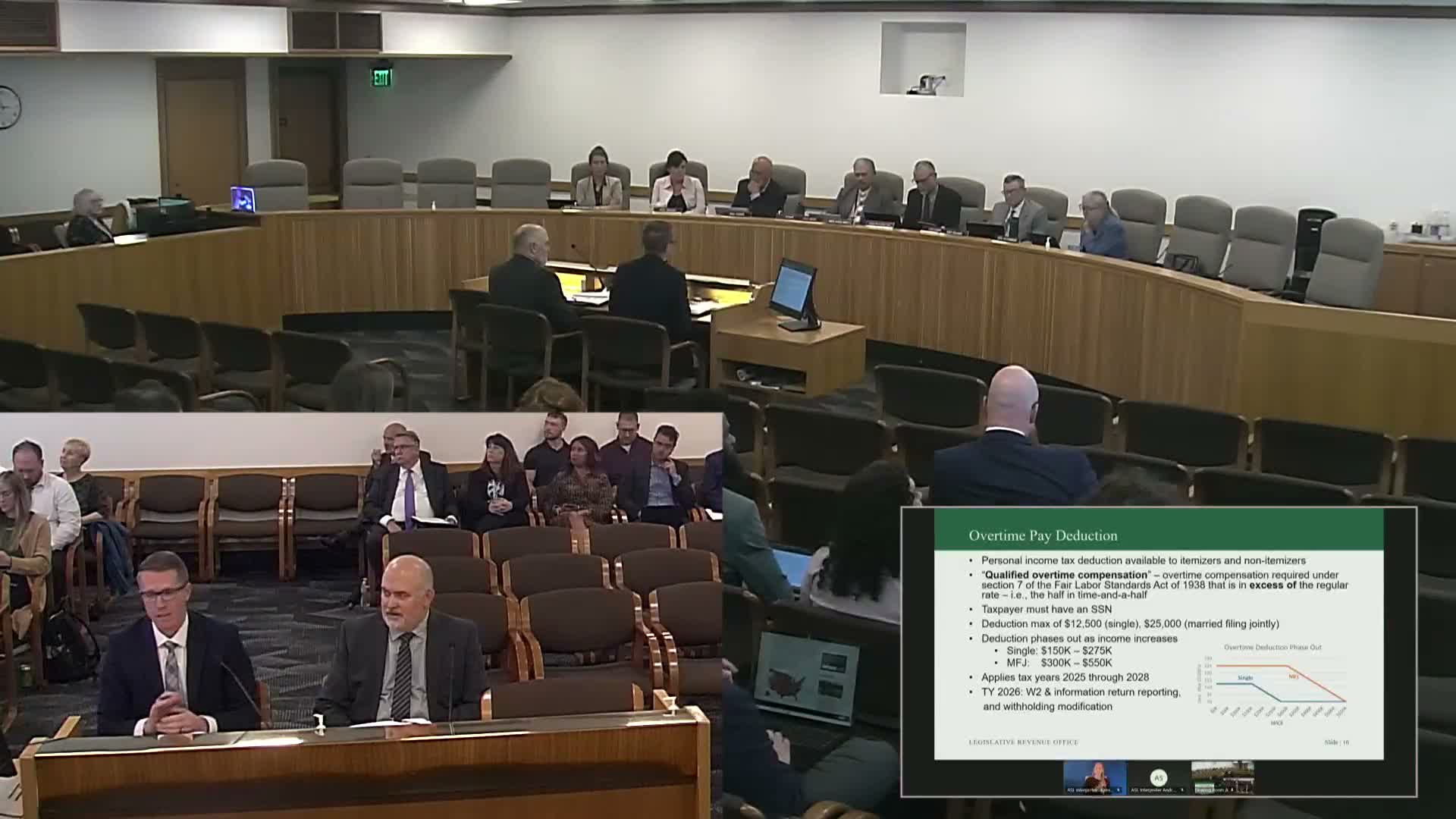
Kyle Easton of the Legislative Revenue Office described the new overtime deduction as a partial deduction for the overtime premium ("the half in time and a half") with maximums of $12,500 for single filers and $25,000 for joint filers and income phaseouts beginning at $150,000. He also summarized the federal tip-deduction design: "it is received in an occupation which customarily and regularly receive tips," that taxpayers must have an SSN, and that Treasury has an occupation list defining qualified tips.
Committee members pressed witnesses on likely effects of disconnection. Vice Chair McLean asked directly whether Oregon no longer taxes tips; Kyle answered: "Yes, subject to those details," noting limits and phaseouts. Several advocates warned that disconnecting broad provisions could cause low-income tipped workers to face state taxation on tips, but they urged the legislature to pair any revenue choices with targeted relief such as an expanded state earned-income tax credit. Daniel Houser of the Oregon Center for Public Policy said the combined tax and spending effects of HR 1 "tilt" benefits toward higher-income households and warned of lost premium tax credits and SNAP and Medicaid spending impacts.
Tax Fairness Oregon and unions urged action to recoup revenue or design disconnection carefully. Jody Weiser recommended immediate work on a disconnect package and public communications so Oregonians understand the tradeoffs. Witnesses repeatedly emphasized that disconnection is a policy choice with many design options: lawmakers could carve out narrow add‑backs (e.g., only for high-income filers) or pursue broader reconnects. The committee did not vote on any disconnect provisions; the chair closed by saying he would oppose proposals to remove tip and overtime exclusions in any disconnection package and adjourned the session.