Get Full Government Meeting Transcripts, Videos, & Alerts Forever!
Get email alerts on the Pension Actuarial Assumptions topic
No spam. Unsubscribe anytime.
PERS board’s new actuarial assumptions reduce liabilities modestly; committee receives report
Summary
PERS director told the subcommittee the board adopted actuarial methods and mortality table updates that lowered liabilities by about $1 billion and produced an average 0.5% reduction in employer contribution rates — roughly $175 million in payroll contributions — and that the assumed rate of return remains 6.9%.
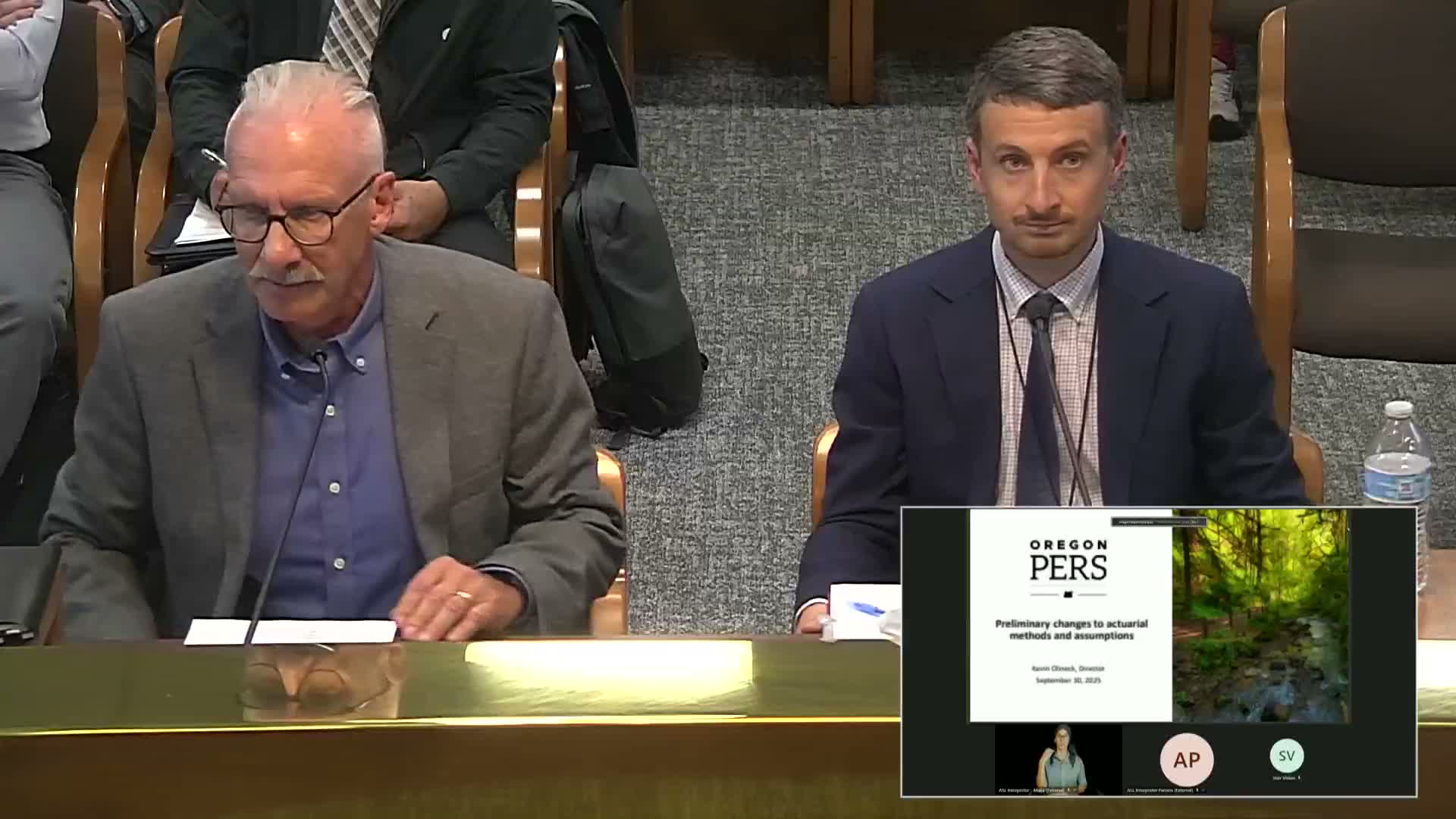
Kevin Linnick, director of the Public Employees Retirement System, presented the PERS board’s newly adopted actuarial methods and assumptions to the Joint Interim Committee on Ways and Means — Public Safety Subcommittee on Sept. 30.
Linnick said the board retained the inflation assumption at 2.4% and payroll growth at 3.4%, adopted the Pub-2016 mortality tables supplied by the Society of Actuaries, and continued an assumed rate of return of 6.9%. He said the consulting actuary adjusted tables to remove anomalous COVID-19 impacts and included a residual special merit salary projection from 2023–24 where significant collective bargaining increases occurred.
"The mortality assumption brought down the unfunded actuarial liability perspective by about 0.4% and the normal cost by 0.1%," Linnick said, and he quantified that change as reducing liabilities from about $109.7 billion to about $108.7 billion. He said that approximately translates to an average overall 0.5% contribution-rate reduction that, based on payroll, equates to roughly $175 million less in contributions.
Linnick explained amortization-period choices and the PERS rate-collar mechanism that smooths employer contribution volatility. He said the board’s decisions reflect long-standing guiding principles — equitability, predictability and actuarial soundness — and that the actuarial assumptions will be used in the 2024 and 2025 valuations (2024 yields advisory rates; 2025 sets actual contribution rates for 2027–29).
Legislative Fiscal Office staff recommended acknowledging receipt of the report, and the subcommittee carried a motion to do so without recorded roll call.
The subcommittee did not change policy on contribution limits or amortization in this meeting; members asked follow-up questions about how assumptions interact with investment-return expectations set by the Oregon Investment Council and about the timeline for employer rate notices.