Get Full Government Meeting Transcripts, Videos, & Alerts Forever!
Get email alerts on the Military Deployment topic
No spam. Unsubscribe anytime.
Oregon Military Department briefs lawmakers after federal call-up of 200 Guard soldiers; mission to protect federal facilities
Summary
The Oregon Military Department told the Ways and Means public safety subcommittee that 200 Oregon National Guard soldiers were ordered to Title 10 federal service to support US Army North and DHS, assigned to protect federal facilities; the department described training, command arrangements and estimated federal pay costs.
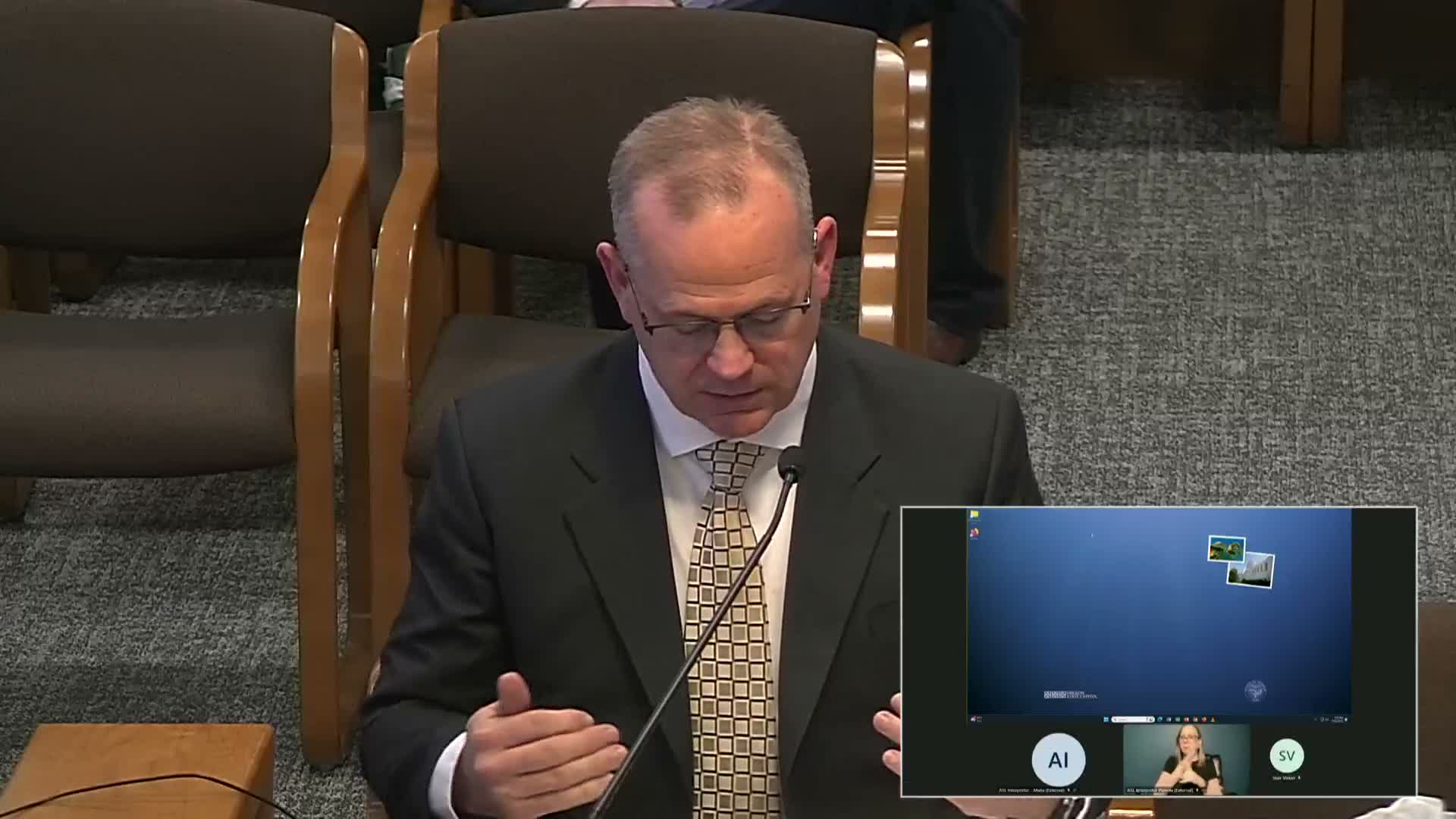
Russell Gibson, government and legislative affairs director for the Oregon Military Department, told the Joint Interim Committee on Ways and Means — Public Safety Subcommittee on Sept. 30 that the secretary of defense signed a memorandum on Sept. 28 ordering 200 Oregon National Guard soldiers into Title 10 federal service effective immediately.
"The Oregon National Guard mission is to provide those 200 soldiers to US Army North in support of the Department of Homeland Security," Gibson said, and added that the memorandum identifies protecting federal facilities as the mission’s primary focus. He said two companies and a battalion headquarters staff were selected to field the force and that US Army North will provide three days of mission-specific training on crowd control and rules of force before deployment.
Gibson emphasized that once the soldiers enter Title 10 status they are under federal command and control. "As those soldiers come on and they enter that Title 10 active duty status, we lose control of their activities," he said, describing Task Force 51 under US Army North as the command element tasked with managing the operation.
Committee members pressed the department on limits to domestic law-enforcement activity and the Insurrection Act. Gibson said he understood that federal forces are restricted from direct law-enforcement activities under the Posse Comitatus Act and that Title 32 (state status) is the control mechanism that, under a governor’s direction and state law, can authorize law-enforcement-style activities.
Lawmakers sought details about the training, materials and who conducts it. Gibson said US Army North conducts the training and that the department would share training materials, noting those documents are generally distributed to soldiers to ensure rules of engagement and use-of-force guidance are clear.
On costs and what the state is temporarily losing, Gibson estimated that 200 service members on an 80-day order would generate roughly $3.8 million in pay and allowance costs (largely federally funded) and said logistical support (meals, lodging, transportation) will also be covered through US Army North support agreements. He said many Guard members are drawn from civilian professions — "teachers, plumbers, electricians" — and that the department would provide a breakdown of civilian professions affected.
Gibson also highlighted the department’s state retention-bonus program, saying a $2.5 million state retention bonus contributed to higher reenlistment and extension rates over the quarter and that retention metrics improved relative to historical averages.
The committee closed the informational hearing after a broad question-and-answer exchange. Several members expressed support for Guard members and concern about communication, troop welfare and preserving domestic response capacity while federalized service occurs.
The subcommittee did not take formal action on the briefing; it requested additional materials, including training documents and a breakdown of civilian professions affected by the deployment, for follow-up.